Showing posts with label Joel and Ethan Coen. Show all posts

Monday, November 11, 2024

Movies Named After Place Names

I’m currently in Atlanta, and something that popped up on my TV was a show named after the city.


I don't love the show for reasons I'll discuss in the post-script*, but I can't help but be bothered by the
sheer brazenness in thinking that your little narrative defines an entire sitcom. The story is about a young man trying to break into hip-hop culture, and because Atlantans consider themselves the capital of hip-hop, it makes some degree of sense, to call a show Atlanta. It is also filmed in Atlanta, so there are recognizable landmarks.

Still, it’s kind of obnoxious to think that your TV show or movie speaks to an entire city. I’ve talked to a couple of locals who say that it’s more of the hip-hop experience than the Atlanta hip-hop experience. Why would a show even want the pressure of appealing to millions of residents of a city, each with their own idea of what Atlanta is?

This is an interesting subgenre of TV shows and films that have tenuous relationships to their place name titles.

Films have varying degrees to how much they use settings as character.

The serialized TV show Ozark has the location baked into the plot. A money launderer is held at gun point by a mobster and improvises a scheme in self-preservation to use the Ozarks as a base of operation. The Ozarks is a stand-in for a shady underworld, but the show goes beyond that. The degree to which the audience surrogates (Jason Bateman and Laura Linney) succeed in their new environment is based on the degree to which they understand the social complexities of this underworld.


In contrast, the 2020 film Arkansas is a dark comedy about two drug pushers on the bottom of the ladder who are forced to wait out the orders of drug kingpin. It takes place in the vague back country South. It’s in the category of films that could take place in the eponymous title, but could also take place anywhere.


Garden State (2004) and (although I'll probably get some fights here) Nebraska (2013) are two films that also fall in the “can happen anywhere” category, but they likely have place name titles because of what is says about their creators


Alexander Payne’s Nebraska, this can be a point of identity for the film maker more than the film. Alexander Payne is from Omaha and it is enough of a source of pride for him that he set his first three films in Nebraska. The film isn’t any sort of socio-economic essay on Nebraska. It’s not even set in Nebraska as it is a road trip through multiple states. But, it represents a director returning to his roots, which parallels a character returning to his roots.

Garden State, a breakthrough indie by then-Scrubs star Zach Braff, has little that can physically place the film in New Jersey. The film revolves around a marginally succesful actor returning from L.A.. to his hometown to reconnect with his friends, father, and fall in love with a manic pixie dream girl. If L.A. Is the big city that people go to to discover their dreams (case study: La La Land), New Jersey can be seen as the anti-LA. It's the densest state in the country, but it's almost entirely dominated by suburbs. In other, the kinds of boring white-bread ho-hum lives where people originate from before making a big move. The character finds enlightenment from returning to his roots.
Does it work? Largely, because Braff made it well-known through his publicity tour and an SNL monologue (in which cast members danced as landmarks of Newark) that it's a love letter to his home state. Still, it's more a symbolic relationship than a real one.

On the other end of the spectrum, Fargo (1996), is a film that represents the Coen Brothers obfuscation of identity. For those that have read interviews with the brothers, they are trolling creators who like to poke fun at any psychoanalysis of their work. The film largely takes place in Minnesota and plays on Minnesota’s geographical tropes but the film’s identity is named Fargo almost as if it is a prank.

On this end, the epic 1973 film Chinatown has nothing to do with Chinatown. The title represents a bad memory and psychological block for the protagonist. It has little to do with the actual neighborhood in Los Angeles. This is a blessing in disguise because if they actually did show the Chinese population of the city as part of a villainous scheme to usurp city control, it wouldn’t be anything but racist.


The more I like into this, the more I find that films like Jim Jarmusch's Mystery Train (1989); the Coen Brothers' O Brother Where Art Thou (2000), Burn After Reading (2008), and A Serious Man (2009); and John Sayles Matewan (1987) and Sunshine State (2002) have the most to do with their settings. And they don't even have manipulative titles.


*I have a largely positive opinion of Donald Glover but the show turns me off in multiple ways. The characters are misogynistic, depressing, and don’t even treat each other well. I view it more as not my cup of tea, than problematic. My problem is more that the critics tend to rain hard on shows of White comedians under the “problematic” banner, whereas they view Black sitcoms as authentic cultural celebrations. In reality, they are both cultural artifacts to be played with and analyzed: Nothing more, nothing less.

Saturday, February 10, 2024

The Big Lebowski: Both Essential and Overrated

 I recently saw the 2014 Paul Thomas Anderson film Inherent Vice. It’s a film that generated a lot of buzz in 2014 and one aggregation ranked it number 10. I was immediately struck by how this film is begging to be analyzed side-by-side with The Big Lebowski. The two films have so much in common that it’s as if Paul Thomas Anderson and the Coen Brothers started from the same points in some sort of film workshop and worked outwards. For further reading, here’s an excellent essay:

Today, out of boredom, I decided that I would post if anyone else thought “The Big Lebowski was a good film but not worth this insane level of a cult following” and I got one positive and negative response, so I thought I’d address them both.

One person said that it was her son who didn’t get the hype, so that’s why it was written to her son.

I would say to your son almost no movie can live up to its hype on first viewing when the hype reaches a certain level. Ever heard of a movie called Citizen Kane? It has long been considered the greatest film in American history (I know the American Film Institute solidified that status in 1998). And since then, 90% of people who I know who’ve watched the film have been disappointed. So it’s best not to measure a film against hype.

I’d say the cleverness of the film isn’t apparent on first viewing, and it’s through outside sources (whether from other films, discussing with friends, or reading an essay about it) that someone might get all the meaning. The question is if he likes movie going to be a deep multi-layered experience or if he’s looking to be entertained for the two hours of the film.

That’s at least what TBL tries to be (and many people other than me say it succeeds). At the same time, some would argue that it’s very entertaining on a scene-to-scene level and that the characters are very original creations who intersect at interesting angles.

The Coen Brothers generally have a strong sense of place (O Brother Where Art Thou is a very interesting fusion of Dust Bowl era Mississippi with superficial biblical elements; I’ve hardly seen a better film that captures the inanity of the DC Bureaucracy and culture than Burn After Reading, A Serious Man has a lot to say about Jewish culture and academia and I’d argue it’s the most quintessential film ever made about the suburban Jewish experience), and that’s evident here is the film examines a confluence of values and a generational nostalgia that traces on the last remnants of Vietnam Era disillusionment. Beyond that, the Coen Brothers process in making their films is very scatological. I won’t say random, but they mix and match a lot of plot elements that most others wouldn’t think of, and for a good number of fans the mixing and matching is likely what connected here.

NOW THE REASONS THAT I DON’T THINK IT’S NOT ALL THAT AND A BAG OF CHIPS:

The film has certain thematic elements that I don’t think are fully formed. One of the big themes is that the Dude is treated as a deadbeat, but he’s really a more caring and responsible citizen than the other Lebowski who is respectable looking, but really corrupt. I can’t see any reason that the Dude isn’t a deadbeat.

The film is loosely based on a confusing noir, the 1946 film The Big Sleep (a much better film than this one), where a man gets implicated in an extremely complex case and decides to go out and find the truth. Here he doesn’t appear to have any agency. He just drifts towards the answers. Could he have just displayed an iota of brain activity? If the film is about a subversion of our expectations, I don’t know if the Dude ever became anyone other than what I expected him to be.

I also think the film has a number of interesting characters, but Walter is a bit too hard-edged for the comedic tone the film goes for and doesn’t appeal to me as much as other fans.

Some might also point out that it has an incredible cast, but I’m moving away from recommending films because they have a good cast. You can see these actors in better things and they’ll still act well.

Tuesday, January 08, 2019

All films I've seen in 2018 ranked 1 to 32

All films I've seen in 2018 ranked 1-32:
1. Green Book-Exactly what our disastrously polarized society needs right now: Throwing political correctness out the window so we can have a real conversation. Think Driving Miss Daisy with a sense of fearless adventure. If humor is about the release of tension, watching these two completely mismatched people go at each other is downright cathartic and hilarious
2. First Reformed-The film’s cinematography is still and meditative, much like the protagonist’s newfound lucidity that doing good involves sacrifices and uneasy compromise. Films about spirituaility and environmentalism are rarely hot topics in moviedom and writer-director Paul Schrader makes the case that these human elements can work cinematically. 
3. The Death of Stalin-Ten times better than anything else Armando Ianucci has done, fitting your style of writing into a historic tragedy and making it hillarious is a high-wire act
4. Disobedience-Orthodox Jewish film about a community outcast (Rachel Weisz) who returns to sex up Rachel McAdams, shot with a Hitchcockonian bent, treats its three leads with a lot of affection
5. Tag-Popcorn comedies can be treated as highish art if done well and this film is sweet, rebellious and does so much right. It's also thematically got a great thematic parable about keeping the best parts about adulthood as you grow up
6. Crazy Rich Asians-Go Asians on screen (is what people are saying)! But this is a film that's legitimately probing into inter-race racism (if that's a term) and classicism specific to the Asian commuhnity and immigration experience, and it's a lot of opulence and scenery porn
7. If Beale Street Could Talk-Better than Moonlight in my book because it was more overt about its racial issues. Beautifully shot and scored although the chronological jumping was more self-congratulatory than useful
8. Leave No Trace-Think a less pretentious "Captain Fantastic" dealing with ADHD and a daughter who has to outgrow her dad sooner than later. By Deborah Granik of "Winter's Bone"
9. Solo-What Star Wars should be like: Quixotic and adventurous, not too rooted in complex mythology, and loaded with fantasical CGI (Full disclosure: Didn't see Last Jedi)
10. Bohemian Rhapsody-Considering I knew nothing about Queen, it was a solid intro to a unique man and his three sort-of-unique band mates (especially the one who still kept that gnarly hairstyle after the 70s). If you already knew about Queen, you'll be less impressed but hopefully enjoy the music deconstructed
11. Ocean’s 8-After seeing "Widows", went back to this one for an execution of a heist film done right. Even with the standard suspension of disbelief, the way they get around James Corden's character is ridiculous but Corden was pretty charming, nice to see him acting. Had more of an emotional uplift than anything in the entire Ocean's 11 trilogy
12. Night School-The premise: novel, the execution: Formulaic but sweet and funny and throws realistic out the window
13. Set It Up-Reminiscent of "Juno" in its efforts to be hip but its cuteness will bowl you over and it's a romantic comedy that ends pretty organically and logically and that rarely happens
14. BlacKkKlansman-This is a guy who "infiltrated" the KKK on the phone? This is like pranking Pizza Hut and saying you've done industrial espionage. It was exciting in parts but not Lee's best work
15. Ant Man and the Wasp-Definitely the kind of fun-for-all-ages film that I imagined Marvel movies used to be modelled after and had room to do big things special effects-wise
16. Ballad of Buster Scruggs-Definitely dark but if you're a fan of Westerns and want to see the different forms of the genres commented on and taken to absurd levels. If it wasn't such a dark murderous year for movies, my patiences for some of these tragic endings might have been greater
17. Black Panther-It's a good movie, I guess? Don't have that much patience for Marvel films that want to be grounded , and now that so many of the must-see films are commentary on the African-American experience in America in some way, the profoundness of any one of these gets diluted. It still had very awesome visuals and I liked the message of the hero that the end goal was peace and not fighting all slights (too bad some of the more extreme leftist voices liked the villain more)
18. The Clapper-It's a pretty low-stakes comedy but the subject matter has some pretty stinging satire in how exploitative our media (and subsequently all of us who absorb that media) can be of our public figures. Not a bad movie at all
20. Bad Times at El Royale-Shot with a lot of stylistic flair and some very memorable scenes. Again, it was a dark year and I kind of got fatigued of so many people **SPOILER** dying meaningless deaths. If you dig the look and the performances, you'll get this film.
21. Dog Days-Very sweet. I got a little teary at the end. Although you know from the very beginning that all the romantic pairs are gonna get together because this is the romantic comedy. So it's not the most organic film
22. Beirut-The Jon Hamm character is very interesting because he has an attachment to a certain kid from the other side of the battle lines and he has a bit of that Don Draper stoicness in geopolitical negotiations. The plot was compelling up to a certain point and then became sleep-inducing (although maybe it was my particular level of fatigue the night I watched the film). So close to being memorable.
23. Tomb Raider-Alicia Vikander and Anjelina Jolie both have the same number of Oscars, but as far as I can tell, Anjelina Jolie was mostly sold to audiences in the 2000s like waitresses at Hooters are sold to potential diners. I’m a sucker for archeological jungle adventures and while the McGuffin was ridiculously weak, the Alicia Vikander character was progressive without being obnoxious, compelling, and was a unique style of action star (mainly crashing into objects with minimal impact). The races and set pieces were pretty solid.
23. Sierra Burgess is a Loser-The protagonist is a teenager who is entirely comfortable with being bullied and eventually uses it to her advantage to get something she wants out of it, that's something novel.
24. Ibiza-Pretty standard "people go on a Spring Break like experience and get wild" film
25. Widows-Loved the way that director Steve McQueen treated such a diverse type of cast members with equal focus but the whole heist thing was a mess. Either they wanted to make the heist intentionally confusing to the point of being forgettable, it was a red herring, or they just fumbled it
26. Thoroughbreads-Nice seeing the young woman from Bates Motel do some acting but this was just dark
27. Ready Player One-I was thinking it was nice to see something other than a sequel, but this was like the quasi-sequel to every film from the 80s. It was almost like fetishizing unoriginality
28. Red Sparrow-A bit gruesome and repetitive but a largely coherent plot and less nihilistic than the female spy thriller I saw last year “Atomic Blonde.” Spy thrillers like these often have too many twists and turns and that can lose viewers at light speed, so that this is a coherent story is a major accomplishment. I also imagine a decent sociology thesis can be written about everything this movie has to say about female sexuality and cinema.
29. Racer and the Jailbird-I thought this would be an exciting film about a female race car driver and a prisoner but it's a dark, dark film. If I had known it was a dark film about two people who suffer a lot, maybe I'd have been more ok with it even if I knew it wasn't a popcorn film?
30. Shock and Awe-A film about hotshot journalism which committed the sin of tedium. Cute romantic plot with James Marsden and Jessica Biel though
31. Game Night--I hardly see a reason to justify this film’s existence. A couple (Rachel McAdams and Jason Bateman) like playing games? That’s the hook? The violent take on comedy has been done a million times and it just feels tacked on here. The “when is this real, when isn’t this real” tension is stripped of its meeting when we know the plot is “thing that they think isn’t real becomes real.”
32. A Wrinkle in Time-This children’s film doesn’t treat its mythology as something worth caring about yet asks us to endure excruciatingly boring technobabble about said non-interesting mythology. The film is too tonally bizarre and its character dynamics too uninteresting to care about anything at all that’s happening on screen. 

Saturday, November 24, 2018

The Ballad of Buster Scruggs and the many types of dark storytelling

Like much of Joel and Ethan Coen's repertoire, the anthology film "The Ballad of Buster Scruggs" is masterfully crafted but devoid of a soul. 


The Coens dabble in a lot of tragedy and their joy is in inverting the familiar notion that tragedy has to have a larger point. If the point of tragedy is to absorb a deeper truth about human nature, the Coens often delight in having you learn as little as possible.

Four of the vignettes of the film end in tragedy and each of them are dark in a way that could take away one's enjoyment of the episode as a whole. What I find most interesting is how this is based on differing views of what one views as tragedy.

The vignette "Meal Ticket" has been cited as the darkest. A scruffy entrepeneuer played by Liam Neeson peddles around a limbless orator (Harry Helping) as entertainment and reaps the monetary rewards. As the crowds dwindle, the limbless man is eventually discarded into a river and replaced by a chicken.
This one wasn't as dark because the entertainer didn't have much to live for in the first place. He had no free agency in a very literal sense but in a broader sense, he was treated as nothing more than property. In that sense, he was put out of his misery.

The titular and first vignette, "The Ballad of Buster Scruggs" , personally negatively resonated the most with me. Scruggs (Tim Blake Nelson) is a simpleton of a caricature who roams the West alternatively singing jaunty tunes and brutally murdering people. What was bothersome here is that
 Buster Scruggs is so casually removed from the pain he inflicted on others. It's true that much of his shooting was in self-defense but at least a couple of his kills (like the bartender in the first bar) were not necessary and one was pretty gratuitous (shooting off every finger). Other people might not mind this as much because violence on this level happens in film all the time. Personally, I'm the guy who watches a James Bond movie and thinks, "hmmm, did Bond absolutely need to kill that henchman? What does it say about us as an audience that we don't care?" But I'm not sure if that makes it any easier; it's just more common place.

The vignette "The Gal Who Got Rattled" was the second most tragic to me because Alice (Zoe Kazan) haracter was so close to surviving. What's more, Alice is the most tragic because she doesnt belong in a Western in the sense that the other tragic characters have more forgivable deaths because they signed up for the risk. Alice is in the mold of a Shakespearean tragedy with maximum irony being wringed out: If fate had gone a hundred different ways, she would have still been alive.

Lastly, there's  "Near Agadones." A bank robber (James Franco) is caught and miraculously saved from hanging by a man who has been illegally rustling cattle. He ends up heing put on the gallows twice in one day and the second time he's not so lucky. To keep things from getting completely bleak, the outlaw dies with a smile because he spotted a pretty girl moments before his death and took a moment to relish in her beauty. But that's just a tad of sweet that's up against A LOT of bitter.

The character's fate was dark in a poignant and somewhat disturbing sense. Athough he did sign up for the risk of a torturous ending when he elected to rob a bank, there's the irony of getting hanged for the wrong crime. Still, what's disturbing about his story is that in the Old West (as portrayed here) the methods of execution are harsher than any other code we live by or know of (theft is not punishable by murder anywhere I know of) and this reality is laid bare in extreme detail. Watching Franco's character hang by a thread is somewhat excruciating.


Wednesday, June 10, 2015

The Quintessential Minnesota Film: The Mighty Ducks

This is part of a series I worked on at one point combining my geography major with my film writing to discuss the quintessential film for each state. 

The Quintessential Minnesota Film: The Mighty Ducks


My Minnesota Credentials:
I spent a summer studying in Minneapolis and visited my sister multiple times when she lived in St Louis Park for 6 years. This is the same Minneapolis suburb that the Coen brothers are from and my sister's synagogue (where my niece was christened) happened to be the shooting location of "A Serious Man". My time in Minnesota was spent as a gangly 20-year-old trying to get a new start halfway around the country (my hope was to finish college there) and as such I became acutely aware of the differences between myself as an East Coaster and the nuances of the "Minnesota nice" mentality. While I was never able to convince my parents to pay the out-of-state tuition to restart my life in Minnesota, I will always have an appreciation for the state where I learned to roller blade, where I learned what it means to be be resourceful in Wintertime, where I rode a rollercoaster indoors, where the evil eye of Walmart is replaced by the mildly conspicuous conglomerate of Target, and where no one gave me weird looks for cross-country skiing.

My Pick:
The films of Joel and Ethan Coen have a strong sense of place as evidenced by their portrayals of Mississippi ("O Brother Where Art Thou"), Hollywood ("Intolerable Cruelty"), a quasi-modern day Louisiana ("The Lady Killers"), Texas ("No Country for Old Men") and Washington DC ("Burn After Reading"). They are perhaps best known for their portrayal of their home state of Minnesota in 1996's "Fargo."

The Oscar-winning film veers towards the darker end of the Coens' dark comedies with graphic images of murder juxtaposed by the offbeat and cheery nature of the characters involved in the case. Since premiering, it has been claimed by many in the state as a quintessentially Minnesotan work of art. When Minnesota Governor Jesse Ventura got into a public feud with another state cultural institution, Garrison Keillor's "Prairie Home Companion", in 1999, he offered up "Fargo" as a better example of Minnesota humor than Keillor who he described as "high-brow and boring."

In "Fargo", there's much to appreciate in the spot-on accents and the portrayal of the bitter cold of Winter. It truly is a kind of cold that demoralizes the population and one gets the sense that these people are committing murders because they have nothing better to do. That's where "Fargo" goes wrong: The portrayal of Minnesota as a bleak and dull winter land is inaccurate.

Minnesotans are among the healthiest, happiest and most civically active people (they actually rank #1 in voter turnout) in the nation. Minneapolis as a breeding ground for backwater hicks also seems incongruous with the version of Minneapolis I've experienced as one of the most urban and fast-moving cities I've ever lived in.

In light of these virtues, what could better representative Minnesota than a sports film about Minnesota's most beloved sport? "The Mighty Ducks" is not the only film ever made about hockey but it might as well have been if you were growing up in the early 90s. For a kid like me, few things would have made me (a kid who always got assigned right field in Little League) feel more fulfilled than bonding to my peers on a diamond or ice rink as a valuable member of the team. I didn't find my athletic niche until 10th grade but in the interim, the movies of the 90's seemed pretty hell-bent on selling me fantasies I could live vicariously through. There was a a high school outcast who suddenly becomes eligible for the Chicago Cubs on a freak accident ("Rookie of the Year"), a kid who unites his broken home through enlisting heavenly aide to help his beloved Angels ("Angels in the Outfield") a boy who becomes a hero on the Iditarod because he's good to his dog ("Iron Will"), and most beloved of all, that kid from Notre Dame who just wanted to play ("Rudy").

Labatt Blue US Pond Hockey Championships
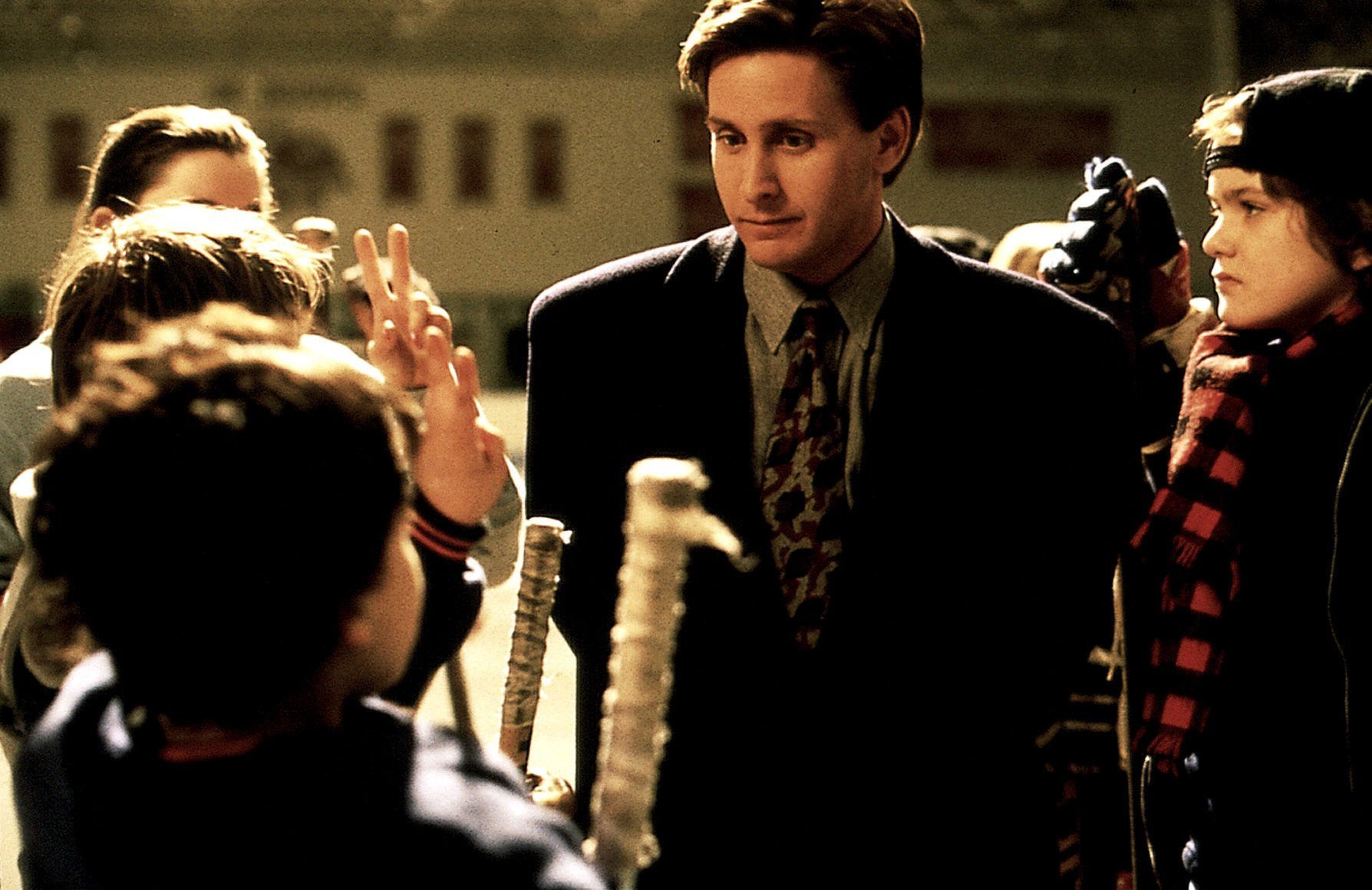
In "The Mighty Ducks," Emilio Estevez's Gordon Bombay, is a disgraced ex-hockey player ordered by the court (see the civic pride tie-in) to coach a youth hockey team. This is a state in which nearly every Minneapolis suburb (that I saw) has its own community center with a hockey rink so it's more than fair to say that many a Minnesotan defined themselves as a budding hockey star before moving onto adulthood.

A lawyer on the go with only a tinge of Minnesotan drawl in his speech, Bombay seems like the archetypal Twin Cities urbanite but he's contrasted with his mentor Hans (Joss Andros) who is an ambiguous Upper Midwestern version of Yoda or Mr. Miyagi if green alien or stereotypical Japanese was replaced with stereotypical Scandinavian.

It's also worth noting that in the land of 10,000 lakes, ice skating isn't just done in the ice skating rinks but on frozen lakes as well. Minneapolis has hosted the U.S. Pond Hockey Championships annually since 2007. It's an ubiquitous part of state culture and Bombay first meets his time as they're playing on a pond. It also must have made many a Minnesotan must have swooned when the film's primary romantic spark occurs as as Bombay is stroking his love interest's hair as the St. Paul's ice carnival is featured in the background.

Friday, November 15, 2013

The Quintessential Alabama and Mississippi films

The Quintessential Alabama film: To Kill a Mockingbird
If being Southern before the Civil War is a bad thing and holding onto that Southerness after the Civil War is considered a very bad thing, then Alabama (along with Mississippi) is widely considered one of the two worst states in the nation. Whereas Mississippi has other points of pride that don't specifically bring up its racist history (the blues, aquaculture, the Mississippi Delta, some of the South's more ornate plantations), there's not as much for Alabama to do except own up to being the epitome of the Deep South which would explain the nickname Heart of Dixie. After all, Alabama today is a center of industry and manufacturing which is something present-day Alabama has in common with Alabama in antebellum days.

Candidates for the quintessential Alabama film ranges from dark films like Color Purple while a film like Tuskegee (or what I imagine Red Tails would be like) tries to simply portray heroism without its contrast. Talladega Nights and My Cousin Vinny also come to mind as films with a specific location but I associate NASCAR as being more of a Carolinas thing and My Cousin Vinny lacks a strong regional flavor. I first assumed it was in the Midwest or Not-So-Deep South before looking it up.

The quintessential Alabaman film, therefore, should be a film that negotiates Alabama's racist past with its progress. It should be a film that's unapologetic about the attitudes of its people back in the day. To Kill a Mockingbird has the quintessential hero in a fight for justice that results in his client not being exonerated. It's a bittersweet film in which the main protagonist (the book's narrator) is a young girl who learns that right and wrong are complicated where they live.

It's a good portrait of small-town Alabaman life as told first-hand by an Alabaman.  Although it's primarily known as a book, the film version is iconic enough to appear in the iconic AFI list: 100 Years...100 Movies.

The Quintessential Mississippi film: O Brother Where Art Thou
Mississippi, like Alabama, is known for being the extreme Deep South so we could go for a film that uses the state as a hotbed for hatred such as "Mississippi Burning" or "Ghosts of Mississippi" but look closer (as I did last year on a very touristy trip through the state while staying in Memphis) and you'll see other traits such as their blues heritage, the riverboat culture of the Mississippi Delta, the ornate plantations, and even the fact that they farm fish (aquaculture). Mississippi also has a natural beauty with its swampy magnolia and oak forests that's almost mystical.

The Coen brothers create a strong sense of place in their films and capture that natural beauty out of which tall tales could be spun, the likes of which appear in the travels of Everett, Delmar and Pete. Mississippi is the proud birthplace of the blues in their purest form (as in acoustic, unpolished recordings) which ties into the trademark sound of the inadvertent band formed by the trio known as the  Soggy Bottom Boys. In its early form, Blues was almost indistinguishable from something heard in churches which is why it's also appropriate that there's such elaborate religious mythology.

Remember the talk of elaborate ornate plantations Mississippi was famous for? We see that in the elaborate divide between rich and poor and the class-conscious ex-wife of Everett (Holly Hunter).

Lastly, when I was in Mississippi, a lot of the tourism centered on roads and corridors such as the Blues Highway (running through Clarksdale) or the Natchez Trace and the film emphasizes this geography as well as all the mythical and legendary stuff they encountered was along the road. The character who sold his soul to the devil (Tommy) is even based on a piece of Mississippi folklore about a famous blues guitarist (Robert Johnson) who sold his soul to the devil at the confluence of two major highways in Cleveland, Mississippi.

Tuesday, September 16, 2008

Burn After Reading review

I have now seen 8 Coen films to date and would not profess myself a major Coen fan. I was baffled by No Country for Old Men, I fell in love with Oh Brother Where Art Thou, I watched the cult status behind Big Lebowski and Fargo grow from the sidelines, I enjoyed Intolerable Cruelty, and I lost my faith in the brothers with Ladykillers and Man Who Wasn't There.

As you can see, it's an up and down relationship that I've had with their films, and was hesitant to log in an 8th Coen outing (I feel 7 is more than enough films to see of a director you're not crazy about) but couldn't resist the bizarre-sounding plot and the idea of seeing Brad Pitt go into full comic mode. And I thoroughly loved the film.

For one thing, I'm a native of D.C. and the Coens have a great sense of place in their films: the superficiality of sunny Hollywood in Intolerable Cruelty, the bible-belt-based bluegrass-churning populist Southern Charm in Oh Brother Where Art Thou, and the quirkiness of the Minnesota cold in Fargo.

I can't tell you how great the reception was in my theater in D.C. where we might not see these things as that far-fetched: beauracrats (in the form of JK Simmons) making decisions about what to do when people are getting killed and secrets are being spilt out to other nations on the basis of what takes the least paperwork and allocating $50,000 for a random lady's plastic surgery for virtually no reason at all.

The plot is truly screwball and does a far better job of past Coen films at raising the ante in the third act so that we're invested to see what deliciously improbable ways the screenwriters will tie up the loose ends. It also doesn't help that some of the protagonists are actually likable: Brad Pitt as the airhead exercise junkie who's as faithful a friend as they come, Frances McDormand as the gym worker who just wants to look pretty, Richard Jenkins as the poor schlub who likes her, etc.

Sunday, August 31, 2008

Links to articles of mine on helium

I've taken to writing more and more on helium as of late. That is why this blog is slower but I appreciate all who read. I just feel the need for a change of pace. This blog will be going on hiatus soon. In the meantime, here are a couple of articles on helium.com I've written. One is a compilation of the top ten definitive Westerns while the other is a look at what made the Coen Brothers successful:
http://www.helium.com/items/1166614-westerns-top-10-westerns-film-genres
Briefly, my list is 1. Searchers, John Ford 2 High Noon, Fred Zinneman, 3. Stagecoach, John Ford, 4. Wild Bunch, Sam Peckinpaugh, 5. Once Upon a Time in the West, Sergio Leone, 6. Butch Cassidy and the Sundance Kid, George Roy Hill, 7. Rio Bravo, Howard Hawks, 8. Unforgiven, Clint Eastwood, 9. My Darling Clementine, John Ford, 10. McCabe & Mrs. Miller, Robert Altman

http://www.helium.com/items/1166504-coen-brothers-films-genre

Friday, March 21, 2008

The best of 2007 from a guest blogger

Guest blogger Brian, a University of Minnesota freshman and cinematic studies major, had these rankings on the best of 07. I am going to make comments in addition to Brian's picks, but that's only for the chance for some point-counterpoint and to encourage further discussion. Credit for the post is all Brian, though:


Tops in the last Oscar Year:
Actor:
Tommy Lee Jones (in No Country For Old Men): Jones’ performance in the Best Picture Winner Film, has been totally overlooked, and should have at least gotten more attention with in the Cinematic Community. Jones’ performance is simple, yet chillingly haunting, providing the foundation for the film’s now famous ending.
Daniel Day-Lewis (in There Will Be Blood): Lewis definitely deserved the Best Actor award: I can’t think of another actor that deserved the award as much as he did. His performance in There Will Be Blood may very well have been the most amazing performance I have seen in years. From beginning to end, Lewis’ acting filled the screen and sent shivers down my spine. His performance during the famous baptism scene will forever be remembered as masterfully powerful.
Johnny Depp (in Sweeny Todd): Depp provided an extremely intense performance of the infamous musical star. And who knew that Depp could sing?? His singing provided an even deeper depth to his already intense performance.
Glen Hansard (in Once): From this “little film that could”, which even won Best Original Song at the Oscars, came his amazing performance. Hansard’s simple, yet powerful performance is extremely natural and life-like, and, like Depp in Sweeny Todd, provides intensely beautiful singing to his character. From his trademark “t’anks” to his trademark costume of jacket, scarf, and short beard, Glen Hansard will always be remembered as “The Guy” (The name as it is stated in the credits). Unfortunately, Glen Hansard has publicly stated that he is going to concentrate on his music career rather than his acting career.
Jonah Hill (in Superbad): Despite the fact that Superbad is anything but a cinematic masterpiece, Jonah Hill’s performance was what made the film so enjoyable to watch. Hill’s acting, albeit mostly improvised, is hilarious. It was the improvisational style to his acting that really brought out the humor in the script of the film. For a film like Superbad, you need someone who can really act out a funny script and ad-lib at the same time; and Jonah Hill was that man.
My opinion: Tommy Lee Jones is my #2 for best supporting actor behind Tom Wilkinson, so aside from a different category placement, I am pretty much in agreement on that. "Chilling" is indeed a good word to describe Jones' stoic style and blank stares into space as he seemed so consumed by the threat of Anton Chirgurh. I agree as well on Day-Lewis: Samuel L. Jackson once said that Oscars (for acting at least) are won not by movies but by moments, and the baptism scene is the clincher for Day-Lewis.

I'm pretty much on the other side of the fence on Hill, mainly because I didn't find Superbad particularly enjoyable because he's right, it takes a great actor to rescue a mediocre comedic script and bring those jokes to life (think Tom Hanks with Ladykillers or Jim Carrey and Jeff Daniels with Dumb and Dumber), and at the end of the day, it still felt like a mediocre script to me. I basically have Superbad as hovering around 2 1/2 stars which in other words, is a mixed bag. I thought the dialogue wasn't particularly anything of note despite setting the record for most 4-letter words per minute (according to the claims of writer Seth Rogen and Evan Goldberg) and it's saving grace was the turn of events in the storyline and its larger themes.


Actress:
Ellen Page (in Juno): Ellen Page is Juno. She was perfectly cast as the part. Page’s performance was way beyond her years, and was definitely worthy of the Oscar nod, and most likely should have won the award, despite the fact that she is so young and that this was her first widely successful film. Her performance was so lifelike that I thought I was watching one of my friends in real life. Page’s acting style is such that she seems to take the script and make it her own and in doing so, she lights up the screen. I was smiling throughout the whole movie (with the exception of the crying scene of course) because it was so enjoyable to see her act.
Evan Rachel Wood (in Across the Universe): Similar to Johnny Depp and Glen Hansard, I am huge fan of the singing-performance. I believe that if you can sing on screen or stage, then you can most likely act as well. This is certainly true of Evan Rachel Wood in Across the Universe. Wood’s singing provides a beautiful backing for her beautiful performance. Her acting reminds me of a stage performance, which, in some cases can be construed as more authentic acting, since stage acting is non-stop on stage (whereas films stop for each take).
My take: I have another Oscar nominee, Cate Blanchett from Elizabeth and the Golden Age as my #1, followed by Evan Rachel Wood (so we're on the same page there), Naiomi Watts from Eastern Promises, and then Page, so we differ a little there. I agree that Paige was perfectly cast in the part, but than in that case, doesn't that significantly lower the degree of difficulty? Although Oscars aren't supposed to be a body of work, it will be interesting to see Paige on screen with words not written by Diablo Cody coming out of her mouth. I do agree, Wood stole the show and gave a performance I will remember for years to come.


Supporting Actor:
Javier Bardem (in No Country For Old Men): Obviously, Bardem’s performance will be forever remember as the new perfect villain. His performance was hauntingly perfect in every sense of the word, even down to his now trademark coin flip.
Paul Dano (in There Will Be Blood): Dano’s performance in There Will Be Blood was unforgettable. The acting of this charismatic clergyman was hauntingly masterful for being so young and in relatively few films.
My comments: Whether Bardem was the perfect villain is a whole other discussion but I agree that Bardem nailed the part and had a certain rhythm and consistency in style to his character that made it come to life. It was such a competitive year for this category that I had to put Tom Wilkinson, Philip Seymour Hoffman, Tommy Lee Jones and Forrest Whitaker from the Great Debaters before Bardem, and I was almost considering Ben Foster who I feel was able to paint a portrait of an equally intriguing villain with few words. From the 85 minutes of There Will Be Blood that I saw, Paul Dano showed quite a bit of versatility in this role as opposed to his role in Little Miss Sunshine last year. It's almost as if he grew up.
Supporting Actress:
Helena Bonham Carter (in Sweeny Todd): Carter’s performance in Sweeny Todd was perfect. It was so enjoyable to watch. There is just something about her acting that makes movie watching so much fun. It must be the juxtaposition of her facial expressions and her hilarious comments in that British accent.
My comments: Unfortunately, being only a part-time film critic I don't see every movie to come out, and Sweeny Todd wasn't something I had the fortune of catching.


Director:
Paul Thomas Anderson (There Will Be Blood): There Will Be Blood was without a doubt a cinematic masterpiece and would not have been so amazing with a different director or cinematographer for that matter. Any viewer can see the amount of work that Anderson put into making the film.
Joel and Ethan Coen (No Country For Old Men): No Country is this Oscar year’s other cinematic masterpiece. From the start to its anti-conventional ending, the film screams amazing directing, which is nothing but understandable from two of our generation’s best filmmakers.
My comments: Interesting fact about Brian: He went to the same high schol as the Coen Brothers in Minnesota. I agree from what I saw of There Will Be Blood and what I know of the storyline that Anderson deserved a best director title over Coen. It was a more ambitious project that acheived its potential


Picture:
Once: The music alone from this film is amazing, but this anti-conventional love story is a beautiful reconnection to the French New Wave style of filmmaking.
There Will Be Blood: A hauntingly beautiful, epic, difficult cinematic work of art.
No Country For Old Men: A genius film with exciting action and a brilliant ending, but a surprising film coming from two amazing (usually comedic) directors.
Sweeny Todd: A sinister masterpiece from the dark mind of Tim Burton, which encompasses all that is great about the Musical/Film hybrid world.
Across The Universe: The best and worst film ever made. A genius idea to create a new narrative with Beatles’ music, however, it seemed too forced at times. On the other hand, the other large majority of the film has some of the most beautifully photographed scenes I have ever seen, where the visuals matched the music perfectly and sent shivers down my spine.

My comments: Whole-heartedly agree with the Across the Universe comment. The idea was genius while the execution was sloppy

Thursday, January 24, 2008

No Country for Old Men isn't going to strike everyone the same way

OK, let me lay it out for you, film buffs and oscar enthusiasts because I'm already beginning to sense this humongous divide:

Annointing "No Country for Old Men" as the film of the year is going to come off a slap in the face to ordinary movie going Americans who don't watch movies as a hobby like you do.

Basically whenever all the critics' groups anoint the picture or pictures of the year, it's your way of telling them that if they perfer staying within the safe confines of National Treasure 2 and I Am Legend, this holiday season then they're cultural buffoons for missing the truly rich and cinematically enduring works in the form of whatever you pick, and in the case of No Country for Old Men, you're sending them to a very unconventional and sparse film that will leave them scratching their heads at the end and complaining to their spouse, "This is what you dragged me to instead of National Treasure? All because you wanted to be culturally enlightened?"

Bottom line: No Country for Old Men will have film students salivating at its masterwork, but it will have regular filmgoers scratching their heads, and if you can't anticipate that regular filmgoers might not particularly enjoy it, then you can reach two conclusions: 1) regular filmgoers are stupid and 2) you're out of touch with regular filmgoers. Both conclusions are correct, but don't just ignore conclusion #2.

I certainly wouldn't recommend people waste 10 dollars and 2 hours of their time on No Country for Old Men on non-film buff friends of mine, because it's not a particularly lifechanging or englightening experience if you're not thoroughly engrossed in the art of film.

Tuesday, January 22, 2008

I just watched No Country for Old Men so you don't have to

The pull of the awards season can be enormous. You might see a trailer or read a synopsis of a film that doesn't look that good but you figure, well it's won so many awards so far, it must be good. This is the case with the Coen Brothers' latest film "No Country for Old Men." Over the holidays, you'll make the routine trips to the movie theater with your family and watch fare like National Treasure, I am Legend, or Fred Claus, but there'll be a voice in your head taunting you with the notion that you're watching easy escapist fare and encouraging fluff and that if you really want to truly experience cinema in all its grandeur, you'll spend those $10 on No Country for Old Men. "But I want to see Nicholas Cage solve mysteries and wisecracking Justin Bartha," you might protest, but the side of you that wants to be more cultured argues "But the New York, Toronto, Boston, Washington and Chicago Film Critics Societies' all voted for No Country for Old Men."


Film critics sometimes fail to grasp, that people aren't always going to drop everything every time someone tells them a film is the must see film of the year. They generally have a limited number of times they can get away to a movie theater, even in a packed holiday season such as this and based on box office figures this past holiday season, those trips might be taken up by films that might not be as cinematic ally rich but which assure the viewer of a good time, like I Am Legend or National Treasure, and God Forbid, they'll miss the film everyone's telling them to go see.


Well, American public, if you chose something over "No Country for Old Men," didn't get a chance to see that and probably won't get to it by the time it's out of theaters, not to worry, it's not the life changing experience they make it out to be. Don't let the critics guilt you into thinking you were a cultural buffoon for missing it.


In reality, the film is one that would make every film student's jaw drop in amazement at the fluidity in editing and economy of tone. For average Joe moviegoer, it's not too much of a life changing experience, however. In fact, it's little more than a run-of-the-mill action flick with a little bit of a higher ambition to be a homage to the Western. There's almost no character development and very little subtext or content.


Am I the only one who feels that it would be a drastic mistake that the critical community anointed this the best film of the year in their quest to keep cinema from being overrun by the action genre with crap like Rush Hour, Die Hard, and yes, Bourne Identity (not saying it's crap but it's low on character) from reproducing into sequel upon sequels with clones like Shoot 'em Up and Shooter popping into the theater each year? Am I the only one who feels that a picture that wins best picture should have a little more than well-choreographed action scenes to it? French Connection was the one exception i'm willing to live with because it was novel at the time, not anymore, especially when last year's winner was an action winner. Now, i'm rooting for There Will Be Blood (or Charlie Wilson's War if it makes the cut).

Sunday, July 22, 2007

A look at the Coen Brothers (1996-2004)

I just saw Fargo so now I´ve seen 6 Coen brother films: Intolerable Cruelty, Ladykillers, and Man Who Wasn´t There are genre experiments of the sort you´d see as film school theses, while Fargo, Big Lebowski, and Oh Brother Where Art Thou bear a more distinct mark of the filmmakers:
-Epic-like narratives (this is more the case in Big Lebowski and Oh Brother Where Art Thou and Fargo to a lesser extent) with long winding storylines
-Vague references. I use the word vague here, because i think a little too much is made of their ability to work in their filmic references into their work. The Big Lebowski-Big Sleep connection is somewhat shady in my opinion.
-Characters who arrive at the ends of their story arcs through means in which they never planned themselves. For instance, George Clooney and company has no clue how he´s going to get out of being hanged when a humongous flood miraculously saves them. In Big Lebowski, Jeff Bridges is royally screwed when he loses that briefcase but in a stroke of luck: it turns out there was never money in that briefcase. In The Ladykillers, the characters´ fates aren´t really determined by anything but unfortunate luck.
-A strong sense of place (Minnesota in Fargo, the Deep South in Ladykillers and Oh Brother, California in Intolerable Cruelty)
-Sidekicks to the protagonists that do more harm than good (Steve Buscemi´s wanting to get laid at inopportune moments and panic under pressure in Fargo, John Goodman´s aggressive outbursts in Big Lebowski, the gay baron in Intolerable Cruelty, the guy with IBS in Ladykillers)

My impression of the three that remained popular is that:
-Fargo was an extreme critical hit garnering an oscar nomination and a place in AFI´s top 100 and made several lists of best films of the decade
-Big Lebowski was an extreme cult hit
-Oh Brother (my personanal favorite and the only one of the three to make my personal top 100 list and garner 4 stars) was somewhere in between. It made many top 10 films of the year list and earned an oscar screenplay nomination.

I was wondering why these three films were received this way. My theories:

-Fargo involves murder as a comic gag while big lebowski and oh brother only involve stealing and adding murder to a plot insantly makes things more serious. Oh Brother has characters like John Goodman die but they never really show his death so they never get as graphic as Fargo.

-I also think that Big Lebowski works as wish fullfillment. The protagonist goes through things and lives a life that young men would love to have: tell off some older authority figure and not have to have respect for your elders, smoke pot and get away with it, knock up a woman and not have to deal with the responsibility of fatherhood, hang out with your buddies all day, escape any negative repercussions when you mishandle large amounts of money, etc.

Saturday, May 12, 2007

Downfall of comedy I: Where it stands today

In response to an interesting question: What's a good "stupid" comedy?

I'm going to assume by "stupid" the person mean films that don't have the respect of critics or film academics. The truth, however, is that comedy usually doesn't get the respect of critics as much.

Although comedy is an integral part of movies and a respectable genres, you have to think that comedy isn't as well-respected as it used to be by the critical community, or not a lot of it anyway. Successful comedies today include:
-Indie hits like Little Mrs. Sunshine and Lost in Translation,
-Dramedies with good scripts and good dialogue by the likes of Alexander Payne, James L Brooks or Charlie Kaufman. It's no small coincidence that these guys win screenwriting rewards at the Oscars
-The Coen Brothers seem to be an outliar among comedic directors and that they seem to be put into a class well above other comic filmmakers by film critics. They're film scholars who are well-versed in film history (as if someone like Mel Brooks or Vince Vaughn isn't?) and it usually impresses the film critics that their movies are usually innovative in their technical aspects or clever uses of refences to past films (i.e. Man Who Wasn't There is based on film-noir, Intolerable Cruelty is based on screwball comedies, and Big Lebowski is based on The Big Sleep). A lot of casual movie fans like the Coen brothers too and have given them a large cult following. The reputation of the Coen brothers is continually being inflated through a mutual enthusiasm between the critics and the casual movie fans that "well, we at least agree on something on the comedy front."
-I could also see the critical community being split between many other comic autuers who would have had more critical respect if the comic genre itself was more respected such as Kevin Smith, Adam McKay, and Judd Apatow (and there might be some other examples in here). Kevin Smith has gotten some good reviews by Ebert and Roeper but I doubt more serious outlets like Sight & Sound or Premiere Magazines would give him the time of day on their review columns.

Comedy used to be equally viable in film achievement on every level back in the day. Columbia Studios became a major power player through the success of the pure comedy, "It Happened One Night" from 1935 which won the oscar that year. Screwball comedies dominated cinema in the 1930's and 1940's and Billy Wilder forged a great career out of comedies. What I find interesting is Mel Brooks' career and how it figures into that transition (which I'll cover in the next post)