Showing posts with label Warren Beatty. Show all posts

Monday, March 31, 2025

Review of Two Period Pieces: Rules Don't Apply and Public Enemies

More of my work is migrating to Patreon, including writings on politics, culture, and how to publish. Feel free to follow me there. There are even free options.


Rules Don’t Apply (2016)-When you think about it, it’s kind of strange that Warren Beatty has only directed five films which is surprising considering his capital in Hollywood: He has a directing Oscar win under his belt, he’s renowned for his charm (in more ways than one, hint hint), and he has political tastes that align well with Hollywood. The last of them is a features iconoclast Howard Hughes. It’s likely not surprising that an iconoclast and ladies’ man like Beatty would relate to a visionary of a historical figure who had a big appetite for wealth, status, and woman. For those who thought Beatty was a shallow product of his era (who wasn’t a rebel in the 60s?), it’s admirable that Beatty knocks Hughes off his pedestal. The story is told from the point of view of a young woman (Marla, Lily Collins) who falls prey to Hughes’s charms and is left to suffer the consequences (AKA a pregnancy, he ignores until the epilogue).

In fact, it’s hard to find a more pessimistic take on Hollywood. Through the eyes of Marla, Hughes is just a microcosm of a whole system that will spit out Hollywood’s chaste young virgin girls once they get deflowered. Similarly, Marla’s true love (Alden Ehrenreich from Solo) is used the way most unpaid interns are. Howard Hughes has been a popular subject for Hollywood. Most notably in the 1980 film Melvin and Howard, and the 2004 film The Aviator. He was even alluded to in the Bond film Diamonds are Forever as the billionaire whose identity Blofeld alluded to. In these films, Hughes is depicted as an oddball who is trapped in a prison of his own making. His mental illness is always a clear part of the narrative, which enables the audience to feel a little bit of sympathy towards him. Without fully spoiling the ending, the film nicely finds a way to split the difference between villain and sympathetic character for the agoraphobic billionaire in the final scene.
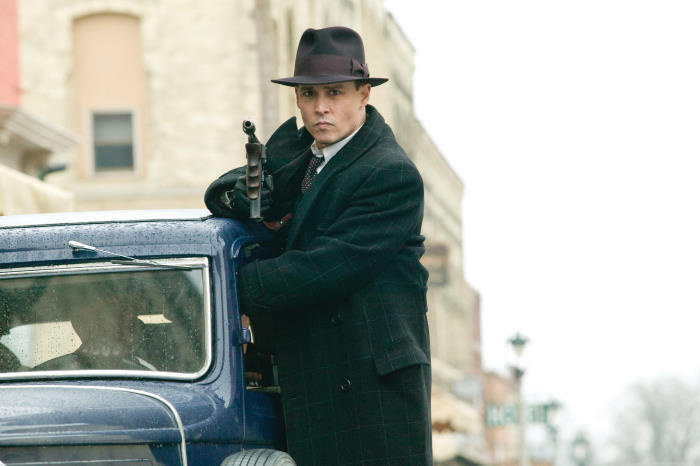
Public Enemies (2009)-Considering how storied the genre of 30s gangster films is, I really was primed to sink my teeth into what should have been a prime example of what this genre offers. The film is by Michael Mann who is supposed* to possess God-like consistency, and it stars Christian Bale, Marion Cotillard, and Johnny Depp. Could a casting director have selected any trio more suited to the period? If he’s not going as a pirate or gothic figurine, the next most likely choice for Depp’s preferred Halloween costume would be pinstripe-decked gangster. Similarly, Marion Cotillard has flapper written all over her. And Christian Bale is solid in whatever box you squeeze him.

The plot tells two parallel stories in the classic fashion of most crime genres: The cat-and-mouse game between a criminal and the man struggling to track him down. The mouse is notorious bank robber (played by Depp) John Dillinger (whose life was insanely interesting), while the cat (Bale) is Melvin Purvis who ran the Chicago office in charge of tracking him down. The character of Purvis isn’t given very much color. He’s mostly an archetype and inaccurate one at that: The real operation was directed by local law authorities until relatively late into Dillinger’s 14-month reign of terror. The script needed a composite character and, as previously mentioned, a broody Christian Bale in a crime movie gets the job done. However, this side of the story, while somewhat of a necessity, is mostly mechanical. One suspects that the script didn’t want to give the (even before the era of cancel culture) morally irksome J. Edgar Hoover (Billy Cudrup) a bigger role as the hero. It’s a shame though, because this is just burying the lead.

Dillinger isn’t necessarily given the hero treatment either. He’s portrayed as somewhat of a feral beast: Instinctually driven to protect his comrades and lovers. He’s also exceptionally clever which is what makes the action scenes so fun.  His famous prison escape scene with a decoy gun, whittled from wood, is played with the kind of claustrophobic tenor from an expert craftsman behind the camera. This is the rare film where I can even pick out the soundscape (the rat-tat-tat of the machine guns, especially) well enough to feel like it should have received a Best Sound nomination at the Oscars (I normally have a weak ear for that).

At the end of the day, the technical construction of the movie is solid but it doesn’t amount to enough “wow” moments to make the whole exercise feel more than typical.


Saturday, May 07, 2011

Great films I just don't get-Starting with A Fish Called Wanda

Just saw A Fish Called Wanda for the second time. This film is considered a classic and I thought it was OK the first time I saw it several years ago, but I found the film really flawed on second viewing.

The film is a combination heist thriller and romantic comedy. The romance is between an entirely irredeemable woman (Jamie Lee Curtis, who I've personally never found very attractive) and pretty much every other member of the all-male ensemble who she seduces as a fall-black plan every time something goes wrong. Not only is Curtis' character unsympathetic, she's uninteresting.

Her main love interest is a British barrister (aka lawyer with a wig) played by John Cleese. She's playing him so that she can get the inside scoop on a case he's trying. Although there's sappy music playing in the background during their scenes together, any sediment here is unearned: Cleese's character loses all credibility by not seeing through a hot young woman (who just happens to be a defense witness) posing as a groupie who wants to discuss details of his upcoming depositions during their lovemaking. He's also irredeemable himself as he renegs on a gift from his wife and then leaves her (along with his daughter) for a woman who is obviously a fraud.

What's worse, even though the movie's clearly a dark comedy, I don't think the film's flimsy romantic subplot was intended in any ironic way either.

One of the other subplots involves another one of the baddies trying to kill off an old lady who's a witness. It's completely predictable that nothing will happen to her because she's really sweet and this particular guy (Michael Palin) is a softie, so those scenes are a waste of time.

The film does have a couple high points. Although he's a little too mean-spirited to be endearing, Kevin Kline creates a character that's certainly amusing to watch. He's Curtis' main lover and is passed off as Curtis' brother for some reason (so she can screw more people) and he has a good running gag of blowing up completely and ruining everything when someone calls him stupid. Michael Palin, as a stutterer who loves animals, also brings something enjoyable every time he's on screen.

The film has some great scenes but as a film, I think it falls apart.

Other films considered classics that I'm not a fan of:
The Incredibles-This Pixar film that parodies superhero conventions is something I saw five years earlier in "Mystery Men" and a year later in "Sky High." I'm sure there are other examples too that I just can't think of at the moment, but "Sky High" (even though it fits squarely in the teeny-bopper genre) and "Mystery Men" are just as astute as "Incredibles" to me.
For a studio that is considered a hallmark of originality, "Incredibles" really didn't bring that much new to the superhero parody genre.

Viva Zapata-Considered one of the better films of legendary director Elia Kazan, the film tells the story of Mexican Revolution hero Emiliano Zapata. The film isn't entirely inaccurate (from someone who was taking a grad level course on Latin American history at the time), but it's also oversimplified and hard to follow, so you likely won't even be able to develop much appreciation for the subject matter anyway. On the whole, I get the impression that Kazan doesn't care much about the Mexican revolution. The film's purpose, as far as I can tell, was to give Kazan's prize pupil, Marlon Brando, an opportunity to flex his acting with dramatic speeches on how he wants to freedom, and later how he doesn't want to fight anymore, or how he wants a pinata that matches his sombrero- I stopped caring after a while.


Annie Hall-Considered Woody Allen's best film. I've never seen a romantic comedy and thought "This is good but it needs more of a Momento-style fracturing of the storyline to make it great." The film attempts to be clever and it really just feels like a stream-of-consciousness first draft of a better film. Woody Allen did experiment a lot with the conventional love story and some of those results are very good. I suppose a few misses are aloud along with the hits and we each have different definitions for what hits are. I'm just surprised so many have gotten behind this one as "the hit."

All That Jazz, 8 1/2 and The Doors-Sympathetic portraits of rock stars who had more sex and fame than most of us will dream of who we're supposed to feel bad for? Films about highly successful artists should at least attempt to bring them down to Earth so we can relate to their struggles and I found myself not really caring about why they caused their self-inflicted reckless behavior. A good film in this genre ("Ray" or "Walk the Line" comes to mind) treats the character like they're interesting stories.

These three films reek of vanity: Be interested in their predictable problems, because they're famous people you know and love and want to know more about them. "8 1/2" reeks of vanity because it's autobiographical. "All that Jazz" is borrowed from the template of 8 1/2. It's probably the most promising of the three films (although 8 1/2 is the most praised): Roy Scheider does well in the part and it has a few interesting motifs.

Expecting me to like "The Doors" is pretty much the same as expecting me to subscribe to "Rolling Stone" magazine and worship rock stars like the magazine does. "The Doors" is even worse than those Oscar bait films about a guy with some disability who's limited in life, because this is a guy who's just inflicting his own wounds for the hell of it. It's the difference between the degree of sympathy we feel towards Charlie Sheen verse Temple Grandin.


The Graduate-Not a particularly bad film, but not a film that isn't great either. It's got great performances, no doubt, but it's just about a guy screwing his dad's friend's wife. It's a little bit of a stretch to say it's a big symbolic statement about the 60's. The filmmakers themselves said that the cross symbol at the Church scene was entirely by accident (I'll have to double-check but I believe that's the case)

Heaven can Wait and Shampoo-If Heaven can Wait is a best picture nominee, then I absolutely agree with Ricky Gervais at the Golden Globes: Ghost Town (or "Heart and Soul" or "Ghost Dad", take your pick) got robbed of a best picture nomination too. It's just a lightweight relatively fun film.

"Shampoo" is really a film about nothing except how studly and charismatic Warren Beatty is and how his politics and problems are interesting. Oh, and it was written by Warren Beatty himself. Nothing against Beatty (he comes from my hometown) but the guy's overrated. He's basically got one go-to move as an actor: shrugging his shoulders like the world is too hard for him. I don't think the quality of his films would be damaged that much if Matt LeBlanc replaced Beatty in every role he played.


The Queen-David Spade, when he was the anchor of "The Showbiz Show" said it best: This was a film that boiled down to about whether to read a press release or not.

Sunday, February 04, 2007

Digging up Shirley MacLaine and Warren Beatty's past

The last week, I've been going to the Central Library of Arlington, VA and looking up stuff in the Virginia Room (which is their county archives), for a grad school study project, and while I was there I thought, what the hell, I'll look up info on Warren Beatty and Shirley MacLaine. They are part of my hometown but I’ve never known much about their connection.

It was an interesting reveal.

So first let’s get the two last names out of the way.  They’re both Beattys but Shirley MacLaine must have been found enough of her middle name back then to include it in the yearbook because she’s listed as Shirley MacLean Beatty. She later substituted her middle name for her last name on the spot at one of her first theater auditions because a casting director couldn't pronounce "Beatty" and altered the spelling.

The two had no other siblings growing up and were pretty close. A positive relationship has been alluded to in interviews the two have given as adults although Shirley wishes her brother was less of a philanderer.

Both siblings were noted to be trouble makers in their pre-adolescent days which must mean they did some truly outrageous things (considering all kids are pretty capable of mischief). They would evidently lie on the street and stop traffic and play neighborhood pranks that were reported to their dad. Their dad was a principal of an Arlington middle school and admitted to being a little ashamed of their antics.

Shirley was a cheerleader at W-L and participated in ballet in high scchool. She went to Broadway the summer before her senior year where she had bit roles. The next summer after graduation she went back to Broadway and landed a role in the Pajama Game that got her discovered by Alfred Hitchcock. Soon she was cast in the film “The Trouble with Harry” within one year of graduating W-L. Not long after that came “Around the World in 80 Days” which was one of the most expensive and profitable films Hollywood had made to date and led to an extensive career that earned her five Oscar nominations and one win among many other accolades.

Beatty was a star football player in high school and the class president senior year. His high school yearbook pictures are a lot more amusing to look at than his sister's because of his crew cut. He was also his senior year class president.

He got into the theater the summer before his senior year when his sister recommended he do it as a stagehand at the National Theater in D.C.  Still, it was his football playing that stuck out. He got somewhere in the ballpark of 10 scholarship offers but he turned them down to study acting at Northwestern University.

So that’s the story so far. There are obviously many more files in the library, so I look forward to doing some more digging…