Sunday, August 30, 2015

Another Period Review

This is an admittedly slapdash review I'm posting here although I wouldn't classify it as my best content. Unfortunately, I'm saving my best content for HiddenRemote at the moment. 


To say the show "Another Period" is rich with talent is an understatement. David Koechner is the family patriarch, underrated character actress Natasha Leggero lends her talents in a rare staring role as one of the two sisters Brian Huskey, Paget Brewster and Brett Gelman are all excellently cast in character roles. Christina Hendricks (who's mostly known for period drama) dives into her role as a scheming servant with an unexpected amount of enthusiasm. Michael Ian Black really sticks out (even in poor episodes) as a character who really puts the "serve" in "subservient" with the character of Peepers.

Peepers is a rich character and fully-formed but seeing him on screen only serves to remind about how deficient all the other characters. Peepers' desire to serve the other characters in the story makes little sense because pretty much everyone else is an extreme caricature. Either that or they're the most inhumane collection of people in history. Watching Michael Ian Black as Peepers is like watching Peter O'Toole act opposite third graders or evil scamps determined to ruin his scene.

The main drawing point of the show (and what keeps it watchable) is that it's a fun period piece and it's very rare to see "fun" and "period piece" in the same sentence of a synopsis. Although "Another Period" doesn't have the production values of a grandiose epic, there is a superficial veneer that shines through. Like any unfocused take on history that is trying to say as much as possible about its setting, nearly every important figure from the 1900's makes their way to the Bellacourt manor with juicy stunt casting. Matt Besser plays Leon Trotsky, Kate Flannery plays Annie Sullivan, Ben Stiller plays Charles Ponzi and Chris Parnell plays Sigmund Freud in clever historical twists although it's fairly clear that these historical figures aren't researched beyond what will earn an easy laugh. Similarly, the show also presents us with a hyperactive Gandhi and though Clone High already went down that road a dozen years ago, it's good enough for a chuckle. 

The show is too sloppy to be taken as much of a satire and its characters are too cruel to be taken sympathetically or even seriously. The bloated ensemble also leads to episodes that are overly crammed for the thirty-minute running time. Despite these flaws, the show is still watchable and worthy of a laugh here and there.

Saturday, August 15, 2015

Ten of my Favorite Journalism and Blogging Experiences


Ten Great Stories of Mine (Part 1):
 I hope to do a series of stories about the journalism process and my particularly journey in journalism by highlighting some of my stories. See the FAQs and Journalism tags for more of my writings on the topic. It goes without saying that not every story I do is an amazing experience. There are quite a few stories that never saw the light of day or didn't go the way I wanted them to (this happened more earlier in my career). Of course, all of these projects are possible through editors who allowed me to write and publish these stories so thanks for them.

1.       Interview with Greg Garcia, Northern Virginia Magazine (2015)
Hometown heroes can provide a way to interview stars if you’re primarily locally-based as a freelancer. Among the people who come from my hometown is Greg Garcia, who created My Name is Earl, Raising Hope, and The Millers. I first heard he went to my high school when new broke out that his cousin (who went to school with us) moved to LA to work on the show.
Interviewing Garcia became one of those big ideas I had on reserve for when I needed to pull out a big pitch to impress a magazine. After publishing my first article in Arlington Magazine, I suggested the Greg Garcia idea to my editor and they were partially open to it, but never really green lit it. Meanwhile, I called a magazine across town called Northern Virginia Magazine and an editor told me that they had been trying to get Greg Garcia, as well which was basically an open invitation to track him down though I didn’t have his direct contact information either. 

I looked up the relevant party on the CBS website and asked for an interview. My request came back with, “Thanks, but we’ll pass.”  I also tried Yellow Paging Garcia’s production company and narrowed it down to a building in LA. The best I could do was call the building manager and he said he didn’t give out tenant information. My friend Will Harris, who has interviewed a ton of people for big publications, suggested that I contact Garcia’s talent agency, and before I knew it, Garcia called back. What’s funny is that he didn’t even know that I had requested an interview with CBS.
That I knew his cousin helped ease our rapport, and we had a pretty easy-breezy conversation for about an hour and a half. We then had another hour-long conversation, in which I basically picked his brain to my heart’s content. I asked him questions not just as an interviewer but also as a fan of one of his shows. The most incredible part was that I learned how My Name is Earl would have ended if it had stayed on the air. I also met him and his family at the Memorial Day Parade.
Northern Virginia Magazine demanded a high word count but the editor was very generous and helpful in the process of writing it, and I pulled something pretty good out of it in the end. Garcia’s family was also very nice and cooperative.

2.       Coyote Sightings, Arlington Now (2013) Link
This was a great story to write and I learned a lot about local wildlife. There are foxes, coyotes, and wolves in my corner of suburbia. I consulted with four or five different wildlife specialists and incorporated quotes from all of them in the article, making it one of my thoroughly sourced articles. I wrote about a certain type of invasive animal that was threatening pets and the like. It was a real community issue that yielded a lot of disparate opinions. I also remember some of the comments from this article being highly amusing. 

 3.       Bethesda Vapor Company, Bethesda Now (2015) Link
This article was written within a few hours of getting hired to write for Bethesda Now. I had my "job interview" for the news site in a coffee shop and at the end of said interview, we agreed that I would do human interest stories to compliment the breaking news on his site.

Because I wasn’t familiar with Bethesda, I decided to use that afternoon to do some scouting. Within a block of walking, I came across something interesting: a surf and skateboard store. I asked the employees a bit about themselves  and they were amenable to having a story written about them, but I’d have to come back later during the off-peak hours.

While waiting, I walked upstairs and met a guy who owned an electronic cigarette shop with his three friends. He was generally amenable to being the subject of an article, but had to check with his business partners. It turned out that I only had to wait half an hour before his senior business partner came in. Then, I was ready to roll at pretty good speed. The shop owners were fascinating and generous people, and their self-reliance in building the business of their dreams was equally impressive. I got a sense from them that there’s a large subculture of E-cig smokers or vapor-smokers out there. They let me stay on their couch while I wrote the story over the course of an afternoon. I was also free to ask for quotes from people walking through the shop.

What I think is most interesting about this story is the circumstance by which Bethesda Vapor Company was chosen as my subject: They were within a block from where I started walking when I sought out a story. What gets in the paper and what doesn’t often has to do with what’s in a reporter’s vicinity. I thought about doing my next story downstairs at the surf shop (or at the diner I found a block away) before I considered that maybe readers would realize that I’m only writing about places within a one-block radius because I’m a lazy pedestrian.


4.       Andrew Dumm Wins the Marine Corps Marathon, Fairfax Times (2008) 
I originally planned to run the Marine Corps 10K run in 2008, but I ended up not going through with it because my training got broken up. Instead, I volunteered at a booth, tracking runners for people who wanted to know where their friends and relatives were on the course. While I was monitoring the race in progress, I noticed that a runner in his early twenties was in the lead. I recognized his name from my time covering the cross-country and track beat for my college newspaper at James Madison. 

Dumm was a UVA runner from Northern Virginia who wasn’t particularly impressive in high school but ended up rapidly improving in college to the point of becoming the ACC champion. I instantly thought that this was a great story and called a friend of mine who ran for UVA and asked him if that was the same Andrew Dumm I remembered. The marathon was run on a Sunday and I decided the next day I'd make a call to the Fairfax Times.

To me, the impressive thing about this story is how the cards all fell into place. Normally, stories require advanced planning, but this one came together really easily and quickly. I called the editor of the Fairfax Times the next day and convinced him to give it a shot. Within a day, I had contacted Andrew, his brother, his mom, and his high school coach. The high school coach was the hardest to work with since I had to catch him during the school day when he had a free period, but I lucked out pretty quickly on that front.

Speed isn’t the ultimate goal in journalism, of course, but considering the fixed pay of freelance articles, it is a very good thing to be able to do a story quickly. I also get a sort of focus when doing a story in one continuous bout that I wouldn’t trade.. Lastly, there are the issues of deadlines and timeliness, which mean that being on your game as a journalist means being able to do a story with quick turnaround.


 5.       Twelve Most Disastrous Events of the Olympic History, Mental Floss Magazine (2012) 
(Link)
Around early 2008, I got the idea that I should write for Cracked—but deciding you want to do something and actually making that dream a reality are two different things. When I first started pitching ideas on Cracked’s message board, I got laughed at, derided, and none of the editors liked my stuff. I even got a message from an editor (after begging for feedback) saying something along the lines of that I wasn’t a very good writer (A very generous author named Kristi “Here in Idaho” Harrison advised me to stick with it and treat any response as positive).

Everything I pitched got rejected except for an idea about disastrous events in the Olympics (I tend to get obsessed with the Olympics every four years) that had some editorial note saying it was good but too late for the 2008 Olympics. Hey, that wasn’t complete rejection.

Four years later, I still had the research I’d compiled for that pitch, and I had published an article or two with Cracked. I re-pitched the Olympic disaster idea, but editorial put me through a tremendous amount of hair-pulling frustration as they repeatedly rejected different parts of my article and sent me back to look for more examples of outrageousness. I felt like I had combed through the entire Complete History of the Summer Olympics.

I was ready to give up when I pitched the article to Mental Floss Magazine during the first few days of the London Olympics. I had been pitching to Mental Floss for three or four years with no luck at all but this time I caught the editor’s attention on Twitter. Pretty soon, he got in touch with me and said he was in immediate need of Olympic material. We had an extremely good relationship and he let me publish my original article with pretty much complete creative freedom regarding which events I wanted to feature. This led to me publishing several articles through Mental Floss, including two more about the Summer Olympics and one about the Winter Olympics in 2014 (I strategically withheld the Winter Olympics entries because I anticipated I might use it down the road).


6.       George Mason High School in Falls Church Copes with Grueling Schedule with Smiles, Run Washington Magazine (2012)
In 2011, I did a Fall Preview of five or six different sports in a massive 1,400-word article for the Falls Church News Press. I interviewed a cross-country coach who was enthusiastic enough to get me interested in her program. One thing about her that stuck out to me was that her school , George Mason High, was in the smallest schools division because of accidental gerrymandering. The tiny city of Falls Church is no less dense than the larger surrounding municipalities (Arlington, Alexandria, and Fairfax) but because Falls Church is so small, its school population is less than half the size of neighboring high schools’. As a result, the team has to drive one-to-three hours to compete against schools in its same class, most of which are from rural areas.

After I wrote my first article for Run Washington Magazine, I remembered this anomaly and proposed it as a subject for a second article. The article became something of which I was highly proud because I discovered a lot of new information along the way that fit perfectly into my article, such as the relationship history between Falls Church and its school district, and the dilemma of having kids double or triple up on extracurricular activities. It also helped that the athletic director, who was also the football coach, was very passionate and knowledgeable about the cross-country team and gave quotes that conveyed that passion.

The editor added a nice graphic but I felt he might have short-changed the article by insisting that a kid on the team needed to be quoted at the expense of some of the athletic director’s material.

I don’t mind admitting that Run Washington Magazine and I have parted ways in a non-amicable manner. My writing wasn’t a good fit for them. Translated in less tactful way, the editor did not like my writing style. Fortunately, Pacers New Balance loves my writing and continues to use my running material, so it has all balanced out.


7.        Mankiewicz Brothers Feature, Nostalgia Digest Magazine (2014)
The impetus for this article was a reader Q & A with Turner Classic Movies host Ben Mankiewicz. I was struck by the fact that a reader asked him about his grandfather, Herman Mankiewicz, having co-written Citizen Kane. Ben corrected the questioner by stating something along the lines of, “Orson Welles DID NOT write Citizen Kane (family issue).” 
To give a little background, Citizen Kane is considered by many sources to be the greatest American film in history. Three people were involved in developing the story: the film’s wunderkind director Orson Welles, Jon Houseman, Welles’ producer from his days as a theatrical director, and a studio veteran named Herman Mankiewicz. After the film was written, Orson Welles wanted to claim credit as the sole screenwriter. Houseman acquiesced but Mankiewicz not only wouldn’t back down, but claimed that Welles didn’t write it at all.

I’ve always sought to make film history relevant to modern day audiences through my writing and here was a very literal example of film history’s importance: Why would a guy in the 21st century care about a feud regarding a 1941 film even if his grandfather was involved? By all accounts, Ben Mankiewicz is a very regular guy. He was a political reporter in broadcast news before being poached by Turner Classic Movies, and most will agree that he comes off as more of a TV host than a film obsessive. At the same time, he is a link to film history because his grandfather worked on Citizen Kane and his grand-uncle Joseph Mankiewicz is the two-time Oscar-winning director of classics such as All About Eve and Guys and Dolls. These connections make it all the more ironic when he introduces a film either of those two had a hand in with any sort of partiality.

I had already published an article with Nostalgia Digest but that involved previous research. For the Mankiewicz brothers article, I had to start from scratch. I checked out a couple of books from the library to just absorb and gobble up. I found a lot of interesting stuff, such as the fact that the Mankiewiczes were raised by a Prussian academic father who pushed them to perfection and indirectly led to at least three generations of incredibly successful people; the fact that each of the brothers had different vices (Herman had gambling and ego problems; Joseph was a womanizer with workaholic tendencies); the stories of Joseph’s incredibly life-draining shoot of the disastrous Cleopatra film and Herman’s early work with the rambunctious Marx Brothers, etc. 

I started the article in 2012 and because it didn’t pay much, I tossed the project aside when another article opportunity came along. The savior here is that I wrote out my notes and printed them out. A year later, I worked from those notes and submitted it to Nostalgia Digest. Nostalgia Digest had a loose policy of never guaranteeing placement in advance of the issue because they had no idea how much space each article would take. Since I had already typed up the article, I sent it in, although I didn’t like the risk of it taking forever to run, if it ran at all. 

Something fortuitous, happened, however. That fall, Ben’s father Frank Mankiewicz, who was famous in his own right as a speechwriter, passed away and his obituary was printed everywhere. This suddenly made my article relevant and it was printed in the very next issue.
  
8.       Arlington Inn Roads, Arlington Magazine (2013) Link
I have always thought hotels were interesting places, and in 2011, I pitched a story about the hotel district to the Connection. I didn’t think too much of it because I didn’t really have a solid story. There was one hotel along Route 1 in Crystal City that stood out when I drove past it because it had this old-timey, historic look. In 2013, I was writing for ArlNow and pitched an idea about the old hotel but it didn’t take. A few months later, after ArlNow didn’t have the budget for freelancing, I pitched the story to Arlington Magazine and they were interested enough to investigate it further.

When I looked into the hotel further, I found it to be fascinating for a number of different but linked reasons. The Americana Hotel and its large Art Deco sign were noticeable from the limited-access highway because at the time of its construction in the 1950s, that big highway was a regular road from which cars could turn off into hotel parking lots. The transformation from a normal road to a highway actually hurt the Americana because it could no longer use its front side as an entryway and it was much less noticeable from the backside. In the 1970s, a hotel boom changed the landscape in Arlington and today, Crystal City is dominated by some of the most glamorous hotels in the region. The Americana is the only relic from former times left on that strip. Furthermore, Arlington hotels are interesting in general because the Marriott hotel chain got its start in Arlington. I was able to tie the Marriott’s story into the story of the Americana.  

With sharp editing, I wrote this all in about 400 words. I thought that was pretty incredible.


9.       Reflections on Arlington from a Lifelong Resident, Connection Newspapers (2011) Link (Read on pg 7)
I had a neighbor who lived in Arlington forever and I always enjoyed hearing her stories. At one pitch meeting for the Connection (the only place where I’ve literally worked in a newsroom, not counting my first internship as a 17-year-old), I suggested this story with little confidence that anyone would like it, but my editors bit instantly.

My neighbor, who was around 80 at the time, inundated me with great stories but had all sorts of preconditions. She was a bit of a worrier about consequences, as a lot of newspeople are. She didn’t want the names of her siblings to be mentioned because they didn’t have a say about being in the newspaper. She also wanted to read the article beforehand, which generally isn’t something that happens, but my editor allowed a special exception. We ended up using a picture of her and mentioning her married name , initially against her wishes, but she eventually acquiesced. There isn’t too much to say about this story because it basically wrote itself really well.
  
10.   Glass Harp Player Jamey Turner, Connection Newspapers (2011) Link
Jamey Turner is a glass harp player who is famous enough to have been featured on the Tonight Show four times. He lives in Alexandria and when he’s not travelling the world doing concerts, he likes to play on the Old Town waterfront. He doesn’t need the money but likes to practice in front of a crowd of people and enjoys the audience’s reactions.

I can’t take credit for this initial story idea. At Connection newsroom meeting, one of the interns suggested writing a story about a guy at the 100 block of King Street who played a glass harp, but no one knew much about it. We walked all the way down King Street (our office was on the other end of Old Town at the 1600 block) and the two interns decided to break for either lunch or another story. I asked if they still wanted to explore the story about the glass harpist and they shrugged it off. When I got to the end of King Street, I found Jamey giving an incredible concert using water-filled glasses. He was incredibly friendly and amenable to being featured, and I got a fantastic story out of it. Moral of the story: Don't break for lunch because a more ambitious reporter might take your story away from you.

Monday, July 13, 2015

If I had an Emmy Ballot: Lazy Comedy Picks

This is the comedy series of my lazy Emmy picks. As I said in my previous post, this is where I make decisions about what I would submit on an Emmy ballot without having seen everything. I wish I had time to fill in some of my opinions, but I'm writing so much over at Hidden Remote.


Best Series:
Last Man on Earth  (Fox)
Mom  (CBS)
Unbreakable Kimmy Schmidt (Netflix)
It's Always Sunny in Philadelphia (FX)
Fresh off the Boat (ABC)
Silicon Valley (HBO)
Modern Family (ABC)

Best Actor:
Will Forte, Last Man on Earth
John Cho, Selfie (ABC)
Jeffrey Tambour, Transparent* (Amazon)
Jay Harrington, Benched (USA)
Ty Burrell, Modern Family (ABC)
Ken Marino, Marry Me (NBC)


Best Actress:
Zoe Deschannel, New Girl (Fox)
Jane Fonda, Grace and Frankie  (Netflix)
Lily Tomlin, Grace and Frankie 
Amy Schumer, Inside Amy Schumer (Comedy Central)
Anna Faris, Mom
Amy Poehler, Parks and Recreation (NBC)


Best Aupporting Actor:
Hugh Laurie, Veep* (HBO)
Taran Killam, SNL 
Charlie Day, It's Always Sunny in Philadelphia 
Titus Burges, Unbreakable Kimmy Schmidt
Sam Waterson, Grace and Frankie
Adam Scott, Parks and Recreation

Best Supporting Actress:
Constance Wu, Fresh off the Boat
Chelsea Peretti, Brooklyn Nine Nine
Carol Kane, Unbreakable Kimmy Schmidt
Judith Light, Transparent*
Ariel Winter, Modern Family
Julie Bowen, Modern Family

Best Guest Actor:
Paul Giamatti, Inside Amy Schumer
Jim Carrey, SNL
John Hamm, Unbreakable Kimmy Schmidt
Chris Dianotopolous. Silicon Valley
Oliver Platt, Modern Family
Paul Scheer, Fresh off the Boat

Best Guest Actress:
Vanessa Bayer, Portlandia (IFC)
Reese Witherspoon, SNL
Mary Steenburgen, Last Man on Earth
Mary Steenburgen, Togetherness
Natalie Morales, Parks and Recreation
Jennifer Hasty, Selfie


Best Directing:
It's Always Sunny in Philadelphia
Unbreakable Kimmy Schmidt
Inside Amy Schumer
Selfie
A to Z (Fox)
Modern Family


Best Writing:
Archer (FX)
It's Always Sunny in Philadelphia
Grace and Frankie
Last Man on Earth
Inside Amy Schumer
Unbreakable Kimmy Schmidt

If I had an Emmy Ballot: Lazy Edition Drama Picks

I preface the word "Lazy" with my Emmy predictions because I can't watch everything so I'm making speculative picks based on what I know of a show from past seasons or have heard of it.

For instance, although I have only watched two or three whole episodes of Mad Men, I know that it's the show's last run and I like Jon Hamm and Christina Hendricks enough that I'd be happy to see them rewarded with Emmys despite the fact that I can't possibly judge their worthiness. Why don't I just watch Mad Men so I can definitively say whether they belong? My schedule is too busy to start watching every single TV series just for a simple personal blog entry.

In other cases, I like the idea of Downton Abbey as a show and I'm happy it's being watched. I just made a decision not to watch it because, like I said, so many hours in the day. At the same time, I can say without watching Mr Robot that it doesn't sound like a show I want to see rewarded, and while it's not a well-founded decision you should trust me on, them's the rules of this exercise.

Lastly, there are shows that I watched in past seasons that I didn't get around to watching this season. Synopses and previews have helped me determine whether these are shows I'd want rewarded. In the case of The Americans, I quit the show because I found Phil and Elizabeth's ability to fool everyone around then unrealistic. However, this season I heard from general buzz that their daughter Paige discovered their secret identities. Now that sounds like the show I was hoping for. Am I gonna go and backtrack through a season and a half? Hell no! The good news is that this not watching everything method is something you can all participate in, so here we go:

Best Series:
The Bridge (FX)
Orange is the New Black (Netflix)
The Americans (FX)*
Mad Men (AMC)*
Empire (Fox)
Boardwalk Empire  (HBO)
Good Wife (CBS)*

Best Actor:
Clive Owen, The Knick (Cinemax)
Terrence Howard, Empire
Jon Hamm, Mad Men*
Bob Odenkirk, Better Call Saul (AMC)
Charlie Cox, Daredevil (Netflix)
Steve Buscemi, Boardwalk Empire

Best Actress:
Julianne Margulies, The Good Wife*
Lizzy Caplan, Masters of Sex (Showtime)
Dianne Kruger, The Bridge
Tatiana Maslany, Orphan Black*
Taraji P Henson, Empire
Hayley Atwell, Agent Carter

Best Supporting Actor:
Jeffrey Wright, Boardwalk Empire
Ben Mendelsohn, Bloodline (Netflix)
Jussie Smollett, Empire
Andre Holland, The Knick
Nick Sandow, Orange is the New Black
Donal Logue, Gotham (Fox)

Best Supporting Actress:
Yael Stone, Orange is the New Black
Christina Hendrichs, Mad Men*
Katja Herbers, Manhattan (WGN)
Emily Mortimer, The Newsroom (HBO)
Deborah Ann Woll, Daredevil
Olivia Cook, Bates Motel (A&E)

Best Guest Actress:
Juliette Lewis, Wayward Pines (Fox)
Margo Martindale, The Americans
Franka Potente, The Bridge
Annaleigh Ashford, Masters of Sex
Barbara Rosenblat, Orange is the New Black
Alysia Reiner, Orange is the New Black

Best Guest Actor:
Pablo Schreiber, Orange is the New Black
Terrence Howard, Wayward Pines
Zeljko Ivanek, 12 Monkeys (SyFy)
Frank Langella, The Americans
Beau Bridges, Masters of Sex
F. Murray Abraham, Homeland*

Drama Writing
Good Wife*
The Americans
Orange is the New Black
Boardwalk Empire
Empire
Downton Abbey*

Directing
Orange is the New Black
Sense 8 (Netflix)
The Knick
Agent Carter
The Americans
Boardwalk Empire


An asterisk indicates a show I didn't actually see.


Friday, July 03, 2015

Links to all my work at Hidden Remote

Since May, I have been writing for Hidden Remote as a TV reviewer.

I have not been able to blog here as much but I will use this space to highlight the work I've been doing there.

First off, here is my author page.

I started out with an essay on breakout stars from the Spring of 2015 that follows off my annual Top 25 Characters posts. I included probable Emmy nominee Ben Mendelsohn from Bloodline, breakout scenery chewers Constance Wu and Taraji P Henson of Fresh off the Boat and Empire respectively, Anna Faris of Mom, Carol Kane of Unbreakable Kimmy Schmidt, Charlie Cox of Daredevil, Emily Hampshire of Schitt's Creek and Charlie Day of It's Always Sunny in Philadelphia, Will Forte for Last Man on Earth and recurring star Adam Devine for Modern Family.

I then did a critical reassessment of the 2003 Daredevil in light of the successful Netflix series.

From there I reviewed 2 Broke Girls in the last two episodes of the season and had a lot of fun reviewing a show I feel has some redeeming qualities but is ultimately very crude and sloppy. In the second review, I had a lot of fun dissecting some of the bad jokes line-for-line.

After that, I looked at some of the Guest Stars You Didn't Know Were On It's Always Sunny in Philadelphia.

I also did a Season 1 review of Sense8 which I found a highly ambitious and unconventional superhero show that had a very impressive commitment to being a global show.

Currently, I am reviewing the first season of The Brink on HBO and the second season of Halt and Catch Fire on AMC. The Brink is a show that I have fallen in love with after five episodes but it's been particularly jarring to see other critics in disagreement with me. One of the most exciting things about reviewing TV is that you form opinions in a vacuum and I had no idea that other critics wouldn't respond the same way as I did when I reviewed the show. Halt and Catch Fire is a show I pretty much gave up on first season but because of the convenience of the premiere date (and a connection to one of the show's executive producers), I decided to give it a second try and while the show isn't among my favorites this year, it has markedly improved.


Sunday, June 14, 2015

Episodic Highlights from 2015

Cory Barker's blog TVSurveillance.com has a year-end roundtable where they ask panelists to name their favorite episodes. While I love the critical format of looking at a TV series on an episodic basis, it wasn't until I participated in Cory's roundtable last year that I ever thought of defining a year of TV by its best episodes. Although I don't plan to amass some big or definitive episodes of the year list, it seems worthwhile to put some thought into episodes that resonated with me as we near the midpoint of the year:

While I eventually got bored of the show and hobbled to the finish line of the show's first season, there's a lot to be said for how strong 12 Monkeys came out of the gate.  The show's first three episodes built up high stakes and set up the ground work for loopy sci-fi scenarios with promising speed and efficiency. The series' two main characters were also strongly established from the start and their chemistry intrigued me enough that I was still invested after the way-too-soon death of Leland Goines in the pilot episode.

Though Modern Family is seen by many as a show that has gone stagnant, I continue to consistently enjoy it and maintain my faith that the writers are able to bring it when the occasion calls. "Connection Lost," in which the entire story is told from a half-hour screenshot of Claire's laptop, is the kind of ambitious episode premise that's dynamite if executed well. Some might call the idea of using various apps to tell a narrative might ring to some of shameless product placement, but it's unquestionably innovative and has a high degree of difficulty. This episode reminds me of those art class assignments involving found art.

Fresh off the Boat's 5th episode, "Persistent Romeo". was one of those episodes with a comic hook-- the boys mistake one of those sexual harassment videos they show during orientation as a how-to guide for picking up women -- that was executed perfectly just as the series was finding its groove. The show harkens back to 90's sitcoms in both a meta way and as a stylistic preference. The innocent idea of a kid badly wanting to fit in with his friends and the suspense around whether he'll be able to pull it off with a halfway decent sleepover was also an idea executed well here. My review at TV Fanatic is here.


I've always been weary of praising bottle episodes. Are we celebrating your lack of a locations budget or your homage to some era in TV history few people care about when locations budgets were a big deal? Of course, that was before I saw Archer's bottle episode "Vision Quest" which plays off the character beats so masterfully and establishes new gags (Cheryl's claustrophobia, Cyril's masturbation habit, the uselessness of 911) that escalate enormously over the course of a half hour. My review at TV Fanatic is here. I also gave high marks to the episode "Pocket Listing" for dealing with the sexual chemistry between Lana and Archer so well, for letting Cheryl unleash her crazy, and for giving everyone someone to do in a grandiose comedy of errors.

It's Always Sunny in Philadelphia had another season that blew its competition out of the water. "The Gang Spies Like US" demonstrated the show's ability to mine tremendous comic depth out of a single comic misunderstanding with Dee causing such unparalleled destruction that it reminded me of some of the more well-executed set pieces in the Pink Panther series. "Charlie Work" was another one of those episodes that pushed the boundaries of a comedy and had the kind of innovative camera work that just won a film a Best Picture Oscar.

The inclusion to this list of Wayward Pines' second episode, "Do Not Discuss Your Life Before", is a testament to the potential it squandered by tipping its hand too early. The show is a mystery with an all-star cast and a solid premise, reminiscent of the best Twilight Zone episodes, about a sheriff trapped in a town where people have a habit of getting lost and staying in place for years. The show started out with promise and the second episode really heightened the tension by teasing out answers that seemed attainable but out of reach. The relationship between Juliette Lewis's Beverly and Matt Dillon's Ethan was also starting to give the protagonist a much needed sounding board. Unfortunately, the episode's end solved what I considered the most intriguing mystery (whether the town was in cahootz) and ended the storyline of the much-needed confidante. As a season finale it worked wonders, but the problem was it was the second episode.

I'm a fan of Silicon Valley but I'm generally enjoying it for the strong character work and sense of place and would disagree with an assessment that the site is consistently a laugh-out-loud comedy. The show's humor is generally long-form which can occasionally yield a home run like last year's season finale (which I cited on last year's list of favorite episodes). This year's "Homicide" was another such episode with a hilarious plot (Richard dealing with a client who secretly hates Ehrlich) and an even more hilarious side trip for Dinesh and Gilfoyle (although it's always a given those two will have the funnier plot) enhanced by another visual gag for the ages. On top of that, it was also a meaningful development moment for Richard as he first shows some backbone here. 

Inside Amy Schumer's "12 Angry Men Inside Amy Schumer" is an incredibly ambitious long-form sketch that pays off in droves. The key to the humor is the extreme attention to detail combined with the way accomplished actors Paul Giamatti and John Hawkes tackle the inanity of the subject with utmost seriousness.


My favorite episode of the year, to date, would be "The Gang Beats Boggs" from It's Always Sunny in Philadelphia.  The show's black comedy elements-Frank practically murders a kid, airplane security is jeopardized- were next level uproarious, the confined space of the airplane lent to a great comic intensity, and the running gag (of keeping score) held up throughout. This was the gang at their unruliest and the show at its most hilarious.


Wednesday, June 10, 2015

The Quintessential Minnesota Film: The Mighty Ducks

This is part of a series I worked on at one point combining my geography major with my film writing to discuss the quintessential film for each state. 

The Quintessential Minnesota Film: The Mighty Ducks


My Minnesota Credentials:
I spent a summer studying in Minneapolis and visited my sister multiple times when she lived in St Louis Park for 6 years. This is the same Minneapolis suburb that the Coen brothers are from and my sister's synagogue (where my niece was christened) happened to be the shooting location of "A Serious Man". My time in Minnesota was spent as a gangly 20-year-old trying to get a new start halfway around the country (my hope was to finish college there) and as such I became acutely aware of the differences between myself as an East Coaster and the nuances of the "Minnesota nice" mentality. While I was never able to convince my parents to pay the out-of-state tuition to restart my life in Minnesota, I will always have an appreciation for the state where I learned to roller blade, where I learned what it means to be be resourceful in Wintertime, where I rode a rollercoaster indoors, where the evil eye of Walmart is replaced by the mildly conspicuous conglomerate of Target, and where no one gave me weird looks for cross-country skiing.

My Pick:
The films of Joel and Ethan Coen have a strong sense of place as evidenced by their portrayals of Mississippi ("O Brother Where Art Thou"), Hollywood ("Intolerable Cruelty"), a quasi-modern day Louisiana ("The Lady Killers"), Texas ("No Country for Old Men") and Washington DC ("Burn After Reading"). They are perhaps best known for their portrayal of their home state of Minnesota in 1996's "Fargo."

The Oscar-winning film veers towards the darker end of the Coens' dark comedies with graphic images of murder juxtaposed by the offbeat and cheery nature of the characters involved in the case. Since premiering, it has been claimed by many in the state as a quintessentially Minnesotan work of art. When Minnesota Governor Jesse Ventura got into a public feud with another state cultural institution, Garrison Keillor's "Prairie Home Companion", in 1999, he offered up "Fargo" as a better example of Minnesota humor than Keillor who he described as "high-brow and boring."

In "Fargo", there's much to appreciate in the spot-on accents and the portrayal of the bitter cold of Winter. It truly is a kind of cold that demoralizes the population and one gets the sense that these people are committing murders because they have nothing better to do. That's where "Fargo" goes wrong: The portrayal of Minnesota as a bleak and dull winter land is inaccurate.

Minnesotans are among the healthiest, happiest and most civically active people (they actually rank #1 in voter turnout) in the nation. Minneapolis as a breeding ground for backwater hicks also seems incongruous with the version of Minneapolis I've experienced as one of the most urban and fast-moving cities I've ever lived in.

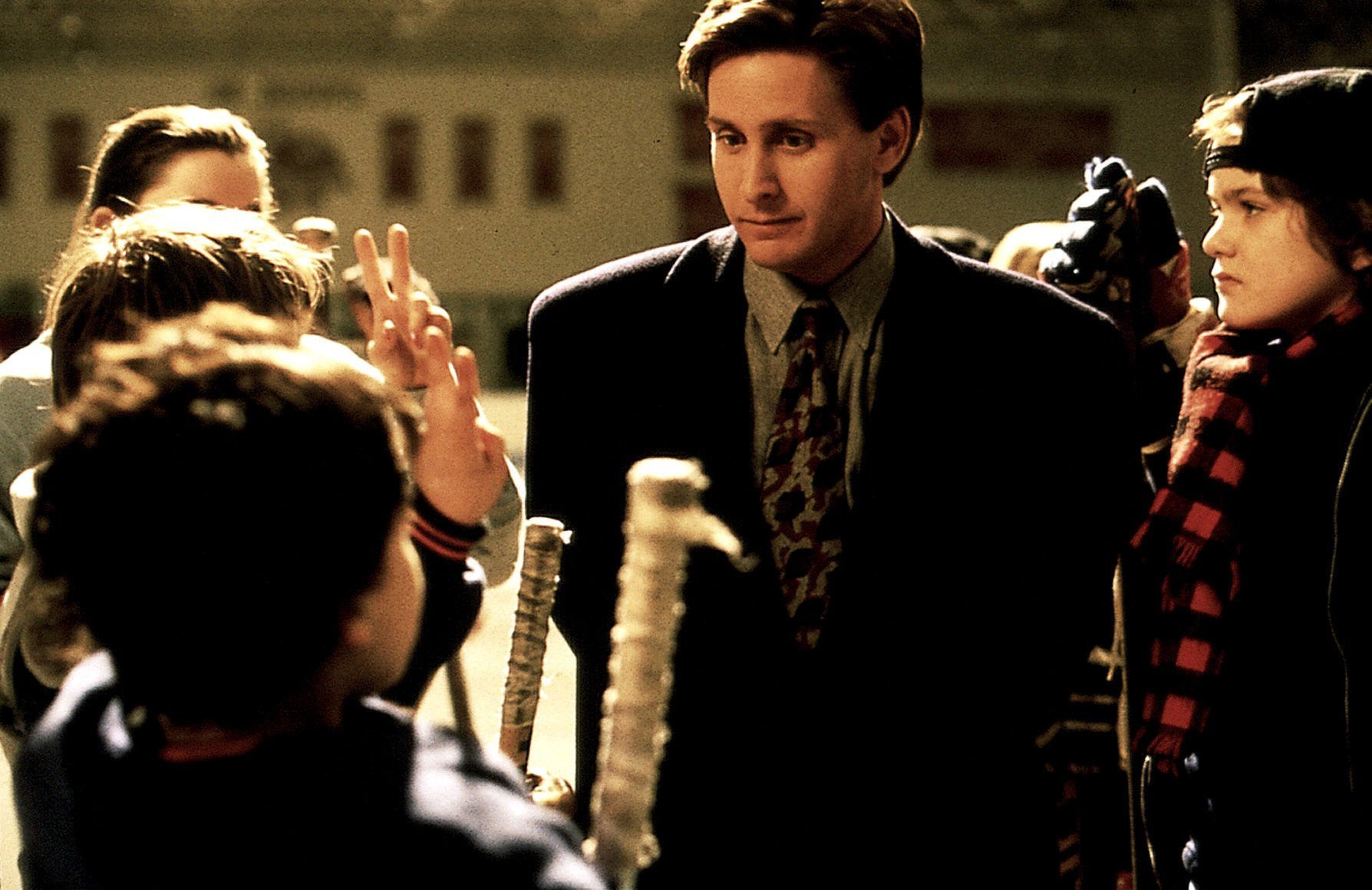
In light of these virtues, what could better representative Minnesota than a sports film about Minnesota's most beloved sport? "The Mighty Ducks" is not the only film ever made about hockey but it might as well have been if you were growing up in the early 90s. For a kid like me, few things would have made me (a kid who always got assigned right field in Little League) feel more fulfilled than bonding to my peers on a diamond or ice rink as a valuable member of the team. I didn't find my athletic niche until 10th grade but in the interim, the movies of the 90's seemed pretty hell-bent on selling me fantasies I could live vicariously through. There was a a high school outcast who suddenly becomes eligible for the Chicago Cubs on a freak accident ("Rookie of the Year"), a kid who unites his broken home through enlisting heavenly aide to help his beloved Angels ("Angels in the Outfield") a boy who becomes a hero on the Iditarod because he's good to his dog ("Iron Will"), and most beloved of all, that kid from Notre Dame who just wanted to play ("Rudy").

Labatt Blue US Pond Hockey Championships
In "The Mighty Ducks," Emilio Estevez's Gordon Bombay, is a disgraced ex-hockey player ordered by the court (see the civic pride tie-in) to coach a youth hockey team. This is a state in which nearly every Minneapolis suburb (that I saw) has its own community center with a hockey rink so it's more than fair to say that many a Minnesotan defined themselves as a budding hockey star before moving onto adulthood.

A lawyer on the go with only a tinge of Minnesotan drawl in his speech, Bombay seems like the archetypal Twin Cities urbanite but he's contrasted with his mentor Hans (Joss Andros) who is an ambiguous Upper Midwestern version of Yoda or Mr. Miyagi if green alien or stereotypical Japanese was replaced with stereotypical Scandinavian.

It's also worth noting that in the land of 10,000 lakes, ice skating isn't just done in the ice skating rinks but on frozen lakes as well. Minneapolis has hosted the U.S. Pond Hockey Championships annually since 2007. It's an ubiquitous part of state culture and Bombay first meets his time as they're playing on a pond. It also must have made many a Minnesotan must have swooned when the film's primary romantic spark occurs as as Bombay is stroking his love interest's hair as the St. Paul's ice carnival is featured in the background.

Saturday, May 16, 2015

Favorite Songs for their Lyrics Part VI

This is another edition of "Favorite Songs for their Lyrics" where I pick a number of songs whose lyrics resonate with me and whittle away at them to my heart's content.  I focus only on the song's lyrics because I feel like quantitatively judging music along some scale of good to bad is mostly pointless. Music just hits us certain ways. Also, worth noting: My musical tastes are embarrassingly mainstream and I've never been particularly adventurous at seeking out things other than what's on the radio, but isn't that more fun for everyone since you'll know the songs I'm writing about?

Bottle it Up, Sara Bairelles - I once heard Bairelles say on Chelsea Handler's show that she's in a healthy and stable relationship so she just channels her sister's problems for her love songs.  Perhaps that's why her two most famous tracks from her first album seem like love songs on the surface but are really expressions of frustration about the pervasiveness of the love song genre. Both this and "Love Song" are extremely direct manifestations of her feelings. "I know it's just your soul but could you bottle it up" could be a direct plea to Sara's sister to use her as a muse because "girls across the nation will eat this up." Yet as the song moves along and the word "love" is repeated over and over and pigeonholed into various sentences,  there seems to be a sense of the singer getting lost in the emotion herself. Even the ability to view "love" with ironic detachment doesn't prevent one from being overtaken with the emotion.

Ain't it Fun, Paramore - The song's first line shows the narrator stating with a hint of casual apathy: "I don't mind letting you down easy" which could mean she's personally rejecting the subject or that she has no problem softening the news that the adult world is going to be tough on the subject.  Or maybe being romantically rejected by the narrator is the subject's "welcome to adulthood" moment? The next line turns contradictory as she advises the subject to "give it time" so that he or she can truly experience the pain ("If it don't hurt now, just wait a while"). But then you realize that the pain of being taken down a notch is part of the process of growing up. Ain't that fun?

Annie Waits, Ben Folds-Folds is one of the few consistently interesting lyricists because he uses the medium to tell stories and he realizes that the best stories aren't necessarily about himself. On its surface,  "Annie Waits" is another of Ben's folksy yarns and the catchy piano riff is misleading as well. A girl named Annie is being stood up by a friend but this slightly unfortunate afternoon is indicative of a larger pattern of disappointment and loneliness. The song juxtaposes the ticking of Annie's biological clock ("She's getting old") with the fact that it's getting late on this particular afternoon. The tragic undertones are evident in everything from Annie's worst-case-scenario daydreams ("Friday bingo, pigeons in the park") to the way the headlights cast shadows that "pass her by and out of sight." A second layer of the song is that whether she's really lonely or not is based on the point of view of the narrator who happens to want her and therefore thinks that it is the end of the world for Annie that she's being stood up. The twist is that maybe the narrator's the lonely one.

Blank Space, Taylor Swift-If you've been living in a nuclear facility underneath a cave on the moon for the past five years, let me catch you up: Taylor Swift is an extremely popular singer-songwriter who’s known for writing her own songs, being a serial dater, and using her break-ups with famous people as fuel for her songs. Although most singer-songwriters in the 18-25 range write about break-ups a lot (in addition to those under 18 and over 25), Swift gets a disproportional amount of flak for wearing her feelings on her sleeve but that’s because she’s extremely direct in her songs. At times, her directness can be almost sophomoric as with “Shake it Off” where she basically says nanny-nanny-boo-boo to her haters and makes a song out of it.


Taylor Swift tries to split the difference in a far more fascinating way with “Blank Space” in which she realistically explores what a relationship with “Taylor Swift: tabloid fixture” would be like. Like “Shake it Off,” Swift insists on being foolish with her romantic decisions using the “we’re young and we’re wreckless” defense. To review: She wants to immediately show the object of her affection “incredible things” right after being introduced to him, she treats love as a game, and she is already referring to her as “his next mistake.” Did we mention she also gets drunk on jealousy? The song’s most interesting line is “I can make the bad guys good for a while” which strikes me as a reversal. I know Taylor’s commenting on her wrong decision, but isn’t getting someone involved in wreckless behavior (AKA romance) turning someone bad?


Adia, Sarah McLachlan- Sarah McLachlan sings to a friend who she let down in what seems to be a major way.  As I listened to it a couple more times,  it became unclear who committed the transgression as evidenced by the hints of uncertainty (Clues here are "Adia, I do believe I've failed you" and the last line of the chorus "Does it matter?"). So instead of singing out an apology,  Sarah pleads with Adia to not lose her innocence. It's possible that innocence could be used in a "not guilty" way but a "not bitter" interpretation is more likely here.

This is interesting if Sarah was the transgressor that she would plead for her victim to not feel pain but that also makes a lot of sense for admittedly selfish reasons.  If you hit someone with a car,  wouldn't you be relieved to know for the sake of your conscience that the other person was OK?  Another possible interpretation is that the narrator let her down by simply not preventing Adia from harm or simply letting her grow older to the point where she'd have to face the dangers of adulthood (hence the reminder that "we are young").

Broadway is Dark Tonight, Goo Goo Dolls- It's a bit of a downer as a song but the song paints such a rich scene. The setting here is an "old man's bar" where a young man is drinking something off his mind.  In the second verse the narrator addresses the subject in second person and says (possibly in the form of a command or a condensed form  of description) "forget your only son" so that might have something to do with it. And then there's the rich description like "You pray to statutes when you sober up for fun" whatever that means. Perhaps, the young man drinking at the old man's bar laments a generational shift as noted by the fact that "The cowboy killed the rockstar." Johnny Rzeznik likely grew up idolizing the quintessential image of a rockstar because that's what he became (also because he looks like someone who could have scored an invite to stand in with the Rolling Stones or Aerosmith), so you can imagine what the murder of the rockstar at the hands of the cowboy means to him. The song has a strong sense of place that I knew it wasn't based on the Broadway district of New York before looking it up to confirm that.
  
Your Armor, Charlotte Martin-Whether you find love or don’t as you get older, we all tend to get jaded towards love songs. Heck, even Adam Levine proclaimed “One more stupid love song and I’ll be sick” even though approximately 100% of his songs are about relationships. But a song like “Your Armor” is wistful and enchanted enough to do the trick. The narrator is fascinated with a special someone who, at first glance, seems to be timid and shy as described by the word “Armor.” She asks him in the chorus “Is your armor thin again? Do I want to wear it down?” By painting him in this way, she admits that his reserved nature is intriguing. I always have been attracted to the reserved librarian type, but I realized listening to this song that being attracted to what you don’t know about a person is pretty universal.
Martin then asks two more questions that rephrase the previous line but these questions are a little bolder: “Am I worthy to come in?” expresses self-doubt and “Do you want to be found?” cuts deeper than asking about the subject’s personality. She wants him to make a voluntary decision to shed it.  Again, this is pretty bold for a narrator who admits that these are “words that she could never say.” She and her subject both run around pretending the sun is all they need and that “chasing you around the room is tempting.” Lastly, the song makes use of a great time metaphor for the passage of time, which is always something I love: “Making deals with minutes that will slip away.”
Learn to Fly, The Foo Fighters-You can’t go wrong introducing the devil and angels in the first verse and playing off each other: “Run and tell all of the angels, this could take all night. Think I need a devil to help me get things right.“ The narrator oscillating between using both the devil and all of the angels for guidance is indicative of this sense of panic he’s feeling that’s prevalent through much of the song.  In the next verse, he wants a new revolution to be cooked up and it’s almost as if he’s having a manic episode or some party drug is starting to kick into his blood stream. The other interesting thing about this song is that the narrator seems clear-headed in terms of knowing what he needs to get him out of this sticky situation (i.e. to fly, all of the angels, for the subject to fly along with him) but he’s also “looking for a complication” before admitting “I’m looking cause I’m tired of trying.” Is the “complication” a sort of hail mary pass because he knows he’s failing? The theme of an airplane here is key here because then the concept of a nose dive  fits the premise perfectly.
Thrift Shop, McElmore and Lewis-There’s not much to say here because the songwriter’s satirical spin on the rap song is pretty clear to anyone who listens to this song and that’s a pretty beautiful thing in and of itself. There’s nothing wrong with obvious symbolism. There’s also nothing wrong with being hilarious: “I’m gonna take your grandpa’s style, I’m gonna take your grandpa’s style. No for real, can I have your grandpa’s hand-me-downs?”
Team, Lorde-This is one of those songs where I’m going to have to wrack my brain on each line because Lorde isn’t making it easier on me. If “Royals” is any indication, Lorde’s main shtick seems to be “I’m an outsider, I’m not decked in bling, take me seriously anyway.”  Of course, one has to ask why she feels so insecure about her lack of bling. I don’t ask myself “Is the artist visibly rich enough” when shopping for albums, but maybe preteen girls do?
Perhaps, Lorde feels like an outsider because she’s from New Zealand and, if “Flight of the Conchords” is any indication, Kiwis seem to have that chip on their shoulder.  What’s interesting is Lorde uses “Cities you’ll never see on screen” as the metaphor of choice for her outsider status. New Zealand has three sizeable urban areas but the first thing people think of when they picture New Zealand are pastoral countrysides filled with sheep. Maybe Lorde is working in conjunction with the New Zealand Chamber of Tourism to highlight New Zealand’s great cities (she was born and raised in an urban area), but it’s more likely that she’s reflecting back against the images of the U.S. she’s inundated with (most foreigners are now subjected to more American TV and movies than art produced in their own country). It’s worth noting that Lorde’s portrayal of what she does see on screen is negative. There are “a hundred jewels between teeth” and “between throats” which reflects a sort of excess. In contrast, her boys have “skin like craters of the moon”  but they love that moon like brothers.
Clarity, Zedd-Who is Zedd (other than the evil lord from the Power Rangers) and will we ever hear from her again? I hope so because she certainly has some pretty enlightened views on love and heart break. She sees the subject as "the piece of me I wish I didn't need" which is a pretty smart way to view someone you can't get over: At a certain point, they stop becoming a person and turn into your image of that person. To cement this idea that Zedd is getting over someone, she uses the metaphor of "Frozen Waves" as keeping her in a state of heartbreak, and considers the subject the past (that, for better or worse, is coming back to life). The narrator is woefully lost in these feelings and portrays them well: "It walks deep through our ground and makes us forget all common sense." The real reason that Zedd can't forget the person in question is indicated in the chorus because he brings her moments of clarity. [Editorial update: I have since discovered Zedd is a guy and the singer of the song is female]
Clarity, John Mayer-Since, we're sticking to songs with the name "Clarity." I agree that John Mayer is obnoxious these days, but in his first two albums, he really had a lot to say. I know it sounds corny but in my formative years, “No Such Thing” was my guide for how to approach adulthood, “Bigger than my Body” was an anthem for how to outlive expectations, and “Why Georgia” captured my desire to move during my quarter-life crisis. “Clarity” captures John Mayer in a brief moment of happiness. The narrator is kind of OCD (no surprise there) but he wakes up one morning with a "calm he can't explain." He was surprised that "it somehow lingered on." The interesting line here (placed appropriately in the chorus) is that he resolved to "Wait to find if this will last forever." Um...how do you wait to find if something lasts forever? Will he send a report back to the subject on his deathbed. The pessimistic way to read this is that the narrator is still OCD and can't be comfortable with this new feeling. The more optimistic view is that if you are OCD, waiting to see how long a good feeling lasts is the best one can hope for.


Be sure to click on the tab that says lyrics for past editions of this series.
Other songs I've done include: Green and Gray, Nickel Creek; Collide, Howie Day; Hard Candy, Rain King,  She Don’t Want Nobody Near, Counting Crows; 3 X 5, No Such Thing, Bigger than my Body, Why Georgia, John Mayer; For the First Time, Script; Fairytales, Sara Bareilles; End of the Innocence, Don Henley; Hey Soul Sister, Train; Over my Head, You Found Me, Fray; Let’s See How Far We’ve Come, Mad Season, Downfall, All I Need, Black and White People; Matchbox 20; Jack and Dianne, John Cougar Mellencamp; Here is Gone, Better Days, Goo Goo Dolls; Breathe, Anna Nalick; First Cut is the Deepest, Cat Stephens; Grace is Gone, Gray Street, #41, Dancing Nancies, DMB; Time, Hootie and the Blowfish; Gone, Landed, Ben Folds; Stars, Switchfoot; Your Winter, Sister Hazel; South of Nowhere, Gin Blossoms; On Love in Sadness, Jason Mraz; In Too Deep, Sum 41; I’m With You, Avril Lavigne; Barrytown, Steely Dan; Game of Love, Michelle Branch; Testing 123, Barenaked Ladies; Wake Me Up When September Ends, Greenday