Showing posts with label Box Office. Show all posts

Wednesday, December 29, 2021

2021 was a Year of Great Auteurs and Terrible Box Office Results

To those who don’t follow the box office, it might seem like the pandemic has dealt a blow to movie theaters but the numbers have shown for quite a while that films have been in jeopardy for a few years now.


The blockbuster business model of films has geared towards blockbusters and that disincentivised films from prioritizing quality. For one, the emphasis is generally on making money opening weekend. A film might make half its money opening weekend (generally enough to break even) before audiences realize it’s not that good. It’s a curiosity that film critics even devote their time to big releases when audiences will realize a film’s a dud before it’s too late.

I often cite 2002 as the year things changed because the original Spider-Man became the first film to gross $100 million in a single weekend. Believe me, it wasn’t just me looking at a newspaper and realizing “eureka! We’re in a new era.” A lot of press was written about this milestone (which Google News hasn’t been that generous in preserving). Ironically, some of the films that topped the top ten that weekend were Changing Lanes (a thriller starring Samuel L Jackson and Ben Affleck), The Scorpion King (a Dwayne Johnson film) and The Rookie (a sentimental sports movie).

Tragically, very few films would survive in today’s market. A sports film (particularly the Kevin Costner kind) but it’s chances are slimmer, especially in today’s market.

Dwayne Johnson still makes films but they’re board game and Disney ride adaptations in the case of Jumanji and Jungle Cruise. Which brings me to the point that even tired and tested brands and genres like those mentioned above might not get financed if they’re price tag is too expensive. The only thing that sells today is what’s known as Intellectual Properties or IPs which translates to films made from a past property whether a sequel/prequel/reboot/remake of an existing film or an adaptation of a highly popular comic/TV show/broadway show/book (i.e. Harry Potter, Twilight, Hunger Games, 50 Shades of Gray). In fact, in the year 2016, only 2 films out of the top 20—La La Land and Hidden Figures—were original films.

One way around this is to hire visionaries to get an intellectual property and make it their own like Christopher Nolan, Sam Mendes, and Taiki Wahiti have done. Paul Schrader, the screenwriter of the classic film Taxi Driver, wrote and directed the brilliant film First Reformed with Ethan Hawke to the tune of $3.4 million. Director Todd Philips had much better luck when he used Taxi Driver as a heavy influence on his (marginally) comic book based film The Joker for a film that grossed roughly 100 times that amount.

This phenomenon is known as the death of the mid-range film which many people have written about:
Is the Mid-Budget Movie an Endangered Species?

This all came to a head when mega-influential director Martin Scorsese penned an essay attacking the multi-headed beast of Marvel for ruining movies.

Which Brings Us to 2021

I keep track of a list of directors I've seen 4 or more films of. Last year, of the around 45 films I saw only 2 directors that met that benchmark (Ron Howard-Hillbilly Elegy and Chris Nolan-Tenet) and very few other notable names who I just hadn't seen enough of like Lee Daniels (Billie Holiday), Charlie Kaufman (I'm Thinking of Ending Things) and Paul Greengrass (News of the World)...most films I saw were by directors who were making a film I'd seen for the first time. I think (though I could be wrong) that studio money going to trusted film makers is going down and you just have to watch a lot of indie stuff on streaming to not get typical franchise stuff. However, this year that number ballooned to 8 out of only 34 films I've seen so far*. Additionally, there are so many artistically-renowned directors that I haven't yet seen or might not see--Mike Mills, Paul Thomas Anderson, Joel (without Ethan) Coen, Chloe Zhao, Pablo Sorrentino, Pablo Lorrain, Guillermo del Toro, Peter Jackson, Sean Baker—that it's a remarkably rich slate. A few years ago with David Fincher and Steven Soderbergh moving to TV and aging masters like Mike Nichols, Francis Ford Coppola, and Jonathan Demme struggled mightily with the studio system.

Now whether they're streaming or in a theater, I'm not sure if we can declare movies dead just yet if visionary filmmakers are being able to get their visions met. This has been a great year for movies.

Most industry insiders treat Steven Spielberg’s 1975 film Jaws (followed by his friend George Lucas’s 1977 film Star Wars) is ground zero of blockbuster culture.

Spielberg’s near-impossible feat of remaking a classic--West Side Story—and turning it into an entirely new classic puts him in the category of auteurs behind this year’s wave of greatness.

However, like great auteurs in this day and age he also has no place in the new sad era of the blockbuster. Instead, it’s once again Spider-Man which grabbed those headlines with another record-breaking gross even in the age of the pandemic.


Tuesday, August 24, 2021

Big News: I Found Four Non-Superhero Films on the Big Screen (Cruella, Jungle Cruise, Free Guy, Space Jam 2)

It’s pretty apparent to most of us, that the pandemic changed the movie-going experience with tent poles (surefire blockbusters that carry a studio’s financial risks) having to navigate to premium streaming in an effort to recoup their costs.

As a result, there’s even less money to be made at the box office now unless the film appeals to a broad audience. In other words, a film has to either have action/explosions, appeal to kids, based on a familiar source (known as intellectual property), or some combination of the three. This has been going on for some time as even epics shot for the big screen by Martin Scorsese, Fernando Meirelles and Alfonso Cuaron were relegated to Netflix.

Mid-range films (comedies, courtroom dramas, espionage thrillers, romantic dramas, etc) have even less chance of playing at a movie theater and a larger share than ever before is being dominated by the superhero film which I’m extremely bored of. In light of this, I’m pleased to have made my way to four films so far in 2021 that are not superhero films: Cruella, Free Guy, Jungle Cruise, and Space Jam 2.

Yes, they were clinging to their IP sources as if they were broadcasting to audiences “don’t worry, we’re not going for too much independent thought here. This is still cozy familiarity.” At this point in the degradation of movie going, I’m prepared to accept that Faustian bargain that film makers must strike with their studios and broader audiences so that a decent movie going experience can exist at all.

Furthermore, I think that all these films offer more originals stories than anything that can exist within the confines of a superhero film. Since Robert Downey Jr. bought a snarky take to Iron Man and the more absurd heroes like Ant Man and Aqua Man got their own films, the genre has tried to give enough winks at the audience to create a sub-genre of “superhero film that doesn’t take itself too seriously.”

However, the straight-up parody already exists (Sky High, Mystery Men, the Incredibles) that when I recently saw the superhero parody “Thunder Force” earlier this year, I felt I had seen these comic angles so often—whether in explicit parodies or goofier superhero films –that there was just nothing new to say.


Cruella takes a Disney villain and attempts a sympathetic backstory. In the canonical timeline, she’s crossed what’s known as a moral event horizon by slaughtering dogs and making a coat out of them. The film’s attitude about this seems to be, “um, let’s push that to the back of your mind” focusing more on the mannerisms of Cruella as played by Emma Stone who relishes being handed the villain card. It also helps that Cruella is society’s punching bag before ascending to the top.

The film essentially reveals itself to be a heist film in a game of one-upmanship between two strong-willed players (Stone and Emma Thompson) with Joel Frye and Paul Cole Hauser as stereotypically cockney henchmen. It’s sleek and stylish with some pathos, and for a popcorn film, that’s not bad.

The film’s big problem is not knowing when to end. There were at least 3 or 4 times when I got up as if to leave the theater only to realize the end credits weren’t rolling.

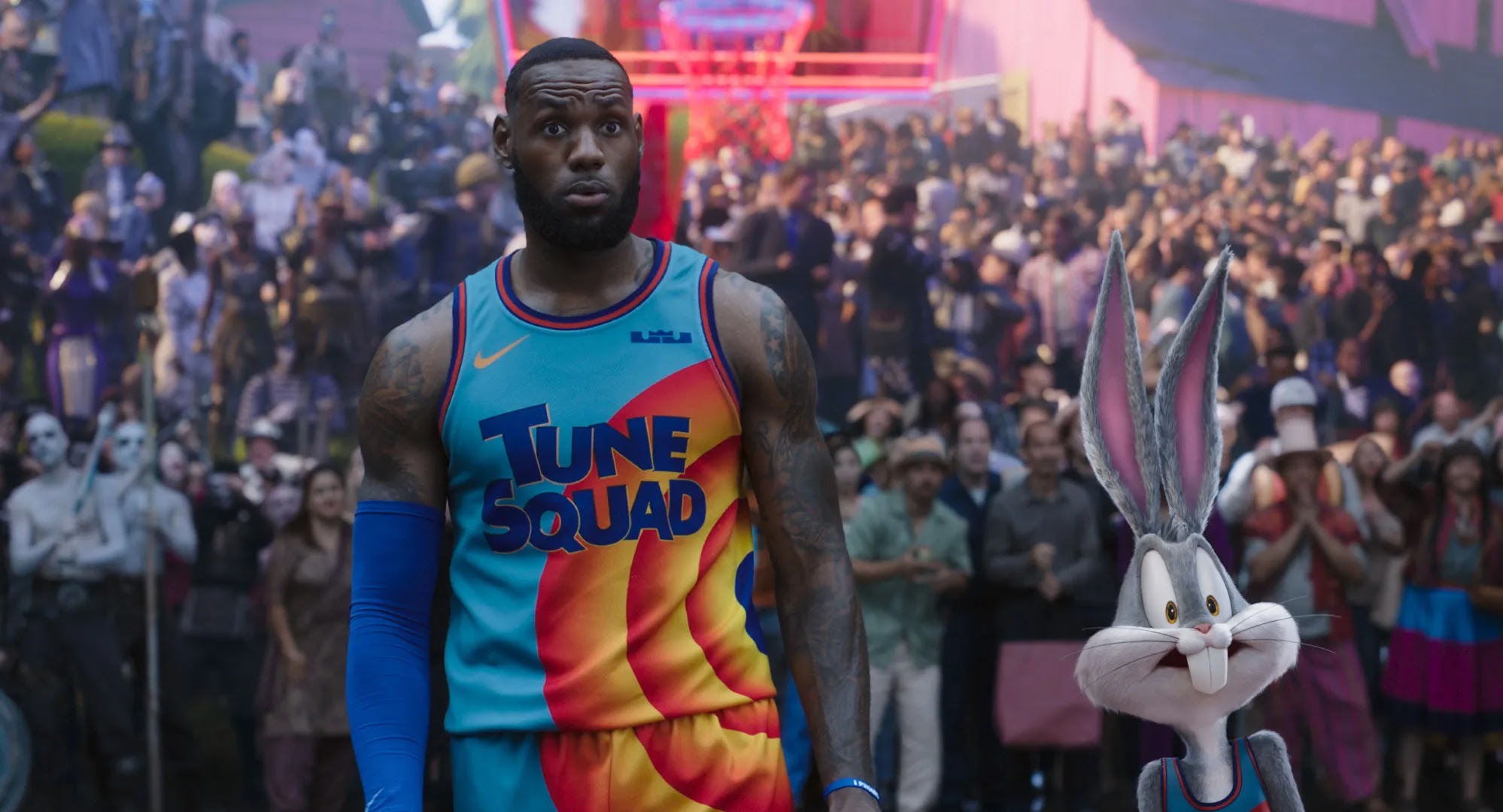
Some might call Space Jam 2 an obligatory sequel, but I like to think that the film’s strength isn’t that it wasn’t so inevitable. The film needed the right star and modern take on the material to justify its existence and those ingredients are essentially met here. Additionally, I’m a sucker for the Looney Tunes and it’s been 18 years since their last film. If Harry Potter or Lord of the Rings characters had to wait that long, there’d be riots.

Rather than a random hole in the ground that leads to a basketball in the center of the Earth, the film (in a not-so-subtle meta-commentary on IPs) takes place across the confines of a server-verse. A handful of scenes intermingles the Looney Tunes characters with Superman and Harry Potter among others, and while they are inevitable, they’re pretty fun.

While some might disagree, Don Cheadle makes a good kid’s villain: The personification of a psychotic algorithm. His motive is simple to understand but encoded (forgive the pun) with an extra layer of depth (he wants attention, isn’t that how algorithms work?).

Granted, LeBron James was a little weaker of an actor than expected, but it is a relatively smart script that gives its actors some latitude.


Jungle Cruise has been criticized as extremely derivative of the Pirates franchise and that’s true, but again, we have to come from the angle of “hey, at least it’s not a superhero film and it’s wide release in a movie theater.”

The film has a lot going for it: Luscious scenery porn from the Amazon basin that doesn’t overuse CGI, the rarely disappointing Emily Blunt, well-choreographed set pieces, a brisk pace, and a fairly deep love story that works. To the latter point, others have commented on the lack of chemistry between Dwayne Johnson and his leading ladies. On paper, however, the character movements between the two protagonists are set up well enough to where their choices eventually reach into “aww, I need a kleenex” territory.


Free Guy is set in the universe of gaming which some might consider low-brow. If the frames weren’t so cluttered with graphics, I surmise it might favorably compared with good sci-fi or even fiction deconstruction classics like The Truman Show and Pleasantville.

While that might be high praise, the story--an NPC in a Grand Theft Auto style video game who gets triggered by the programmer’s love interest into sentience and is called upon to save his fellow secretly sentient NPCs from extinction—is ambitious and, more importantly, air tight in its world-building. If people get into the experience, this could be one of the most discussion-worthy films of the year.

Jodie Comer does impressive double-duty as a frumpy computer developer and a stealthy action heroine and it’s all the more impressive that the film juggles two love stories with her character that both work.

On the commercialization side, I was pleased that the film worked as an air-tight story that doesn’t necessitate a sequel. Whether they milk one out of it is a different story.


Wednesday, April 29, 2015

Discussing TV vs. Movies with Adam Spector Part III

This is Part III of a series where my friend Adam  Spector and I debate the merits of movies verses television. Adam keeps a column on film here and leads a film discussion group in DC every month and has a highly impressive knowledge of films. Our discussion began here with my confession that I watch way more TV than films these days because TV has so many built-in advantages. In Part II, we discussed how TV had threatened films before but movies responded with innovation and considered the possibility that movies might not have as much in their bag of tricks.
 
Orrin -- Well, we've certainly had strong powers of persuasion over one another. Your first response made me reconsider strongly whether it was foolish to proclaim films in decline, and now you've changed your tune (I suppose Mark Harris' article also had something to do with it).

First off, I wouldn't entirely say that I'm averse to franchise films. I enjoyed Star Trek into Darkness and X-Men Days of Future Past as well as Iron Man 2 and, hey, I even spent $12.50 watching Horrible Bosses II last week. What all those films have in common is that I saw Part I. It wouldn't make sense to watch Captain America II or Kick Ass II or Wrath of the Titans when I didn't see Part I of those films and there are only so many Part Is I'm willing to see in a given year. In other words, the sequels and movies meant to launch sequels are overloading me at this point. Similarly, something like Guardians of the Galaxy which seems intended solely to have sequels is also a turn-off. My feeling of alienation when I check out what's playing at the movie theater and  see mostly Part IIs and Part IIIs to films I didn't see in the first place. 

I theorize that as long as there's a best picture race (and I wonder if expanding it from 5 to up to 10 pictures was Hollywood's saving grace) studios will care enough to try and get their products into those 5-10 slots. This year there are not just going to be 9-10 pictures but it seems like there's another 7 or 8 knocking on the door of a best picture nomination: Foxcatcher, Boyhood, Birdman, Gone Girl, Whiplash, Grand Budapest Hotel, Theory of Everything, Imitation Game, Unbroken, and Selma might be the ten if it gets filled out to maximum capacity with American Sniper, Wild, Mr Turner, A Most Violent Year, Inherent Vice, and Nightcrawler all having the potential to play spoiler. All of those films were clearly made with the intent of getting some awards attention and the result allowed art verse commerce to win. That's not even counting ambitious films that came out to mixed reviews like Homesman or Interstellar and films that could result in acting nominations like Still Alice, St Vincent, Snowpiercer, The Judge or Big Eyes.

In all, I just listed 25 films all somehow tied to the Oscar race in some way or another and I'm likely forgetting a few. I think the larger question is how these people are getting films made. It might be that the end of Hollywood as we know it hasn't arrived just yet, but we could be getting to the cusp. I could see someone like Tim Burton staying in the film game as some of his films like "Charlie and the Chocolate Factory" and "Alice in Wonderland" have shown he can make money. Obviously Christopher Nolan isn't going anywhere. But what about Alejandro Inarritu, the promising J.C. Chandor (who directed Margin Call and All is Lost)  or Jean-Marc Vallee?

There's likely always good films out there that are falling below the radar as well of the independent variety. I used to hang out in a movie group (circa 2008-2009) that would see films I never even knew existed before I went to see them like Brideshead Revisited, Bottleshock, Towelhead, Gonzo, The Brothers Bloom, and "In the Loop" (this one ended up getting a lot of awards attention later on). Similar examples of recent films in that below the radar category might be "Bernie" "Safety Not Guaranteed" "Robot and Frank" or "No." It's hard to say whether these films were better or worse than (surely a few are) but they generally aren't part of the national conversation on movies and are generally not accessible. In some cases, it's a little less fun to view films that aren't in the national conversation. I couldn't really check my opinion on "Brideshead Revisited" against friends or people on IMDB because so few people had seen or heard of that film. If the film is good, one hopes for several reasons that it's part of the national conversation. There's also a question of whether those below-the-radar films are under threat.

But the bottom line is what would have to happen to affect change? The article suggests that this is simply the result of executives who are no longer interested in art. If I'm not mistaken, the Weinstein Brothers at Miramax were champions of ambition and funded many Oscar-calliber films and passion projects. Would it simply take a couple more executives like the Weinsteins to turn things around?

Adam – I’d like to think that I have not “changed my tune.”  There are very troubling signs about the future of movies but that doesn’t mean I’m ready to give up or that we can start giving cinema its last rites. 

That said, the numbers are not good.  Box office for 2014 dropped five percent from 2013 and the total number of tickets sold is the lowest since 1993 (http://grantland.com/hollywood-prospectus/the-box-office-winners-losers-of-2014/).   The major theater chains’ panicky retreat with The Interview opened the door wider for simultaneous theater and VOD releases, which the those same theater chains have fought bitterly.    

If Hollywood studios are scared, and they probably should be, then they are even more likely to play conservative and rely heavily on franchise films.  For every one person like yourself, who may not see a Part II because he hasn’t seen Part I, the studios are betting on many more people who have seen Part I feeling compelled to see Parts II, III and IV.

As I noted, I have no problem with franchise films, provided they are made intelligently.  Luckily many of them have been lately.  But one problem with having so many of them is that you lose the element of surprise.  Even if they are made well, to some degree you know what you are going to get.  Of course this predictability is what studios are banking on. 

For me though, one of cinema’s joys is discovery.  A few years ago I got off work early and had time to kill.  I walked to the Landmark E Street Theater and picked a film called Timecrimes purely on the basis of it starting soon and having not seen it before.   I walked into the theater not knowing anything about  Timecrimes  other than that it was a Spanish thriller.  I walked out exhilarated.   Timecrimes brilliantly deconstructed the idea of time travel by playing the same story through different angles.  It trusted the audience to follow the complex story and filling in the details as they are slowly revealed.  Films such as Timecrimes, or Boyhood more recently, give us that unique opportunity to see something on film that we have not seen before. 

With the franchise films, it’s not surprise or discovery but anticipation.  The studios want your overwhelming feeling upon leaving the theater to be not so much “What a great film!” but rather ‘I can’t wait until the next one!”  For us that feeling can be a little deflating.  First, the endless hype before a film can build up expectation so much that disappointment is almost inevitable.  Second, it can be more challenging to get into a film if you know it’s only getting you from point B to point C in a five part storyline. 

You made a good point about the Oscar race.  For as much as we may criticize the Oscars, the prestige of winning them may be the one remaining factor that gets more adult-oriented non-franchise films made.  I don’t believe that the filmmakers themselves set out to win an Oscar.  But the studios decision to make or even distribute these kinds of films could largely be awards driven.    

It may take more people like the Weinsteins to stem the tide we are in.  Thankfully the Weinsteins are still active and are distributing films such as The Imitation Game.  Some of the others helping are not distributors, but people with wealth and clout who have their own production companies.    Oprah Winfrey’s Harpo Pictures helped finance Precious, The Butler, and most recently Selma.  Brad Pitt’s Plan B also supported Selma and last year supported 12 Years a Slave.  Megan Ellison’s Annapurna Pictures financed Zero Dark Thirty, The Master, Her, American Hustle and Foxcatcher.

It's people like Winfrey, Pitt and Ellison who still give me hope.  It’s also the fact that in the past year, I saw original and daring films from Wes Anderson, Richard Linklater, Alejandro González Iñárritu, David Fincher, Steve James, and Michael Winterbottom.  This week I am going to see films by Clint Eastwood, Paul Thomas Anderson and Mike Leigh.  Angelina Jolie has proven that she’s a talented director.  So have emerging new voices Ava DuVernay, Damien Chazelle and Morten Tyldum.  

Closer to home, the Arclight just opened in Bethesda as has Ipic.  Between those, the Landmark theaters, the Angelika, and the AFI Silver, we in the DC area have plenty of choices that offer more than the traditional multiplex.  We have access to film festivals, independent cinema and documentaries here.   How much can I really complain?

We and others with similar access must take advantage of our opportunities.   We must also do our part to shape the conversation.  The franchise films will always have a disproportionately large share of the spotlight.  But those of us that love all kinds of films should use the Internet, social media, and even old-fashioned conversation to let people know about the smaller films, the ones that take chances.  I’m trying to do that in my own small way with the Cinema Lounge and my Adam’s Rib column.  You’ve been doing that in your many venues and through your blogs such as this one.  It’s been a privilege to be a part of your world.  Thank you, and I hope we can do it again.       


Wednesday, April 01, 2015

Me and Adam Spector Discuss TV vs Movies Part II

My friend Adam Spector keeps a column on film here and leads a film discussion group in DC every month. I've attended the group but I recently confessed to Adam that I like television a lot more these days which sparked the idea that we should settle the argument once and for all on my blog. This is part two of our no-holds-barred (True fact: I've never typed those words before on a screen, they look much funnier in this format) battle of wits between two intellectual giants with a lot of free time on their hands.

Part I was here and before presenting Part II, I will post the last few lines of Adam's post:
"But there’s still nothing like sitting in a movie theater, having the light go down, and being totally immersed in a film.  No cell phones and no distractions.  Just you and the movie. 

Orrin, you and I have both noted the talent that has worked in TV.  But many of them, including Scorsese, Fincher, McConaughey and Spacey also work in film.  They haven’t focused on one at the expense of the other, and neither should we. "

Round II
Orrin-- That's true that TV in the 1950's was a significant threat to the movies as box office receipts dropped. It's also a fitting parallel that just like JJ Abrams and Joss Wheedon ascending to the elite as movie directors rather quickly, so did John Frankenheimer, Delbert Mann and Sidney Lumet after cutting their teeth in television.

But I think there's a key difference. TV didn't threaten the movies by being a superior art form. They threatened movies simply by existing and being novel. TV was actually behind the times in terms of quality. While films were getting risque with "The Seven Year Itch" and "Pillow Talk" (and well over a decade after "Gilda" "The Big Sleep" and "Double Indemnity"), TV's most progressive show at the time, "I Love Lucy" shied away from even suggesting that a husband and wife could sleep in the same bed. In the interim "Leave it to Beaver" and "Andy Griffith Show" (which debuted in 1960) reinforced conservative American family values while Douglas Sirk was tearing the image of the American family apart in films like "Imitation of Life" and "Written on the Wind." And that's not to mention other 50's films like "Splendor in the Grass," "Searchers," "Three Faces of Eve," "Salt of the Earth," "Defiant Ones," and "Night of the Hunter" that deal with murder, racism, mental illness, the red scare and economic depression. As the code was being broken in the movies, it was being reinforced on TV.

Movies evolved by innovating. They tried some nutty ideas like smell-a-scope and 3-D but more to the point, cinema also evolved through delivering what TV couldn't: Epics. "Ben-Hur", "Ten Commandments" and "Lawrence of Arabia" were all highly successful films that came about in the decade after TV started to hit homes and couldn't be replicated on the small screen particularly easily. It also seems that talent always had something to do with the equation. I mentioned last time we met that I thought Blake Edwards defined the '60s as a director and was responsible for my favorite films of that decade. If we had one less Blake Edwards, film would have been changed.

While you mention that many talents navigate both film and television, I can't help but feel TV talent might be exerting a toll on film. If you check Kathy Bates' filmography, she's pretty exclusively in TV and Jane Fonda, who hasn't been very prolific as an actress since the '80s, has devoted her time to "The Newsroom" and her upcoming Netflix project. Similarly, another talented actress Maggie Gyllenhaal has nothing on her slate after acting in "The Honourable Woman." Actors have the freedom to navigate both mediums nowadays but they might choose TV over film when making a decision and become known as a TV actor like Ted Danson, Kelsey Grammer or Julia Louis-Dreyfus and that makes TV more glamorous.

You're right that moviedom isn't dead and I'm not suggesting good movies aren't out there. I think a smaller percentage of movies that are released are worth watching as opposed to a decade ago, but I'm not suggesting that movies as a medium are dead. I'm wondering though what's left in filmdom's bag of tricks. What's their 3-D/cinemascope grand plan? (I'm just remembering as I typed that last sentence that 3-D movies are back in style these days). In that sense, television might be a greater threat to movies today because TV is innovating faster than movies in everything from economics (With ITunes and TV on Demand, the pay models are evolving whereas movies are forced to ride demand out with increasing ticket prices and ridiculously priced concessions) to the actual content itself.

Adam – You have caught me at a bad time Orrin.  It’s growing more difficult to defend cinema in the face of articles such as “How the Death of Mid-Budget Cinema Left a Generation of Iconic Filmmakers MIA” (http://flavorwire.com/492985/how-the-death-of-mid-budget-cinema-left-a-generation-of-iconic-filmmakers-mia) and “The Birdcage: How Hollywood’s Toxic (and Worsening) Addiction to Franchises Changed Movies Forever in 2014” (http://grantland.com/features/2014-hollywood-blockbusters-franchises-box-office).  In the latter article, Mark Harris writes that “In 2014, franchises are not a big part of the movie business. They are not the biggest part of the movie business. They are the movie business. Period.”  It’s probably not a coincidence that the late Mike Nichols did not direct a movie for the last seven years of his life.  It’s growing more and more difficult for filmmakers to make non-franchise character driven films unless they are able to do so with a very small budget.  Younger filmmakers just starting out can do this, but for older, more established, filmmakers sometimes it’s just not worth it.  That’s why, as you have noted and the Flavorwire article describes, more of the established filmmakers are turning to TV.    

We differ in that I often enjoy franchise films.  As I noted before, the last Captain America film was a smart thriller and Guardians of the Galaxy was a fun ride.  I can’t wait for the next Bond movie and eagerly gobbled up the trailer for the new Star Wars film.  But it’s frightening to realize that Hollywood’s reliance on these films can crowd out everything else. 

I have recently been studying some of the greatest film years in the '70s.  The first Star Wars film debuted in 1977 as did the Bond film The Spy Who Loved Me, but so did Annie Hall and Looking for Mr. Goodbar.  Two years later brought the start of the Alien and Mad Max franchises, but also Being There, Norma Rae, and The China Syndrome.   Let’s look at the best of the '90s.  In 1997 Titanic, the biggest blockbuster of all, came out along with Men in Black.  But so did L.A. Confidential, Boogie Nights and Eve’s BayouThe Matrix franchise launched in 1999, but it was joined by American Beauty, The Talented Mr. Ripley, and The Insider.  At Hollywood’s best, there was room for all.  Are those days gone?

You described the studios’ response to the TV threat in the 1950s.  It’s eerie how similar the response is today.  Back then, films eagerly embraced 3-D technology.   Today, most blockbusters are done in 3-D.  In the 50s it was Cinemascope, today it’s IMAX.   Plenty of biblical films then, and this year we had Noah and Exodus: Gods and Kings.  The other major response comes from the theaters, which are increasingly offering plush accommodations, a wider variety of concessions, and the ability to pick your seat.  

Innovation flourishes more easily on TV, with its greater array of platforms, than it does on TV.  But, even there, we need to specify matters a bit.  There’s no doubting that cable networks, Netflix and Amazon offer much greater freedom then Hollywood studios.  However, on network TV, sports events dominate the ratings leaders.  Mindless reality shows still abound.  Networks have also tried to go back to their past, with live specials such as “The Sound of Music” and “Peter Pan.”

Of course most TV networks and Hollywood studios are owned by the same huge multinational corporations.  They can spread franchises, such as the Avengers and Star Wars over both TV and movies.   You and I both talk about movies vs. TV, but every day there is less difference between the two mediums. 

With all of that, I try to remain hopeful.  Maybe it’s my lifelong love of cinema, or maybe it’s just naiveté, but I can still find reasons to go to the movies.  While TV takes more chances than most movies do, I already cited the exciting, groundbreaking work of Richard Linklater and the Alejandro González Iñárritu this year.  Another example is Alfonso Cuarón’s Gravity, which used 3-D not as a gimmick, but a method for a new kind of immersive storytelling.   Unfortunately, actresses “of a certain age” have always had problems getting good film roles.  But I’m encouraged that Meryl Streep, Helen Mirren, Julianne Moore, and Susan Sarandon still appear on the silver screen regularly.


In the end though, it’s up to us: The viewers.  Hollywood always follows the money.  If we only go to the big franchise films, studios will have every reason to continue down their current path.  If we want filmmakers to take chances, if we want thought-provoking films made for adults, then we need to support those films with our ticket-buying dollars.  So see Boyhood, Birdman, Selma, Wild and Foxcatcher and do not just wait for those films to come out on DVD or appear on TV.  If we do not support the films we say we want to see, then we can only blame ourselves if those films disappear from our theaters.      

Monday, July 08, 2013

FAQ: Who is the best director today

This is a response to a message board question that asked who the best director was today. It's by no means the best sample of my work but I thought it was interesting enough to post here:

The original question:
"Who is the best director today in commercial terms?

Spielberg and Cameron obviously. Then probably Nolan. It's hard to tell exactly how big he will be without Batman but if Inception is any indicator he is pretty huge. Tarantino has had two big hits in a row. I think he might be top 5."

Who else?"

My response:

Tarantino is by no means Top 5. He had two critical hits, and I might even go so far as to say they created a lot of water cooler buzz and that they both rocked the cultural ether but that doesn't mean he was high in the box office. Django Unchained grossed $161 million which is comparable to a high-performing sports film (Remember the Titans and both versions of The Longest Yard were roughly comparable), an Adam Sandler film (which have consistently been between $110-$170 million dating from the Waterboy) or an animated film that isn't made by Pixar (Kung Fu Panda, Over the Hedge and the Ice Age series are all between $150 and $200 million).


Nonetheless, for someone like Tarantino, whose films don't have wide appeal to the kinds of people who don't frequent this message board, $161 million is pretty impressive.


Films with nuanced dialogue dont do well over seas, but then again the world is a little smaller since then, and I'm convinced that if anyone has a chance of selling their films to a distant market like Southeast Asia or Europe, Tarantino might be able to do it. But, a straight-up action director like Roland Emmerich, Wolfgang Petersen, or Michael Bay doesn't have the disadvantage of being overly steeped in film history and therefore already has a head start.

The top commercial directors isn't something that's as debatable as one might think because numbers don't lie. The ones who draw the biggest are, off the top of my head, Spielberg, Michael Bay, McG, Roland Emmerich, Ron Howard, Gore Verbinski, Jon Favreau, Wolfgang Petersen (although some of his films like Troy and Poseidon did fall short of $200 million which is what I would define as a bonafide hit). Some of the names on this list like Michael Bay and McG aren't particularly well-liked by the masses but they continue to be successful which just indicates that being successful on a commercial spectrum isn't something to brag about.

On the other end of the spectrum, Spielberg is critically acclaimed and successful and is pretty much the Michael Jordan of dominance in the box office. Don't forget that Lincoln grossed $155 million and it's not full of actions or explosions, but rather a thinky piece about whether to ask congress to back the 13th Amendment. It's essentially a 19th Century version of C-Span with the world's greatest method actor that would be


If I'm not mistaken, I think the two people who stand behind him on the all-time list last I checked were Ron Howard and Rob Zemeckis. Zemeckis is a protege of Spielberg and has aimed some films like the Polar Express or Christmas Carroll directly to the children's demographic while two of his most famous films Roger Rabbit and Back to the Future are films that can be enjoyed by children and adults alike which is a great recipe for success. No one is going to say that Howard is one of the greatest auteurs but he balances quality with commercial success very well.

I would agree that Nolan is doing very well for himself. I think the biggest measure of his success is when venturing outside of the Batman franchise because it's relatively easy to make a Batman film gross high. Inception had $292 million which is pretty solid. It's somewhat a marvel that it got that high because it's such a confusing film. I think he's riding the coattails off his batman reputation and when that wears off, I think he'll still be a genius, but not sure if he'll have populist appeal.

I think that if you're going to go with the most prominent and bankable director who's name isn't Spielberg, it might be J.J. Abrams. He made Star Trek a success, Super 8 did pretty well and was well-received and I think Star Trek 2 is gonna gross a lot. He also just took over Star Wars. Similarly, Joss Weedon has followed a similar path and Avengers had a spectacularly high gross but it's hard to say whether that's the film or him. He wasn't able to get eyeballs on his TV shows.

James Cameron is a crap shoot because he goes long breaks without making a film. For all we know, in ten years, the public appetite might have changed completely. If you don't make films frequently, it's hard to keep the public appetite up for your next film.

To some degree, it's the properties and not the directors that make big hits. Verbinski lucked out by getting the reigns to Pirates of the Caribbean which increases his average significantly. On the other hand, Favreau grossed $300 million plus with Iron Man but considering he was able to make money off films as disparate as Elf and Cowboys and Aliens, I have some confidence in him.

Lastly, Ben Stiller (a sometimes director of his own material) also has some good commercial instincts. Series of his such as Night at the Museum and Meet the Fockers are seemingly ordinary but they both had incredibly high grosses.


Friday, July 03, 2009

Megan Fox slams Transformers

I actually have to admit I kind of enjoyed Transformers the first time around. It was partially because the summer of 2007 was such a massive dissapointment from the letdowns of Shrek 3 to Pirates 3 to lucklaster comedies like Lisence to Wed and I Now Pronounce You Chuck and Larry to films that didn't excite me enough to watch in the first place like Simpsons Movie (the show has been going on too long and lost my interest 10 years ago), Rush Hour 3 (Rush Hour 2 was one of the worst experience I've ever had), Ratatouille (A Pixar film has never sounded that horrible).

Granted, Transformers sounded even dumber but somehow I made my way in the theater (I was working in a theater and it was all free) and the star charisma of Shia LeBouf and the Spielbergesque element of the lost son made me pleasantly surprised. Desperate to like something from that awful summer I proclaimed Transformers a decent surprise.

Looking back, Transformers represents so many bad things all at once, it should not be encouraged. It probably made everyone in the cinema a little dumber for having watched it:

The soundtrack was writen by someone with massive ADD, the action scenes were nonsensical (why would humans be needed in a fight between cars/robots?), and worst of all, you had the most stereotpu In the midst of the most stereotypical collection of characters I have ever seen together in one film:
1. The tough-guy marine with a soft spot for his daughter who solves problems by taking civillians like John Turturro and ramming them against a wall
2. The childish black guy who provides comic relief but within the plot actually does something well (knows computers or whatever)
3. The goofy government bureaucrat who is about as viable of a threat as Wile E Coyote is to the road runner
4. The hot girl next door
5. The hot girl's boyfriend who's sole purpose in life is to demonstrate his superiority over the nerds in school

I did really, really like the Australian defense analyst because she didn't fit into any box. She was attractive but because of Megan Fox's role in the movie, you didn't get the sense she was there just to provide eye candy. I also loved LeBouf.

But worst of all, inserting shiny cars into a movie is an overly commercial move designed to attract fan boys. It's practically screaming out at its audience that the film is nothing more than an attempt to round out a McDonald's Happy Meal with a toy.

So anyway, onto the news:
Megan Fox of Transformers fame, who's role is basically eye candy, protests that Transformers is a film that's basically about Special Effects and not about acting. She acknowledges the film made her career, but admits that it is crap. I'm not sure whether to applaud her or not, because if Fox had any integrity at all, she probably wouldn't sign up for the part of "teenage male fantasy," or maybe she'd try to do something with it.

http://movies.yahoo.com/feature/us-magazine-megan-fox-bay.html


Then again, maybe I should give Fox points for being self-conscious of the fact that I basically think nothing of her. I would never see a Megan Fox film on the basis that she has no acting value to me. Transformers doesn't cut it. Still, if Fox insists that she's not just eye candy but a good actress, the burden is on her to prove us otherwise.

Meanwhile, Bay points out that he launched the careers of Shia LeBouf, Nicholas Cage, and Ben Affleck. Shia LeBouf, Nicholas Cage and Ben Affleck had already showed their range and what they could do in films before they appeared in Bay's films. LeBouf was in "The Battle of Shaker Heights", "The Greatest Game Ever Played" and "Disturbia." Those films grossed a small amount of money and weren't seen by a lot of people. If Bay puts Shia LeBouf in a film that's seen by millions and millions of people, of course he'll turn into a star. Is that to Bay's credit? Did Bay discover him? Not really.


I wrote more about this here:
www.examiner.com/x-3877-dc-film-industry-examiner

Thursday, January 15, 2009

America gets it right at the box office: Gran Torino!

I complained a week ago that America had consistently ignored Oscar-caliber films and were discouraging their commercial viability through selecting Bedtime Stories, Marley and Me and Yes Men instead. However, there's light at the end of the tunnel. Gran Torino, in its first weekend of wide release grossed $29 million and beat Bride Wars to take first place. Gran Torino nearly doubled Bride Wars' total and it was playing in 400 fewer theaters. I also wasn't paying too much attention to per-screen average earlier because I hadn't noticed that Benjamin Buttons was slowly chugging its way up the ladder to a very handsome $92 million. Once the Oscars are announced and Ben Buttons makes the final five, one can expect to see it get an extra boost from that as well.

In terms of Gran Torino taking first place at the box office. It's hard to put in perspective how unlikely that was. $29.8 million is more than healthy for a December opening. Tom Cruise pre-Oprah gate didn't gross that much with his Oscar contender The Last Samurai and neither did Will Smith in his Oscar-buzz film Pursuit of Happiness. I could read you a long list of oscar contenders with crossover mainstream appeal that never reached that number on opening weekend, but suffice it to say, it's pretty much everything except Lord of the Rings and King Kong.
In addition, Clint Eastwood while a legend of Hollywood for sure, does not have the box office draw that Brad Pitt, Leo DiCaprio, or even Owen Wilson or Anne Hathaway enjoy. The cinematically literate crowd knows of him more as a director (consider that he only appeared as an actor in 1 of his last 5 critically acclaimed films), the non-cinematically literate crowd thinks of him as an old guy who used to be in Westerns 40 years ago. There could very well be a group of teenagers today who don't really know of him at all. And yet, somehow the 15-28 year old demographic that supposedly leads the movie industry flocked to see him in droves.

In a way, that's what the film was about: Clint Eastwood as an octegenerian had his toughest battle because he was facing teenage hoodlums who were raised on rap and MTV and not only were they unafraid of him, they didn't even know who he was. Well, the numbers indicate a large percentage of America is getting to know who Clint Eastwood is in his old age. When was the last time an 80-year old beat a hot 20-something A-lister (Anne Hathaway) at the box office? I'm pretty sure the answer is never.


Without Clint Eastwood's involvement, the story would never have even been greenlighted by a major distributor without some success at Sundance beforehand. Gran Torino's story about a cranky old veteran who copes with the changing demographics of his rustbelt suburb by befriending his immigrant neighbors and defending them from gang violence, is the kind of plot that usually has to gradually warm up to an audience. The film made the top 10 films of the year list for AFI and made it's way onto a few other critics' lists (it's in my top 2, i'll say that), but did not have the kind of mass Oscar buzz to turn people into the theater.

Sunday, January 04, 2009

America gets it wrong week after week

I'm getting pissed off at this country for their moviegoing tastes. An adam sandler film (his 22nd in a row in which he talks like a kid and has bathroom jokes) and a film featuring tabloid sensation jennifer anniston in a film about a dog, have beaten revolutionary road, curious case of benjamin buttons, valkyrie (it's at least made by a respectable director) 2 weeks in a row.

Before that, Yes Men, a Jim Carrey copy-off of Liar Liar and nowhere near the level of acting that he displayed in Majestic, Man on the Moon, Truman Show or Eternal Sunshine, beat Seven Pounds, Doubte and Frost/Nixon. Four Christmas pummeled Milk and Doubt, two or three weeks before that.

Anything that's remotely worthy of an Oscar is not getting any people to see their movie. I can understand a slight discrepancy and that the popcorn fodder would perform well but Four Christmases doubled Australia's box office per theater total and grossed $26 million dollars more. Reviews I read in the Washington Post and New York Times praised Australia. I know Oscar buzzers have written it off, but mainstream reviewers said it was worth seeing, on the whole.

Anyway, it would take a lot of analysis to measure this correctly because the holiday releases release in a lot fewer theaters and work their way up, but on the whole people are choosing to spend their money on generally unintelligent films such as Bedtime Stories, Yes Man, The Tale of Despereaux, Four Christmases, than films with oscar buzz. I realize that a film being nominated for an Oscar doesn't make it better, and I appreciate a wide range of films. Cheaper by the Dozen, Anchorman, X-Men 2, Finding Nemo all made my top ten lists of their respective year and this year's lot will include Be Kind Rewind, Quantum of Solace, and possibly Valkyrie.

Still, I generally believe that oscar-buzz films are of greater quality on the average than Yes Men, Four Christmases, Marley and Me and Bedtime Stories

Monday, December 15, 2008

The worst wide release film ever

http://movies.yahoo.com/feature/delgo-worst-opening-ever.html
http://www.helium.com/users/456988

Movies.yahoo.com, took some liberties in proclaiming Delgo the least successful film ever in only 3 days. Animated movies do tend to have a longer shelf life past opening weekend and the drop-off should be lesser.

It's also worth noting that Delgo beat oscar contenders Doubt and Gran Torino.

The key to it? Delgo opened in 2,160 theaters so it's per screen average was incredibly low, only $237. The article suggests that at $237 per screen, assuming it was 5 showings a day at the average ticket price, you'd have something along the lines of 2 people seeing it per showing.

First off, a steady stream of two people per showing isn't that bad, I've seen worse. I'd also imagine since the primary audience was children, that more people saw super-discounted morning showings or matinee which would be cheaper. Lastly, it was such a crowded weekend with Day the Earth Stood Still, Gran Torino, and Doubt coming in, that I doubt Delgo got four showings a day.

Monday, October 06, 2008

What a godawful weekend at the box office....

If you read any newspaper's weekend section, you would have seen reviews for Nick and Nora's Playlist, Religulous and Blindness and Beverly Hills Chihuaha was most likely relegated to the "Also Playing" section, because it didn't seem particularly noteworthy. Besides, you already pretty much know it's for the same crowd who finds those 30-second spots for Taco Bell amusing and figures that seeing a talking chihuaha on screen for a couple hours is a little safer than the 3 aforementioned films of Ed Harris' critically acclaimed Appaloosa, and there's not much to explain in the story.

Well, mediocrity wins again for a 3rd straight weekend: Previous box office champs have been Eagle Eye and Lakeview Terrace, neither of which have been appealling.

One notable thing about this weekend's winner is that it was directed by Raja Gosnell who Richard Roeper cited in his book "Hollywood Schlock" as one of the worst directors in America, and although Roeper is just one person, I'm moderately inclined to agree with him. Unless you found the Scooby Doo series to be successful, than anyone looking at his imdb profile could easily see he's produced bad movies all over the place. Roeper also notes in that same book that bad directors have the edge over good directors that they're name isn't attached to films. If a good or great director like Ron Howard (example of a good director) or Fernando Meirelles (example of a great director) makes a film, whether good, bad or slightly dissapointing, than people will remember it because their name is always marketed with the film. The fact that Raja Gosnell is nothing to be proud of means he has immunity and he can continue to go on and make awful movies.


Raja Gosnell who Richard Roeper lists as one of the handful of
1 N Beverly Hills Chihuahua BV $29,000,000 - 3,215 - $9,020 $29,000,000 - 1
2 1 Eagle Eye P/DW $17,700,000 -39.3% 3,516 +6 $5,034 $54,605,000 $80 2
3 N Nick and Norah's Infinite Playlist Sony $12,000,000 - 2,421 - $4,957 $12,000,000 - 1
4 2 Nights in Rodanthe WB $7,355,000 -45.2% 2,702 -2 $2,722 $25,075,000 - 2
5 37 Appaloosa WB (NL) $5,015,000 +3,321.6% 1,045 +1,031 $4,799 $5,570,000 $20 3
6 3 Lakeview Terrace SGem $4,500,000 -35.4% 2,574 +107 $1,748 $32,140,000 $20 3
7 5 Burn After Reading Focus $4,083,000 -34.1% 2,397 -252 $1,703 $51,641,000 $37 4
8 4 Fireproof Gold. $4,069,000 -40.5% 852 +13 $4,776 $12,491,000 $0.5 2
9 N An American Carol Viv. $3,810,000 - 1,639 - $2,325 $3,810,000 $20 1
10 N Religulous LGF $3,500,000 - 502 - $6,972 $3,519,000 - 1
11 N Flash of Genius Uni. $2,328,000 - 1,098 - $2,120 $2,328,000 - 1
12 N Blindness Mira. $2,002,000 - 1,690 - $1,185 $2,002,000 - 1

Sunday, May 04, 2008

If you check the news on most internet outlets or listen to the radio right now), you'll see news about the film Iron Man having had a $100 million plus weekend. Specifically, boxofficemojo has the number at about $750 thousand over the 100 million mark. This is somewhat of a big deal as only a small handful of films have ever grossed that much in a 3-day period. Spiderman was the first to do it in 2002 and since then, I believe 6 other films have done it (Matrix Reloaded, Pirates of the Carribean II and III, Star Wars III, Shrek II and Spiderman III, correct me if I'm wrong).

Does anyone ever wonder how the reports of the box office weekend can come out before the weekend is over? Movie theaters around the country are just beginning to close at this hour and the general managers are counting up the revenue produced at the box office for the day. That's an entire third of the weekend. Well, what actually happens is that the box office gurus predict the weekend count based on Friday and Saturday's take and extrapolate for what Sunday is supposed to be. On Monday afternoon and even on Tuesday, studio estimates will continually be updated as returns come in. So the actual figure of whether Iron Man grosses $100 million dollars is a very loose figure, but it still is one that newspapers will take and run with tomorrow morning. Keep in mind, the actual figure could be higher or lower than the current estimate, but either way, $750 thousand is a small enough margin of error, that newspapers should mention because if they don't, it wouldn't be an entirely honest headline that will line the top of the arts/style/life sections of newspapers nationwide tomorrow morning.

So whatever happens, Iron Man is pretty much now a hit and has made history as the first non-sequel film since Spiderman to gross $100 million in a single weekend, even if it really hasn't. Five years ago, Matrix Reloaded was given a very low exit score by dissapointed viewers walking out the theater, and it's not particularly well-remembered today but as far as the studios are concerned, it will always be known as a commercial success for its historic first weekend and history is likely to repeat itself tomorrow morning.

On a side note: The opening number for a weekend box office gross is very important, as movie theaters make a mid-week decision as to what to run the following week, based on weekend box office figures. As a result if a film doesn't have a good opening weekend, it haseven less of a chance of doing well the second weekend and each subsequent weekend thereafter, so be sure to see a film you want to support between Friday and Monday.

Monday, March 17, 2008

Are stars obsolete?

I saw this article on time.com about how the movie star era is ending because reliable stars like Robert Redford, Meryl Streep, and Tom Cruise didn't gross a lot of money for Lions for Lambs and neither did Julia Roberts and Tom Hanks.
http://www.time.com/time/specials/2007/article/0,28804,1720049_1720050_1721687,00.html

The article claims that since Charlie Wilson's War and Lions for Lambs did not do well that we are no longer in an age of stars and people gravitate towards story lines now. I disagree with Corliss' notion that anything has changed much at all. Take his examples: Lions for Lambs starred Meryl Streep, Robert Redford, and Tom Cruise which I don't consider a good combination of star power to begin with for the time the picture was released.
-Cruise, although I don't say this with any sense of joy, was already going downhill in terms of reputation.
-Streep is in 3-4 films a year which dilutes her star power significantly. It's hard for the public to tell which of the many, many films she's in are worth going to whether it's Evening, Redacted, or Lions for Lambs. In 2004, Manchurian Candidate didn't do particularly well but Lemony Snicket did because Lemony Snicket was a better use of her star power.
-Redford hasn't really been a big star since the 1970's and early '80's. Today's teens and 20-year-olds are going to have to practically be film historians to remember the heyday of Robert Redford and get all worked up about it.

As for Charlie Wilson's War, that film didn't do particularly poorly. It grossed a respectable $66 million dollars and is enjoying a surprisingly long run at the theater. My local 8-theater complex is still playing Charlie Wilson's War all the way into March, and that's what's really important: For your film to still be accessible to the public months after release. Charlie Wilson's War debuted in an incredibly crowded weekend where Tom Hanks' star power competed head-to-head with Johnny Depp in "Sweeny Todd" and Nicholas Cage in "National Treasure 2 "anyway, so it's not like it was a battle of the best stories. As for the failure of Julia Roberts to secure box office clout, she's semi-retired and like Redford hasn't appeared in many films in the last few years to keep her name hot.

There's no doubt that star power still is the controlling factor in Hollywood. It's what makes Will Smith, the trio of Orlando Bloom, Keira Knightly and Johnny Depp; and Nicholas Cage dominate the box office with mediocre material. More importantly, stars still capture the public attention. That's why in most Oscar pools, people are 10 times much more excited about the acting races than they are best screenwriting or best directing races. Whenever, I suggest a movie to my parents, the first question they ask is, "Who's in it?"

The only difference between today and yesteryear? The public just has short-term memory. The Oscar races and the special edition end-of-the-year reviews that appear in most newspapers and magazines covering pop culture are eager to crown the stars of today and leave the stars of yesterday behind. How hot are the names Joaquin Pheonix, David Strathain, Reese Whitherspoon, Felicity Huffman, and Phillip Seymour Hoffman right now? How excited do you get about a film when you hear that one of those names is in it? Those were the leading contenders in the best actor and actress races at the 2006 Oscars, just two years ago. Two years ago, the public might have been far more excited about them which just goes to show how fast the trends move.

Not to worry, success can be achieved by catering to this trend. Case in point: Judd Apatow, Seth Rogen, and Jonah Hill not only had the good fortune of being involved in the summer's surprise hit "Knocked Up," but since their next film came out before the summer even ended, they benefited even more from being fresh in the minds of moviegoers. The result: Not only was Superbad a surprise hit as well, but Seth Rogen and Jonah Hill have become stars big enough to attract invites to host Saturday Night Live, and Judd Apatow was named the smartest man in Hollywood by Entertainment Weekly. Shia LeBouf, arguably the year's breakout star has benefited from a double-dose of audience exposure as well, slowly building his familiarity with the movie going public with Disturbia before officially breaking out in Transformers and this strategy has been going on for years. Would "Ray" have enjoyed the same level of hype if Jamie Foxx didn't start getting attention for "Collateral" earlier that summer? Of course being too prolific like Jude Law (the butt of an infamous Chris Rock joke during the Oscars), Will Ferrell, and Ben Stiller can tend to backfire.

So the trends have changed but the same formulas are still there. As long as people ask "Who's in it?" before they ask "What's the storyline?," stars will be the tools that drive the star system.

Wednesday, February 13, 2008

From a consumer's point of view, the writer's strike wasn't so bad

The writer's strike wasn't such a bad thing because I constantly feel attacked by pop culture. Sometimes, I feel like I have to see the latest episode of Heroes or The O.C. or some reality show to catch up with what's going on and I don't have time to do it all. Sorry, Mr. Trump, I wanted to see your Celebrity Apprentice, but I couldn't afford to catch more than half an episode so far. The writer's strike gave me a chance to stop, catch my breath, and catch up on whatever shows I wanted to watch at my own pace. I think the networks feel like they must constantly suffocate us with pop culture so that we don't find other non-TV-related hobbies to take up.

Honestly, the idea that we constantly need new movies and TV shows in the theater is something decided by the entertainment industry, not us.

More specifically, the idea that the general public needs approximately 3-5 large scale releases added into circulation, is one created by the movie theaters, not the general public. Adding 3-5 large scale releases decreases the circulation of 3-5 other pictures and often bumping them out of your local theater. Ordinary moviegoers might go to the movies two times a month. I go about 3 and I'm blogging about films. I saw about 31 pictures from 2007 in a movie theater between March '07 and February '08 (I saw about 4 more on DVD or hotel pay-per-view) and I had the advantage of working in a movie theater where I was often too tired at the end of the shift to do anything but plop down in front of a movie screen.

My point: Keeping up with films is not what drives people to the movie theater. People don't have time in their schedule, usually to see all the films they want to see. Even though you might want to go just because have a friend who's a film buff (and this wouldn't be me, but one of my film friends) who's like "You have to see this! How could you not have seen this?" and you don't want to dissapoint him/her, you usually can't keep up with all the films you want to see in a theater before they run out.

To compound matters, half the films worth seeing usually come out in the same month: December. There were approximately seven or eight films I wanted to see that came out in December. Last week, I worked my way to seeing Charlie Wilson's War and I still have to see Juno and There Will Be Blood. That would be nice if the movie theaters let the Christmas films run for a few months because people still probably want to see all of them. To some degree this is happening: The Christmas season films last longer in movie theaters than films from any other release period of the year, but still, Oscar-quality films are being gradually pushed out by film output from the first couple of months like Underworld: Evolution, Freedom Writers, Are We There Yet?, the Pacifier, Norbit, Epic Movie, Failure to Launch, The Shaggy Dog, Date Movie or Wild Hogs and films this year like Meet the Spartans, 27 Dresses, and Rambo. Occasionally, a film like V for Vendetta, Eternal Sunshine of the Spotless Mind, Erin Brockovitch, and 300 will be a surprise hit, but the movie business doesn't really care about the period from January to April. The movie studios will make most of their money in the summer months and they'll produce the really good films that will be remembered for years to come between October and December (making September another awkward filler month). They only release movies between January and April as filler during this time. These films are the equivalent of the bench for a sports team that takes the court as the stars are resting.

The studios figure they might as well put something out while waiting for the blockbusters or quality films to come out, but they shouldn't be too quick to relegate their proverbial star players to the bench until they're all used up. The average moviegoer did not get a chance to see The Kite Runner, The Great Debaters, No Country for Old Men, Charlie Wilson's War, Juno, There Will Be Blood, Atonement, The Savages, and Persopolis and while the box office numbers are indicating declining performances for all these films each weekend, these films will still have an audience of people who will go out of their way to see them. Studios shouldn't underestimate that

Tuesday, December 04, 2007

Updates on Matt and Ben

I feel that even though I'm happy that Ben Affleck is getting great reviews for directing Gone Baby Gone, I feel there's a negative side to this in that the backlash from Gigli, Jersey Girl and Pearl Harbor have cornered him so that doing an art picture sparingly like Hollywoodland and getting behind the camera are the only options for him. Affleck is a very self-deprecating and eternally affable character, and the public has no real reason to dislike him, but to keep moving forward, Affleck is going to naturally say "Oh, I'm getting tired of starring in action movies, you guys were right and I was wrong. I want to only do meaningful art films and direct" when what he really means is "I've concluded (or rather Hollywood has concluded for him) that being at the helm of a film with any sizable budget is too risky for me careerwise so I'm only going to take small roles in pictures like Hollywoodland and direct. That way if the film bombs, it's a) not my responsibility since I'm not the star and b) probably no big deal because you guys will have never heard of it."

In other words: What Affleck is projecting to us as taking bold risks by taking a supporting role in Hollywoodland and directing, is really playing it safe and cowardly. If Affleck really wanted to be brave, he wouldn't cater to a wishy-washy American public. He'd stand up and say "Yeah, that's right, I made Pearl Harbor, Armegeddon, and Daredevil, they were kickass films, and I'm proud of them," so as not to hurt their DVD marketability. He'd continue to take leading roles as he saw fit and he'd take another superhero role and make it work, American moviegoers be damned!
Being nominated for his second Oscar with Gone Baby Gone is a copout. If Affleck wanted to be brave, he'd take Daredevil 2 into an Oscar winning performance.


Meanwhile, I can't help but notice that Matt Damon is being proclaimed the most popular star by Entertainment Weekly Magazine, the sexiest person on Earth by People Magazine, and the most bankable star by Forbes Magazine in a year where he did VIRTUALLY NOTHING AT ALL.

A short review: Matt Damon did two sequels, one of which he was merely one part of a 14-person ensemble and one one which he carried to a respectable $200 million threshold. Bourne Ultimatum was only the 6th highest grossing film of the summer. His last film that he actually starred in Good Shephard (in 2006, not 2007) got a couple decent reviews but completely wilted at the box office.

Why didn't you reward Matt Damon in the year where he did Syriana or even Good Shephard. Those were films that weren't sequels and actually required some original thought. All Matt Damon had to do in 2007 was pal around with Clooney, Pitt, and Cheadle on screen in one film, and look serious and shoot guns in the other.

I've previously written on Ben in: http://sophomorecritic.blogspot.com/2007/10/i-liked-daredevil-goddamnit.html

I've previously written on Matt in http://sophomorecritic.blogspot.com/2007/08/overgeneralizing-on-matt-damon-and-box.html

Tuesday, August 28, 2007

More box office inaccuracies

Also, I've been seeing more inaccuracies in box office representations everywhere. Jimmy Kimmel repeatedly referred to Brett Rattner as a billion dollar director, when in fact Brett Rattner had grossed a little less than 850 million dollars domestically prior to Rush Hour 3 coming out which was when Brett Rattner was touring the promotional circuit. Peter Bart and Peter Guber also incorrectly classified Rattner as a billion dollar director on Sunday Morning Shootout. They might have been referring to his international take but I doubt that's the case as that would mean that the number of billion dollar directors would expand to people whose commercial instincts are not that impressive. Guber and Bart also cited Rush Hour as a billion dollar franchise internationally, when Rush Hour 1 and Rush Hour 2 both made less than $600 billion.

There was also an article in Variety I read here: http://www.variety.com/article/VR1117970302.html?categoryid=1082&cs=1, which misquoted the box office return of The Day After Tomorrow as a $200 million film domestically when it only grossed $186 million. It also was slightly off on Star Wars III's gross: 380 million. The article is more accurate in taking into account production values but it doesn't say how much in advantage the number of sequels give one summer over another.

Wednesday, August 15, 2007

Reading through oversimplified blurbs

Yesterday in USA Today, there was a blurb that read as follows:


"Matt Damon is filmdom's sexiest moneymaker. His The Bourne Ultimatum outgunned The Simpsons at the box office ($131.6 million for Bourne in its second week vs. $128.1 million for The Simpsons). The under-the-radar leading man was named most bankable actor by Forbes. Maybe Ocean's Thirteen co-star George Clooney had the inside track last year when he said Damon should be People's next Sexiest Man Alive?"

The main takeaway from this is that Forbes Magazine really needs to stick to non-movie analysis.

It's true that the "Bourne Ultimatum" is successful but to be considered a bankable actor over the course of your career, you should have to show two hits in a row on your resume. The last movie that starred Matt Damon (an ensemble piece like "Ocean's 13" doesn't really count) was "The Good Shepherd" which netted only $59 million domestically. Not too long before that, "Syriana" netted in just $50 million despite high critical praise and Terry Gilliam's "The Brothers Grimm" earned $37 million.

Box Office Mojo calculates the average gross of a Matt Damon film to be $80.4 million dollars. If we remove the four films (not including cameos) he appeared in prior to his breakout role in Good Will Hunting ("School Ties", "Geronimo", "Courage Under Fire", and "The Rainmaker") that's adjusted to $90.2 million which is still not as good as the unadjusted figures for Jim Carrey ($102 million), Steve Carell ($108.6 million), Tom Cruise ($99.9 million, although he's averaged $120 million since his breakout role in Top Gun), Harrison Ford ($106 million), or Orlando Bloom ($207 million).

One wouldn't expect a Matt Damon movie to necessarily do well because he usually chooses roles like "Bourne Ultimatum", "Syrianna", and "Good Shepherd" with political subtexts that could tend to polarize audiences like Sean Penn. This is not to say Matt Damon is not a truly gifted and admirably intelligent actor because he is. Damon is not a bankable actor but that is because he chooses not to be: He chooses roles carefully and diversifies his challenges.

The problem is to prematurely label him as the new "It boy" in Hollywood and pin lofty commercial expectations on him and his future projects.

Lastly, who's to say "The Bourne Ultimatum" is successful? It's only been out 2 weekends, and it had a 52 percent falloff rate on the second weekend whereas 40-45 percent is considered the average drop off. The article also says it beat the Simpsons movie's 10-day total, but who cares? "The Simpsons" movie was only the sixth highest ten-day total of the summer. "Bourne Ultimatum" didn't beat "Transformers" or "Harry Potter" which didn't have the advantage of being the back-ends of trilogies.

The lesson: Do not read too much into oversimplified blurbs that are written by people with short-term memory. They're created out of little more than a need to throw a couple of facts together into a paragraph to make copy look interesting

Another case in point: USA Today's movie round-up on the front page of the Life section in this very same issue:

"Transformers at No. 11 this weekend, becomes the fourth movie to cross the $300 million mark this year, a record number. This summer is on par to become the largest of all time, with ticket sales up 6% over 2004, the current record holder."

On the contrary, this summer is highly disappointing if ticket sales are up only 6% over 2004. Transformers is the fourth movie to cross the $300 million mark but considering that past installments of the "Shrek", "Spiderman" and the "Pirates of the Caribbean" series have each grossed over $400 million* the third installments were in a position to easily sleepwalk their way into $300 million grosses, which is precisely what they did. The critical consensus is that "Shrek the Third" was an entirely unnecessary tack-on, "Pirates of the Caribbean: At World's End" was incomprehensible, and "Spiderman III" was arguably decent with some definite cringeworthy moments. The fact that the back-ends of the three most successful summer movie trilogies of the decade were all premiering this summer and none of them grossed more than $340 million is an indication of how they disappointed audiences. "Transformers" is an unabashed success but it's still too early to tell if "Bourne Ultimatum" or "Harry Potter" will join them.

*Pirates of the Caribbean: Curse of the Black Pearl, Shrek II, and Spiderman are among just seven movies to gross over $400 million. Spiderman II grossed $373 million which places it among the top 10 all-time


Tuesday, August 07, 2007

Directors by total gross earnings

Here's an interesting chart I compiled through box office mojo. Richar Donner I had to make an . Michael Bay and Brett Rattner (currently at #24 with 840) should have an easy time crossing one billion dollars with Transformers gaining more and more money each week and Rush Hour opening this weekend.

This list goes to show:
-How Stephen Spielberg is on a whole other stratosphere. He averages a very healthy $149 million per picture and that includes films from the 70s and the 80s when he was starting out that were not designed as commercial vehicles like "Sugarland Express" "1941" and "Color Purple."

-His protege Rob Zemeckis is also at #2 with hits like "Forrest Gump" ($300+ million), and Back to the Future and Cast Away which have grossed over $200 million and if you take away his first two unsuccessful films ("Used Cars" and "I Wanna Hold Your Hand"), his average gross is $147 per film)
-How much a single trilogy like Pirates of the Carribean, Spiderman, or Lord of the Rings can help push these figures up for a director like Gore Verbinski, Sam Raimi, or Peter Jackson, respectively. These film trilogies single handedly earned billion dollars in domestic revenue for their studios, which makes your resume look very good. In actuality, a terrible third edition of a trilogy like Pirates 3 or Shrek 3 can pay off over 100 million in an opening weekend en route to 300 million total before anyone notices that it's really not that good of a film.
-How prolific Clint Eastwood is rather than how commercially successful he is. He made 26 films which means that he just barely passes the $1 billion dollar mark with a pretty low $38 million average. Only two of his pictures grossed more than $100 million dollars and those are the ones he won an Oscar for, meaning that they were able to benefit from post-Oscar releases

This list does not show:
-Much about how commercially successful any director before the last 10 years was because inflation at the box office is not accounted for here. It is true however that the advent of block busters has grown stronger in the last 10 years as people have
-An accurate representation of Andrew Adamson who was one of three directors working on Shrek 2, which has the 3rd highest box office total of all time
-An accurate representation of George Lucas, considering that he is not credited as director of Return of the Jedi or Empire Strikes Back
-An accurate assessment of a comic director like Jay Roach. Roach directed Austin Powers trilogy and the Meet the Parents/Meet the Fockers series, which were successful more due to the talents of Mike Meyers in the former and the Robert De Niro/Ben Stiller chemistry in the latter than the director.


Directors with total earnings in billions (top 3 films in order):

  1. Stephen Spielberg 3.447 (E.T., Jurassic Park, Jaws)
  2. Rob Zemeckis 1.718 (Forrest Gump, Cast Away, Back to the Future)
  3. George Lucas 1.700 (Star Wars, Star Wars Ep. I: The Phantom Menace, Star Wars III: Revenge of the Sith)
  4. Ron Howard 1.606 (How the Grinch Stole Christmas, Da Vinci Code, Apollo 13)
  5. Chris Columbus 1.568 (Harry Potter and the Sorcerer's Stone, Home Alone, Harry Potter and the Chamber of Secrets)
  6. Gore Verbinski 1.306 (Pirates of the Carribean: Dead Man's Chest, Pirates of the Carribean: At World's End, Pirates of the Carribean: Curse of the Black Pearl)
  7. Peter Jackson 1.271 (Lord of the Rings: Return of the King, Lord of the Rings: Two Towers, Lord of the Rings: Fellowship of the Ring)
  8. Sam Raimi 1.248 (Spiderman, Spiderman II, Spiderman III)
  9. Tim Burton 1.235 (Batman, Charlie and the Chocolate Factory, Planet of the Apes)
  10. James Cameron 1.146 (Titanic, Terminator 2, True Lies
  11. Richard Donner 10.96 (Lethal Weapon 2, Lethal Weapon 3, Superman)
  12. Michael Bay 1.071 (Transformers, Armageddon, Pearl Harbor)
  13. Clint Eastwood 1.002 (Unforgiven, Million Dollar Baby, Space Cowboys)
  14. Andrew Adamson 1.001 (Shrek 2, Chronicles of Narnia, Shrek)
  15. Ivan Reitman 0.996 (Ghostbusters, Ghostbusters II, Twins)
  16. Joel Schumaker 0.962 (Batman Forever, A Time to Kill, Batman and Robin)
  17. Tony Scott 0.943 (Top Gun, Beverly Hills Cop 2, Enemy of the State)
  18. Jay Roach 0.927 (Meet the Fockers, Austin Powers in Goldmember, Austin Powers: The Spy Who Shagged Me)
  19. Tom Shadyac 0.878 (Bruce Almighty, Liar Liar, Patch Adams
  20. Barry Sonnenfeld 0.880 (Men in Black, Men in Black II, Wild Wild West)
  21. Roland Emerich 0.850 (Independence Day, Day After Tomorrow, Godzilla)