Sunday, June 30, 2024

The Abyss (1989): A Movie About Brock From Titanic?


The Abyss can be seen as a spiritual predecessor to the Titanic in that it marks Cameron’s love affair with the ocean and his desire to push the furthest limits of special effects in its discovery. It’s even been rumored that Cameron took on the assignment of Titanic as an excuse to indulge his zeal for undersea exploration. In addition to being one of the few people to dive to the bottom of the Mariana Trench, he holds the record for having spent the most time on board the Titanic (with the caveat that he never spent an hour with the ship when it was above board).

Among the things that fascinate me about this film is that he created an entire film for Brock.


Brock is the deep see gem miner played by Bill Paxton, who can be seen as an avatar for Cameron (considering a certain 2009 film, I’ll have to add a “no pun intended”). Both pride themselves on their adeptness, both feel comfortable in command, and both are capable of being moved by a story. 


In an alternate ending, Brock actually catches Rose in the act of throwing it in the ocean. Rather than do everything in his power to stop her, he holds it for a moment, lets Rose throw it over and laughs. It's as if he learned a (very improbable) lesson on the true power of wealth.


James Cameron has been known as a controlling man on set and he has likely made enemies from the studios for overspending their money. If Titanic didn’t hit that lightning in a bottle and win big at the box office, it would have gone down as cinema’s biggest failures. Maybe Brock was a way to justify Cameron himself.


Whereas the final cut doesn’t give Brock the satisfaction of moral agency (he’s in the dark), it’s indicative of the way Cameron wants to see himself as a man who values wonder and exploration above everything. As an auteur, the way he (some might say carelessly) drives up the budget of his films reinforces this.

The Abyss is one of the most ambitious underwater films ever filmed this side of The Poseidon Adventure.


As part of the 1980s, it’s heavy on heroes and action. At its center is Bud Brigman. Played by Ed Harris, he might not look like a Sylvester Stallone or Harrison Ford; but he has the chip on his shoulder and the confidence in his own vision that is requisite of a frustrated auteur like another James Cameron stand-in. There’s also a quasi-military element which matches other films of the era like Hunt for Red October and Top Gun.


As Brock is potentially implied to be powered by greed (if we go by canon), Bud’s faults are presented by his soon-to-be-ex-wife and professional foil in Lindsey (Mary Elizbeth Mastrantonio).


But here’s the thing: We only see the competent version of Bud. The only negative things we hear of him are in flashback through Lindsey. It’s as if the flashbacks are a way for Cameron to address rumors or his internal doubts, while the man he wishfully presents to the world is an ordinary-looking man who becomes a hero.


Without giving too much away, Bud’s transcendent journey comes from curiosity and appreciating wonder. He also gets the girl back, just as Titanic and Avatar have non-romantic issues resolved through a cathartic love story.

Tuesday, June 25, 2024

Introducing Terry Gilliam and The Fisher King

 Film of the Month Club: Fisher King and Terry Gilliam Tickets, Tue, Jun 25, 2024 at 9:00 PM | Eventbrite


Here is my intro for the film:

If watching a movie critically is a richer experience than watching a movie passively, than Terry Gilliam is a good place to start because every choice he makes is strong. His artistic process is among the most transparent of any film maker. It’s very easy to spot his bold choices and it might not be too much of a stretch to reach into his head.

The former animator for the Monty Python troop sees the world as a children's storyteller of sorts influenced by mythology, science-fiction, and absurdist humor.

Pretty much nothing about the way his films are made are ordinary from the internal logic of his films, to the way his actors act exaggerated and can even be seen as live-action cartoons, to the close-ups and Dutch angles by which he will film his actors, to the artifice of the art direction, to the overwrought scores. But does it all add up to the sum of its parts? Is it enchanting?

The Fisher King might be Terry Gilliam's most adult film. It deals with loss, trauma, and metamorphis, and the nature of charity. 
His cartoonish style when Jack Lucas is interacting with Parry is juxtaposed against a straighter visual and aural tone when Lucas is interacting with people in the regular world. Whereas his characters often act cartoonish, Jeff Bridges and Robin Williams deliver two of their greatest performances here, Mercedes Ruehl won an Oscar in the supporting actress category, and Amanda Plummer should have won the Supporting Actress Oscar for my money. It would be rather far-fetched for anyone to earn a nomination in any of the earlier stages of Gilliam's career.

WHAT ELSE WILL THE FILM OF THE MONTH CLUB BE COVERING:
Future installments include: Sunshine State and the poverty exposes by John Sayles; Zorba the Greek and the jet set era of 60s films; Sex Lies and Videotape and the birth of indie films; Treasure of the Sierra Madre and the capacity for the adventure film; Who Framed Roger Rabbit and the re-interpretation of noir.

Sunday, June 09, 2024

If I Curated a Film-of-the-Month Club

 This isn't that much of a hypothetical as I am currently starting one on a shared FB chat. 


I have a list chock-full of favorites My Top 100 of the 20th Century (imdb.com) (and have these 50 favorites on top of the original: 20th Century 50 Runners-Up (imdb.com). However, this isn't what I'm looking for when deciding what I want to do when curating a list of films for discussion.

For instance, I think Terry Gilliam is a good film director to examine because he's a very odd anomaly with a lot of variances in his popularity. A good discussion can be had about why his films might resonate and what holds him back from achieving more popular success. Someone in the group suggested Brazil but I think that might not create optimal discussion considering it is one of the most beloved films of all-time. I would imagine that 9 out of 10 viewers would find Brazil brilliant which wouldn't lead to as much discussion over a polarizing film director. Films like Fisher King (an attempt at merging mythology with a sappy drama about high stakes and trauma) or Time Bandits (a time travel sci-fi film that's underdeveloped in terms of world building by today's standards), or 12 Monkeys (a more universally enjoyable film, but has some odd attempts to integrate the source material to the final product) will challenge the audience more to see the director's vision. That would be more ideal for discussion.

Here are my picks for a batch of films that have a certain quality, will enrich the viewer, encompass variety, and provoke discussion.

So here is what I would pick if I could say curate for a year (I stretched it out to a year and a third)

1.     Sunshine State (2002) by John Sayles. It’s a film about poverty, class (a little bit about race), and people coping with changing economic conditions. Plus, it's a great Florida film (my favorite invented genre). I’m assuming that people in my group will have less familiarity with him as other auteurs, and that should be changed.

Alternate: Matewan


2.     Theoretically, Liz (the horror buff) would pick the second film and she would probably like to do horror and I don’t know how much stomach we have for that group.. But  David Cronenberg’s 1980s film Videodrome is a thoughtful film (I have seen about half of) and I might be able to appreciate it in a way and it might be a good way to bend. it’s firmly within the realm and I don’t think it’s too horrific for people who don’t love that type of horror.


3.     The Elia Kazan film Pinky (1949). This will be a very interesting film to discuss because this is a 1940s film about race that would get canceled immediately today because the character’s mixed race and she’s played by a white actress. Kazan made a lot of social message films but some like this and Gentlemen’s Agreement (in which a clearly non-Jewish person tries to expose anti-semitism) seem dated, but we can look at such things from a modern lens and evaluate. Mind you, the film might be dated but it is not boring. I really do remember this to be a very moving and good movie.


4.     The disaster film Airport  (1970) upon which Airplane! devised some of its popularity. We should look at the disaster film as a whole and evaluate whether this is just frivolous Blockbuster or like a really good film. 

Alternatives: Airport, Earthquake, Towering Inferno


5.     Treasure of the Sierra Madre (1948) It’s one of those films that regularly appear on the top 100 films of all time lists, and is part Western, part adventure, and a little formless. It’s a beloved film, so the discussion can be about whether it’s worth the hype. I’ve only seen half of it on TCM (not the start and not the beginning).


6.     The Conversation (1976). A 1976 Francis Ford Coppola film made at the height of the film director’s power that was sandwiched in between the Godfathers and Apocalypse Now. It’s about surveillance, and equally as acclaimed but not as famous. I haven’t watched any Coppola films outside some of his unacclaimed 90s stuff and Finnian’s Rainbow, and honestly, I don’t feel like starting the Godfather or Apocalypse Now this late in life, so I want to work my way into this wayward stop in his filmography as he returns to form in Metropolis.


7.     School Daze (1988). A 1988 film of Spike Lee that’s right before his defining turn in Do the Right Thing. It might be interesting to look at the elements of Spike Lee before his big, big film.


8.     Sweet Charity (1969). For Mary (a member of our group who liked musicals), we’ll throw in a musical. There's a tremendous number of musicals I'm fond of but for the group, late-period musicals like that of Bob Fosee would be richer for discussion in terms of modern relatabality. Cabaret, because it foreshadows Naziism and the songs serve a purpose that you can argue a lot is an interesting film. But Sweet charity was also an influence in Schmigadoon, and also a Bob Fosse film. I have a feeling it will be very 60s and 70s vibe. As films are a window into history, this could be a big one

Alternative: Cabaret


9.     American Graffiti My favorite coming-of-age film. I’d be curious to see how others see this 1973 George Lucas film as comparing to the ones they grew up on (I’m guessing John Hughes).

Alternative: Rebel Without a Cause


10. The Fisher King (1991) I think Terry Gilliam is an odd bird, to put it mildly. What is it about his visually exxagerative style that works?

Alternatives: Time Bandits, 12 Monkeys 


11. The Day the Earth Stood Still (1956) I want through a lot of sci fi films before deciding on this one. It's not as iconic and influential as Flash Gordon or 2001: A Space Odyssey, but it's a landmark film and symbolizes 1950s films which, like the Twilight Zone, were often rich in allegories and morals. It can be seen as a good code film.


12. What Did You Do in the War Daddy (1966) by Blake Edwards, best known for the Pink Panther. Is a comic war film you might enjoy (I’ve seen it) and can serve as a companion piece to the more famous Rob Altman film MASH (1980) in that it shows the silliness of war


13. Three Days of the Condor (1975) Adam Spector (the local film discussion guru) spoke of this as having some bearing on the Marvel movies, so it could be a good segue to the early action films of the 1970s and 1980s.


14. Cat Ballou (1965) A fun Jane Fonda film and woman-oriented Western which is kind of a curious thing to study from a feminist perspective. It's also a less famous Western, and a very fun film.


15. Dr Zhivago (1965) An epic. The kind of epic that becomes endangered. This is a film I’ve seen half of and own but the second part of the DVD is broken.


16. Looper (2012) Certainly not my favorite film of this era, but it's a curious film and there are a lot of influences in this that might be interesting to examine

17.  Who Framed Roger Rabbit (1988) We can watch noir or we can watch something that references


18 The Matrix (1999) In this case, I'm picking a film I've never seen and should have. It comes from what some in the group consider to be the best year in recent American history. It's also taken on meanings upon meanings as the film has matured, so that evolution can be discussed.


Friday, May 10, 2024

Top Starkid Moments Part I: 21-15

Star Kid is a musical theater troupe started out of the University of Michigan. They uploaded a musical parodying Harry Potter in 2009, that was only intended to be seen by the immediate families of the members of the students as they were graduating.


They soon joined a class that includes Peter Hollens, Studio C, Brizzy Voices (which I've interviewed), Postmodern Jukebox, Kurt Hugo Schneider, Kaboom Production, Scary Pockets, Barely Productions, and Max Frosh (I'm probably missing dozens) of creators who win the YouTube algorithm lottery but step up to the task by managing to be inventive and fresh to deserve audience loyalty for years.
They've managed to finance many more musicals, sketch shows, and web series at this point and have been going for some 15 years and counting at this point.
I just discovered Starkid a little over 2 months ago, and already I've seen Black Friday, Twisted (my favorite), Holy Musical Batman, Nerdy Prudes Must Die, Ani, Trail to Oregon, Firebringer (my second favorite), Airport for Birds, VHS Christmas Carol, and the free sample of the reunion.
I'm going to count down my 21 favorite moments from my Team Stsarkid Experiencee, and hopefully, it will spark some debate. I also have a background in sketch writing, so I bring some of that analysis to it.


21. Christmas Electricity, VHS Christmas.
Jamie Lynn Batty’s out-of-left-field take on the ghost of Christmas past that I’m guessing is inspired by Olivia Newton-John’s music video Physical (?) takes the silver for commitment to the premise, but Christmas Electricity is the best thing about this show. James Tolbert looks like he's having the time of his life in the Christmas Present. Besides, it's kind of a given that if you have a catchy chorus, and you repeat it over and over again, it will get stuck in your head. It’s infectious enough that you could even see Scrooge crack a smile in-universe (which he does!), and bonus points, that moves the plot forward as well.


20. Lost Without You, Trail to Oregon
How debatable is it that Jamie Lynn Beatty is the best pure singer in the company? I haven’t really had any interaction with the rest of the fandom, and I am not the worlds' foremost expert on assessing vocal talents, but it seems like JLB is trying out for American Idol every time she flexes her vocal chords. If you wanted an older reference, you could see her as the Ruby Keeler character in 42nd Street, where the theater manager 1930s-style frantically tells her before going on that she’s got to succeed because the whole company right is riding on her. If JLB, had one song to save her life on, it feels like this one (although please debate me!). Other than a little bit of very clever fourth wall breaking (Cletus and the Bandit King want to sing their own musical number in the back?! Haha), it’s an entirely straight song that doesn’t add to the humor of the show. But comedic musicals need to change the rate of funny, so this works really well.


19. Nintendo, Airport for Birds
This is a case of humor often working, because it keys into hyper- specific) to our experiences. We probably never even voice it out loud to our own selves but yes, we did choose our friends as children based on who had cool toys. I know, I sure did, as my parents didn't buy the newest video game systems or ninja turtle collectibles as fast as other kids' parents. The humor of this moment is that sort of “yes, that’s totally me!” catharsis although it is heightened to comedy extremes. Unless you’ve actually had a date to Burger King, then God help you. This also has further fourth-wall breaking (a trademark of Starkid) that works wonderfully when Meredith can hear Brian singing. It's also great to see further group numbers in the sketch shows. I'm unclear as to the degree to how well everyone (say, the more sketch-focused members, or the dancers) can sing solos, but they're all clearly capable of not detracting from a group number vocally, so it's a good way to show off group harmony.


18. Alfred and Bruce’s dysfunctional relationship, Holy Musical Batman
The idea of Bruce Wayne being a stunted child has been notably done before (most notably in a collaboration between College Humor and Pete Holmes a decade ago), so it loses some points for familiar territory, but comedy is about a way in which we all can relate to, like the Nintendo example. I’m sure it's struck everyone that that the two have kind of a codependent relationship. I don’t know, would Adam West have really have been able to have his costume ironed or his Batmobile in such pristine condition without Alfred doing the grunt work?
Chris Allen nails down the Michael Caine impression which helps make the skewed elements of this parody so effective. Holey Musical Batman doesn’t entirely work for me because of the tonal whiplash. I get it because Batman itself has gone through so many degrees between the pitch-black 2022 pitch and the ultra-camp of the 1960s, and comedy can be mine from those contrasts. This was sent one such case where the warmth of the Alfred Batman relationship was punctured by these “F you” shouting matches, that broke up the mood. However, it was funny as hell.


17. The Bandit King’s Brazenness Around his Child Bride, Trail to Oregon
I can think of few funnier lines from the entirety of everything I’ve watched than “It’s not what it looks like, I was just trying to have sexual relations with your daughter.”
The bandit king’s warped view of love is simply hilarious and manages to walk the fine line of what TV Tropes refers to as crossing the line twice. It’s so absurdly offensive. It just goes back to being funny again.
There are also world-building elements to this as it shows he has a warped view of love. He doesn’t acknowledge his existing lover, he clearly has no handle on how to speak to a woman, and hilariously calls her “child bride.” There’s so much to unpack with this guy.
That it leads to Rachel Slogan’s show-stopping mama bear monologue is just icing on the cake.


16. High school is Killing Me musical number, Nerdy Prudes Must Die
It’s certainly darker than I would expect high school melodrama to be if you pay attention to the lyrics but then again, this is supposed to be a series that does genre shift towards horror midway through each installment. What stands out about this to me is that it really feels like Broadway level choreography and vocal arranging. The way that a plot is actively moving to a certain level of dialogue and the characters of Stephanie, Peter, and Grace are jumping back-and-forth between the Greek chorus is extremely impressive. It also sets the stage for a sweet, although marginally lopsided romance between the school nerd and the school rebel. Just don’t get any false expectations, nerds, but doing your crush’s homework will get you anywhere with her.


15. Bank robbery in an extremely loud space, Airport for Birds
In the sketch, a been customer wants to get a new credit card and the noise becomes so gradually overwhelming and that a robber comes in, takes the customer hostage, gets chased down by police, and no one in the bank even notices. Physical comedy isn’t always about tripping over banana, peels or throwing pies at each other’s faces. Sometimes, it’s the small things like a slow acceleration in intensity does the four bank tellers manage to pull off, while chaos emerges around them. Meanwhile, the sketch’s lead actor (sorry, I can’t ID him, he’s the balding one who’s not Joe Walker) appears to have suffered some serious trauma which some might also call Crossing the Line Twice humor.

Friday, April 26, 2024

15 Actresses Most Overdue for Oscar

Looking at Hollywood’s Most Underappreciated Actresses When It Comes to the Grand Prize

1. Glenn Close-To have that kind of streak in the 80s is something few actresses can manage, and she has followed it up with the kind of good female roles that rarely get recognized in old age

2. Annette Bening-She’s been in prestige films A LOT, and had a well-deserved 5th nomination in Nyad. Close and Bening are almost like Bradley Cooper/Leo DiCaprio and that they might give off the illusion of trying too hard to choose films based on Oscar potential at this phase.

3. Naomi Watts-I view her as on part of the Nicole Kidman/Rene Zellweger/Reese Witherspoon generation that just never got her due despite consistently being in great films

3. Sigourney Weaver-Maybe, it’s the ghettoization of her action or comedy roles, but she’s still been around for a long time

4. Amy Adams-Yes, to have 6 nominations without winning puts you at the upper echelon, but I do feel like it’s competitive at the top and while I adore her from an underdog perspective in years like Doubt or Juneburg, I do feel that Goliath Amy Adams is less appealling (like the due narrative that accompanied Vice).

5. Carey Mulligan-Saoisre Ronan was a child star who lucked into her first nomination (so I’d give her 3 noms rather than 4) which is the same as Mulligan who had a little more agency as the lead in education. The Dig and Promising Young Women are complete opposite ends of the spectrum and she can do period pieces

6. Margo Robbie-I don’t love her, but she’s creeping closer to due territory.

7. Scarlett Johansson-She’s never gone a few years without making something noteworthy. Even something minor like Joseph Gordon Levitt’s Don John or The Man Who Wasn’t There, she brings something to.

8. Saoisre Ronan-She keeps making her way into fantastic films. Counting the one she wasn’t nominated for (Grand Budapest Hotel), all her nominations have been in 5 Best Picture nominees, which bodes well for her.

9.Keira Knightley-Personally, I would have had her winning 2 Oscars already for A Dangerous Method . She can do period and she can do comedy, and is ideal for rom-com (Begin Again, Seeking a Friend for the End of the World)

10. Isabelle Hupert-The Oscars show also include international diversity as well as racial diversity, and this French star has had some major hits

11. Angela Bassett-They probably shouldn’t have given her the honorary Oscar so young (she was around 62–63 by my calculations when the Academy announced the award) and I suspect it was wanting to hedge their bets by awarding a Black actor in case the Academy didn’t nominate any. She’s a personal favorite and honorary usually doesn’t affect in-competition voting but I think she’s worth a lead statue

12. Rosamund Pike-Gone Girl was one of the most epic parts ever to lose an Oscar (or at least in the 2010s) and she is always taking prestige roles. You can see her trying to spin Oscar bait out of subpar material like Beirut.

13. Toni Collette-I get the sense she’s more likely in supporting, but she rarely goes a few years without something experimental and wild like Midsomar or I’m Thinking of Ending Things and she’s prolific

14. Michelle Pfeiffer-Here’s the thing: With women, they sometimes drop off in noticeable roles as they age. I don’t like it any more than anyone, and with Stardust, White Oleander, and Hairspray, Pfeiffer fought strong, but it just might be difficult for her to find a good script today

15. Lily Tomlin-I’m not sure how much of a glass cielling voters would consider to have a lesbian win lead actress, but she’d be that and a rare comic actress to win the Award. When she acts in Grace and Frankie or 80 For Brady, it’s kind of sad thinking she’s the only star on screen not to have won an Oscar and only got nominated once.

Personal Wish List: Elizabeth Shue, Charlotte Rampling, Kerry Washington, Keri Russell, Jenny Slate (she has headlined the films before, but her films have been lower visibility, Marcell the Shell might have broken that), Olivia Williams (AKA the other Olivia), Christina Ricci, Kelsey Asbille, Kelly Reilly, Riley Keogh

Sunday, April 07, 2024

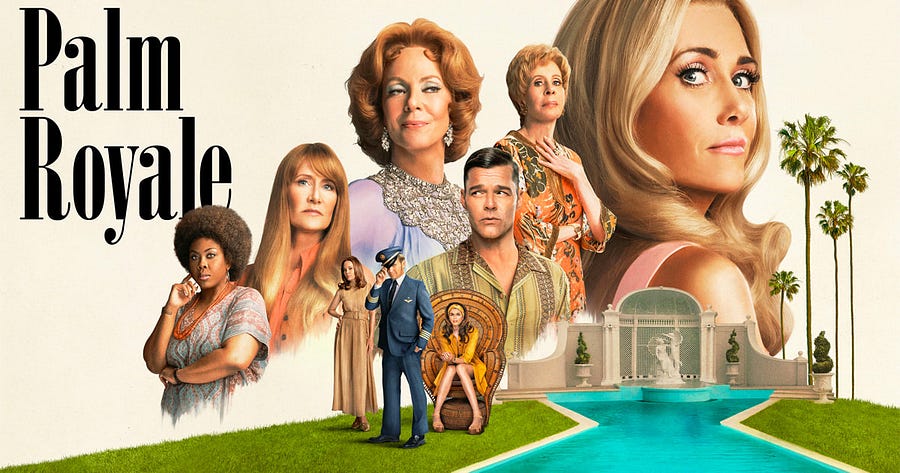
Palm Royale: An Anti-Hero for the Soapy Period Drama


Credit: Apple Studios

Kristen Wiig stars as social climber Maxine in this soapy melodrama about a woman’s attempt at being a social climber in the jet set age of the 1960s.

In the opening pre-credits scene, Maxine scales the wall of the prestigious Palm Royale country club and falls over the other side like a clumsy burglar. It’s an apt metaphor for a social climber who is willing to surrender any level of dignity for her prize.

In the first scene after the credits (which, sidenote, are award-worthy in their own right) Maxine slyly makes her way to the jet setters equivalent of a mean girls club to try to ingratiate herself into their conversation. Her genteel southern charm and agreement with everything they say marks her off as suspicious. 

After queen bee Evelyn (Allison Janney) spurns her encroachment, Maxine gets desperate enough to risk life and limb by crashing her car in front of mean girl Dinah (Leslie Bibb) just to get into a conversation with her. And this is the first episode alone. 

She’s clearly a desperate woman for social status. When Dinah asks her why she would want to be accepted into this club so badly, Maxine technically gives an answer but it’s never particularly satisfactory. This is a running motif: In-universe, the other characters are aware of how strange it is for Maxine to so desperately want to be part of a club that likely doesn’t want her so badly.

It’s eventually revealed that Maxine has some big financial stakes: She’s in debt, and her rich in-law hasn’t yet left her estate. But still, her obsession with high society is still left somewhat enigmatic to the viewer. It’s likely that the intention is to make Maxine’s motivations to be the series’ proverbial rosebud (to borrow a Citizen Kane reference).

What’s clear is that Maxine is not particularly sympathetic. Evelyn’s step-daughter Linda Shaw, who can see through high society’s flaws (although she might be a little too liberal for some audience tastes) might be more in line with reality and heroism. Maxine, on the other hand, is an anti-hero. Even if she never reaches the depths of the villains of Killing Eve, Breaking Bad, The Americans, or Boardwalk Empire, she is pretty singularly focused for grift among morals. 

The negative might be that the stakes will never reach that high in this arena of country club intrigue. The whole saga is framed by a gunshot (so maybe a total body count of one?) and Maxine’s goal is merely to be the head of the charity ball. Sure, there might be intrigue in the detours en route and how low the character will sink to, but the main route of conflict is only appealing to people who want the soap.

Maxine’s tunnel vision is also cringey in the manner of Laura Dern’s protagonist, Amy Jellicoe, in the wonderfully cringey show Enlightened. But again, Jellicoe, has bigger goals (corporate corruption) and pressures that wasn’t of her own making. Maxine’s crusade is basically against some gossipy housewives who won’t let her be part of their club.

Still, it’s hard to predict where this show will go to an extent and that makes it watchable. It’s also got an excellent period feel (the late 60s), and is careful not to overemphasize “hey this is a period show!” Ricky Martin and Laura Dern are also excellent in their supporting roles.


Sunday, March 31, 2024

Miracle Club Is a Celebration of Older Stars but It's a Fine Character Drama

Recent films like 80 for Brady and Book Club provide a joyous context with which to watch screen legends get meaty roles and have fun playing together. Who knew that, say, Jane Fonda and Mary Steenburgen, knew of each other, and liked acting alongside one another. Aww cute!

The downside is that because these are the filmic equivalent of reunion tours, these types of films (as well as Wild Hogs, Old Dogs, and Last Vegas on the male end) are devoid of conflict.

A couple of Maggie Smith films I’ve recently seen- Ladies in Lavender opposite Judi Dench, and The Miracle Club opposite Laura Linney and Kathy Bates – deal with meaty conflict. It’s a film about the aftermath abortion and Catholic guilt in Ireland. This is what almost every Irish film is about, minus the ones that are about the IRA and the civil war. Magdalene Sisters, Vera Drake, and Philomena are examples. In all seriousness, it was a pretty big tragedy (unless you’re a “Christian” blogger or a pandering right-wing lawmaker) wherein Irish society would often ship away pregnant unmarried women to convents to avoid family shame. The women would have the babies and give them up for adoption.

The film opens with Maggie Smith, Agnes O’Casey, and Kathy Bates (inexplicably sporting a full Irish brogue) as Irishwomen joyfully singing karaoke in what appears to be an Irish wake for their departed friend. The trio is taken aback when a stoic Laura Linney enters (thankfully not donning an Irish accent). She’s the daughter of the deceased and has been estranged for the past 40 years. She exchanges some terse words with Maggie Smith in a textbook case of passive-aggressive “I’ll pay for the funeral” ---- “No, I’ll pay for the funeral” one-upmanship.

We soon learn that Laura Linney was a teenage preggo who was sent to the States (thank god, because again, Linney didn’t have to do an accent), but the twist is that Maggie’s son was doing the impregnating. Maggie’s son was in love with her and wanted to follow Laura, but Maggie warned her it was a trap and Laura was just using her lady parts to ensnare him into a life of domesticity. Maggie’s son ended up living an unhappy life and committing suicide in guilt. In the interim, Agnes O’Casey, the youngest member of the karaoke trio, also has guilt of her own because she unsuccessfully tried to abort her baby in the bath tub and he survived but is developmentally disabled. So we got ourselves a double dramatic dose of abortion trauma.

One of the women has won a grand prize in a Church raffle for a vacation for four for some sort of spiritual spa in France. Nitpick time: Spas are spas and they rarely have a spiritual element to them. However, it does set the stage (albeit a little artificially) for a road trip element of reluctant bedfellows : If Laura stayed away for 40 years, you’d think she would never voluntarily spend time with her former best friend and the women who destroyed her true shot at love. But, the tickets were entered in the raffle before the death of Laura’s mom, and the priest (Irish stalwart Stephen Rhea) encourages Laura to redeem her mom’s ticket anyway. If you can get past both those dues-ex-machinas (oh yes, and Kathy Bates’ Irish accent), then that’s the most suspension of disbelief you’ll have to do.

The rest of the film is a well-developed relationship drama that skillfully confronts trauma and the culture’s changing social mores. The trailer advertises The Miracle Club as a feel-good film that might be indistinguishable from 2003's other "Old Stars Putting on a Last Hurrah" genre entries. But this is a film with dark spots that create a much richer sweetness at the end.

Note: The convention is to generally refer to characters in review by their character names and list actor names in parenthesis on first reference. I thought I'd try something different this time.


Thursday, March 28, 2024

15 Actors Most Overdue for Oscar

1. Ralph Fiennes — Longtime cinephile's favorite online publication The Film Experience often refers to him as the best actor of his generation not to win. In addition to his two nominations in the 90s, he also was a great lead in another Best Picture nominee in Quiz Show. In the 00s, he garnered buzz in Constant Gardener, and the trifecta of Reader/In Bruges/Duchess (which might have split votes) in 2008, in addition to infusing one of the decade’s big franchises with Voldemort. He also got in on the Hannibal action in Red Dragon. In the 2010s, his output lessened. He likely was the most inventive Wes Anderson protagonist ever put to film in Grand Budapest Hotel (sorry Jason Schwartzman in Rushmore) and was quietly brilliant in The Dig a bit more recently.

2. Bradley Cooper -- While finishing a distant third in this past year's Oscar race, Cooper is well-known to have education bona fides (he went to an elite school) and to be a serious actor with a capital S. His streak of 3 straight nominations from 2012-2014 shows and 5 total shows that he's managed to break through at the top of wish lists by now. He’s getting so immersive (and possibly desperate) that he might pull a more extreme stunt like Revenant and get himself eaten by a bear.


3.  Paul Giamatti — I think the voters and media got a taste of how good the possibility of “And the Oscar Goes to Paul Giamatti” would have sounded. That he does not like a conventional leading man has worked in his favor as he is very much an ordinary man in the same way that Dustin Hoffman and Ernest Borgnine captured our imaginations.

4. Harvey Keitel — With luminaries like James Caan, Ned Beatty, and Danny Aiello tragically gone, he might be the last of the greatest generation of character actors who changed acting in the 1970s. Like Bill Nighy or Bruce Dern with recent norms, it might never be too late

5. Daniel Craig — Sean Connery won an Oscar for James Bond, but Craig had a far wider range and showed before and after Bond that he was willing to take risky roles, like Truman Capote’s lover in Infamous or a detective whose idiosyncrasies seemingly are modeled after Foghorn Leghorn. There are a ton of great roles in between in Craig’s filmography and his turns as Bond and LeBlanc make him a more marketable figure than, say, Colin Firth.

6. Johnny Depp — I’m not sure I’d cast him on a film because his drunken and difficult on-set behavior has become quite legendary (exacerbated through accounts at the Amber Heard trial), but to the degree that he would get cast, he’s never less than brilliant and superbly inventive. That can’t be denied.

7. Hugh Jackman — A convincing musical lead is hard to deny like his work in Les Miserables or Greatest Showman (a fan favorite, didn’t go so well with critics on the left). With his popularity with the Wolverine roles, and his range of work like The Front Runner or The Fountain, it’s not far-fetched at all that in a given year, he might have the best performance of the year. If it’s close, I have faith that the extremely amicable Jackman could get the award by doing well on the awards circuit

8. Benedict Cumberbatch — I tend to think best actors should be a little on the older side, and after Casey Affleck and Rami Malek, I’m happiest with actors winning the lead award over, say, 40, which is why Adam Driver seems a bit young for me (he’s 39, and nowhere near due). Cumberbatch might be there at 48. Damn, how the time has flown. He’s been superb in movies dating quite a while, and even if he doesn’t have a gazillion nominations, he does have an Emmy, and he’s the kind of guy you know could nail any future challenging role. He has been in 5 Best Picture nominees (War Horse, Imitation Game, 12 Years a Slave, Atonement, 1917), so his filmography is solid, even if his roles in a couple of his pictures were small.

9. Ed Norton — An actor’s actor, Norton has had some great break-out roles in the 90s, and has acted in a wide range (he even directed a romantic comedy). Motherless Brooklyn (his second directorial film) and his role in the Glass Onion show he’s still pretty ambitious.

10. Liam Neeson — His batting average of noticeable performance to regular performance is low considering how prolific he is, but he’s pretty beloved, and he has an excuse for acting in so many movies (it helps him get over his wife’s death). The probability that he has another brilliant performance like Kinsey or Schindler’s List shouldn’t be that far out of reach.

11. Eddie Murphy — The degree to which he held up SNL and the film industry in the 1980s can’t be underestimated. If you want to give a comic star an award, Murphy would be a good choice. The problem is that there isn’t that often a role like Dolemite is My Name or Dreamgirls.

12. Michael Fassbender — In 2011, he broke out with simultaneous plaudits for Shame, Dangerous Method, X-Men, and Jane Eyre all at once. He got two nominations in the next four years and I think he’s still growing strong. He’d be on the newer end of nominees.

13. Jon Hamm — The leading man on Mad Men fits the mold of a leading man very easily and I’m often thinking he’d be a good lead whenever I armchair cast a film idea I think of in my head.

14. Steve Martin — Hard to think of a more beloved legend in comedy. Roles like 2005’s Shopgirl show he can do something big if he gets the right role. He’s retiring soon, so he can market such a win as his swan song.

15. Richard Gere — This 75-year-old actor has had roles in key films in the 1970s (Days of Heaven), 1980s (Officer and a Gentleman), 1990s (Pretty Woman, Primal Fear), 2000s (Unfaithful, Chicago, Amelia), and 2010s (Arbitrage). He’s never been the preeminent of his generation and he’s never had the hot streak of a lot of great movies in a row, but his filmography stretches back a ways. With a good role, I don’t see why he wouldn’t be cheered as a consummate screen icon.