Saturday, September 10, 2022

If I Picked the Emmys 2022

Best Limited Series

Winnter: White Lotus*
Nominees:

Dropout*

The Shrink Next Door

Winning Time

MAID

American Crime Story: Impeachment


Actor:
Clive Owen, ACS

Nominees:

Will Ferrell, The Shrink Next Door

Quincy Isiah, Winning Time

Paul Rudd, Shrink Next Door

Mike Meyers, Penuverate


Best Actress: Margaret Qualley, Maid*

Nominees:
Beanie Feldstein, ACS

Sarah Paulson, ACS*

Amanda Seyfried, Dropout*

Alexandra Daddario, White Lotus* (Different Category)

Julie Garner, Inventing Anna*


Supporting Actor:  Naveen Andrews, Dropout

Jason Segel, Winning Time

Dan Bakkehdal, ACS

Murray Bartlett, White Lotus*

Adrian Brody, Winning Time

Fred Hechinger, White Lotus

Tracey Letts, Winning Time


Supporting Actress:
Kathryn Hahn, The Shrink Next Door

Nominees: Kaitlyn Dever, The Premise

Annika Noni Rose, Maid

Annaleigh Ashford, ACS

Jenniifer Coolidge, The White Lotus*

Sidney Sweeney, The White Lotus*

Laurie Metcalf, Dropout


Best Episode: Momento Mori, Winning Time

Nominees: Pilot, Dropout

Toxic Fan, Premise

The President Kissed Me, ACS

Pentagon City Mall Interrogation, ACS

String Cheese, MAID

Bear Hunt, MAID


Best Writing: White Lotus

Nominees:  American Crime Story

Winning Time


Best Animated Show


Winnter: Central Park

Nominees: Adventure Beast

Star Trek: Lower Decks

Dicktown

Inside Job

Solar Opposites


COMEDY


Best Show: Resident Alien

Nominees: 

The Afterparty

What We Do in the Shadows*

Killing It

Ghosts

We Are Lady Parts

Marvelous Mrs Maisel*


Best Actor: Alan Tyduk, Resident Alien
Nicholas Hoult, The Great*

Craig Robinson, Killing It

Matt Berry, What We Do in the Shadows

Keegan Michael-Key, Schmigadoon

Ben Falcone, God’s Favorite Idiot

Glenn Howerton, AP Bio


Actress: Claudia O’Doherty, Killing It

Nominees:

Rachel Brosnaham, Marvelous Mrs Maisel*

Tiffany Haddish, The Afterparty

Cecily Strong, Schmigadoon

Aya Cash, Welcome to Flatch

Elle Fanning, The Great*

Sosie Bacon, As We See It


Supporting Actor: Gwilym Lee, The Great

Mark Prosch, What We Do in the Shadows

Michael Zengen, Marvelous Mrs Maisel

Brandon Scott Jones, Ghosts

Tony Shalhoub, Marvelous Mrs Maisel*

Alan Cumming, Schmigadoon

Sacha Dawson, The Great


Supporting Actress:  Marin Hinkle, Marvelous Mrs Maisel

Alice Wetterkund, Resident Alien

Belinda Bumilow, The Great

Dana Silver, Space Force

Phoebe Wright, The Great

Alex Borstein, Marvelous Mrs Maisel*

Tifany Haddish, The Afterparty


Guest Actor:  Colm Meany, It’s Always Sunny in Philadelphia

Nominees: Matt Walsh, Ghosts

Enrico Colantoni, Ghosts

Owen Wilson, SNL

PJ Byrne, Never Have I Ever

Common, Never Have I Ever

Luke Kirby, Marvelous Mrs Maisel


Guest Actress:  D’Arcy Carden, Killing It
 

Nominees: Kristen Schaal, What We Do in the Shadows

Alex Borstein, Resident Alien

Natasha Lyonne, SNL

Jane Lynch, Marvelous Mrs Maisel

Danica McKeller, Home Economics

Selena Gomes, SNL


Writing: What We Do in the Shadows

Nominees:

Schmigadoon

AP Bio

The Great

Marvelous Mrs Maisel

Welcome to Flatch


Drama


Winner: Yellow Jackets*

Nominees: The Chair

Orville

The Resort

Severance*

Flight Attendant

Star Trek: Picard


Actor: Adam Scott, Severance*

Nominees: Jay Duplass, The Chair

Billy Zabka, Cobra Kai

Patrick Stewart, Star Trek: Picard


Actress: Melanie Lynskey, Yellowjackets*

Britt Lower, Severance

Sandra Oh, The Chair

Annie Murphy, Kevin Can Go F**k Himself

Elizabeth Moss, Shining Faces

Kaley Cuoco, The Flight Attendant


Supporting Actor: Luis Gerardo Mendez, The Resort

Bob Balaban, The Chair

Skyler Gismodo, The Resort

Kevin Bigley, Upload

Daniel Dae Kim, Kevin Can Go F*** Himself

John Turturro, Severance*


Supporting Actress: Christina Ricci, Yellow Jackets*

Allegra Edwards, Upload

Holland Taylor, The Chair

Juliette Lewis, YellowJackets

Peyton List, Cobra Kai

Rosie Perez, The Flight Attendant

Allison Pill, Star Trek: Picard


Guest Actor:

Paolo Costanzo, Upload

Michael  Chernus, Severance

PJ Byrne, Cobra Kai


Guest Actress:
Leighton Meister, The Orville

Mackenzie Carroll, Upload

Whoopi Goldberg, Star Trek: Picard


Episode:  The Chair, The Chair
Dinner Party, Upload

Pilot, Yellowjacket

F Sharp, Yellowjackets

Twice in a Lifetime Graves-Orville

From Unknown Graves-Orville

Wednesday, August 31, 2022

What I'm Watching August Edition: Reviews of Loot, Central Park, Resort, Never Have I Ever, The Shrink Next Door


Loot (Apple Plus)-Maya Rudolph stars as a rich socialite who decides to take a more hands-on approach to running her own charity after her husband dumped her. It’s a classic classist comedy like “Fresh Prince of Bel Air” or “The Nanny” in which people of different social strata learn a little bit from one another. Joel Kim Booster (Fire Island) and Ron Funches are a highlight as a pair of co-workers who are a better fit as besties than Booster’s character would care to admit.  The show is watchable but seems to rely a little too heavily on Maya Rudolph to carry the jokes. Unfortunately, Rudolph’s character of Molly Novak isn’t that much more memorable so far (I’m 4 episodes in) than her character outline suggests.

Never Have I Ever (Netflix)-I hate to use the term “jump the shark” because that fails to acknowledge the show’s achievement of once being good and it implies that it’s the show’s fault that current viewing isn’t as rewarding as past viewing. Never Have I Ever ended on a happily-ever-after resolution that took away my investment in seeing where the characters might go next. Season 2 featured a wonderful arc with Common as a love interest for the mom, the cousin standing up for herself professionally, and the independent-minded Dev yo-yoing between Ben and Paxton before landing in a place of self-respect. I’m still nipping away at an episode here or there, and I’m always happy that other people will get a chance to enjoy another season of a deservingly good show. I just might not partake.

Central Park (Apple Plus)-Set in New York’s Central Park (something I personally view as a minus), the story tells the tale of villainous hotelier Bitsy Bindingham (Stanley Tucci) and her efforts to purchase over Central Park for presumably nefarious purposes. Defending the park are expose reporter Paige (Kathryn Hahn) and husband and Central Park manager Owen (Leslie Odom Jr) and their two mixed-race children Molly (Kristen Bell) and Cole (Tituss Burgess Jr) are also pretty equally invested on the side of good. The family and story’s narrator (Josh Gad) provide the warmth while Bitsy’s snootiness and the deadpan of her devious lackey Helen (Daveed Diggs) provide the humor. And did I mention there’s songs provided by the musical talents of Leslie Odom Jr., Daveed Diggs, and Kristen Bell?

The Shrink Next Door (Apple Plus)-A harrowing yet highly engaging watch about a cunning psychiatrist, Ike Herschkopf (Paul Rudd), who manipulates his patients into giving up their lives in service to him. Although the real Herschkopf swindled at least 16 patients, the story focuses on a nominal millionaire (Marty, played by Will Ferrell) who comes to visit Dr. Ike at a low point in his life (parents just died, uncle is suing him, ex-girlfriend is demanding, yada yada yada) and feels like a new man after a few sessions.

I watched this show in a vacuum so I had no idea through the first two or three episodes where this eight-episode miniseries was going. It seemed like an uplifting story of a therapist helping a timid sack of a man with a few dark undertones here or there. Of course, I knew that prestige TV networks since roughly 2010 haven’t been interested in low-stakes feel-good stories in eight-episode chunks. So yes, I was prepared for the dropping of the other shoe (is that an expression? I don’t even know), and boy did it drop. Dr. Ike persuades Marty to cut off his only family (sister Phyllis, played so endearingly by Kathryn Hahn), make him president of his business, take over his house in the Hamptons and move into the master bedroom, and eventually write him in his will.

Like the aftermath of Hitchcock’s The Birds, I wouldn’t be surprised if a sizeable number of viewers get a nightmare or two about what evil lurks in the hearts of their own therapists.

The series is tear-inducing with credit going to the performances of Will Ferrell and Kathryn Hahn (although it’s regrettable Hahn isn’t in most of the middle episodes) with Rudd providing equal weight as the villain. This isn’t a sad clown performance where a comic actor wants to stretch his wings: This is the real deal.


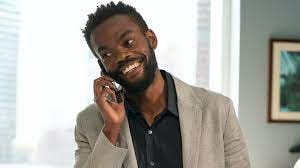
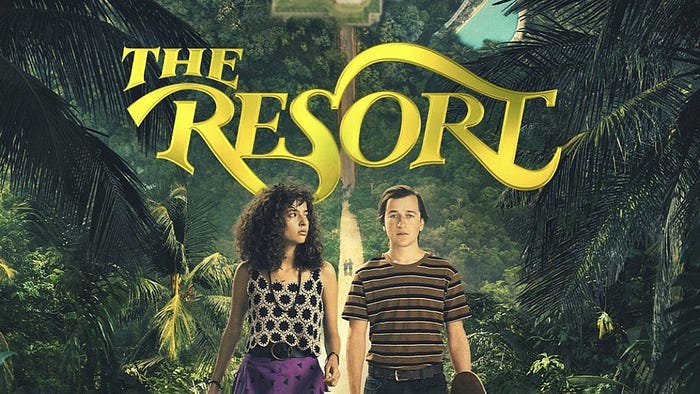
The Resort (Peacock)-A married couple (Christine Milioti as Emma, William Jackson Harper as Noah) is experiencing the doldrums during their 10th anniversary vacation to a tropical Mexican resort. What possibly shakes them out of their rut is when Emma get shaken out of their rut when Emma discovers an old cell phone from 15 years  through going down the rabbit hole of a local  missing persons case.

During one frightful and stormy night (cue the organ music) 15 years ago, a pair of young lovebirds (Skyler Gismodo as Sam and Nina Bloomgarden as Violet) disappeared during a hurricane. Careful not to reveal the sequence of events before Emma and Noah (and the audience) learn them, the series deftly cuts between past and present as Noah and Emmy chase after the trail of Sam and Violet.  

There’s an unevenness between the relative excitements of the past and the present. Sam and Violet, are a fun combination of hormones, angst, and naiveté, whereas Noah and Emma are about as fun as the Needlers (Amy Poehler and Seth Meyers) on SNL. What saves their scene is a delightfully kooky local named Balthasar Frias who fashions himself a noir detective.

The series is ambitious--needle-dropping all over the place and taking its time to cut between stories--and while it's uneven from week to week, it's enough to keep me guessing.


Monday, August 29, 2022

"The Resort" (Peacock) Review

 A married couple (Christine Milioti as Emma, William Jackson Harper as  Noah) is experiencing the blahs on a 10-year-anniversary vacation to a  tropical Mexican resort. William Jackson Harper has only been known to  the world-at-large as the tight-laced hypochondriac ethicist from The  Good Place so it’s a little jarring to see him chilling out in the  tropics with his hair in an — — sorry I’m not well-versed on  African-American hairstyles and not going to try — un-Chidi-like state.

Anywho,  Noah and Emma get shaken out of their rut when Emma discovers an old  cell phone from 15 years through going down the rabbit hole of a local  missing persons case. During one frightful and stormy night (cue the  organ music) 15 years ago, a pair of late adolescents (Skyler Gismodo as  Sam and Nina Bloomgarden as Violet) disappeared during a hurricane.  Careful not to reveal the sequence of events before Emma and Noah (and  the audience) learn them, the series deftly cuts between past and  present as Noah and Emmy chase after the trail of Sam and Violet.

It’s soon revealed that Sam and Violet had a steamy fling, and the  series tries a little hard to posit Sam/Violet (Vam? Siolet?) as younger and hornier doppelgangers to Noah and Emma who not so coincidentally  also met for the first time 15 years ago. Although the series  acknowledges that Noah and Emma are going through a funk, they still  never exhibit much chemistry and are often the least interesting part of  the story except as audience surrogates.
Sam  and Violet, on the other hand, are a fun combination of hormones,  angst, and naiveté. They bounce between a coo coo hotelier who kinda sorta kidnaps them, to an  outdoor farmer’s market to an author (Luis Guzman) with mystical  prophecies and, remarkably, they still manage to stay separated from  their parents for over six episodes and counting.

In the interim, Emma and Noah join forces with Balthasar Frias, a local heir to a powerful family of tailors (this series more than any other needs a larger fan base, just so a  more robust wiki can be created and confusions like “rich family of  tailors” can be sorted out) who’s a delightful brand of kooky on  his own. Frias came to the resort looking for a job of any sort and is  urged by the manager to reinvent himself so he fashions himself a  detective after the novels his father used to read to him as a kid.

It’s  the same character motivation that defines many a film noir protagonist  like J.J. Gittes in Chinatown or Holly Martins in the Third Man who get  caught up in their own myth and are determined to solve the mystery at  any cost. For his part, Frias is still obsessed with this missing  persons case 15 years later, and it seems possible that he’s gotten a  little warped about it with time. He’s the kind of guy who takes the  Dirk Gentley Holistic Detective Agency approach to crime-solving (i.e.  he somehow believes that asking Noah and Emma about their sex life will  somehow provide a clue of a missing cell phone) than standards nuts and  bolts stuff. But what can I say, the show needs a wild card, so away we  go.

Filled with needle drops and time jumps upon time jumps,  the show is certainly ambitious. Whether it follows through, it can be a  little touch-and-go based on the episode, which is why I'll reserve judgment until season's end, but I'm enjoying it so far.

Monday, August 08, 2022

God's Favorite Idiot (Netflix)

Wednesday, August 03, 2022

What I'm Watching July Edition

 Severance (Apple Plus)-One of the best-developed science fiction worlds I’ve ever entered, Severance is about a world where a set of workers have their memories completely compartmentalized when they are in and out of work. Audience surrogate Helly (Britt Lower) works in a classified division of a faceless company who clocks into work every day and has no memory of what her life is like outside. When she clocks back into work, she is essentially a different person with a different set of memories. For Mark (Adam Scott, in his first Emmy nod), erasing his memories for eight hours a day is a good way to deal with the grief of his lost wife. Like great sci-fi, the show explores big themes of the human condition in dramatic terms. There’s also a good mystery angle that moves the plot forward. For reference, the show reminds me of Orphan Black on BBC.

The Bear (Hulu)-This show, about the adrenaline of a gourmet chef managing the kitchen of a high-end New York restaurant, is getting some good reviews. It’s an exciting sphere of our world that we don’t often get a glimpse of, so there’s a lot of potential here on paper. However, I personally wasn’t hooked. It either works or it doesn’t. The show is episodic and none of the 30-minute plots were memorable enough to remember 5 minutes after the show’s conclusion so the show relies primarily on atmosphere which isn’t enough to get over the hump. At the very least, the show gives employment to Abby Elliott, a decent character actor, who was very much in no man’s land through three and a half seasons of SNL.

The Orville (Hulu)-The Orville: New Horizons expanded in ambition this season with a larger special effects budget (a plus) and a new one-hour-plus format (a mixed bag).

The first few episodes were wobbly right out of the gate and when an episode doesn’t hit, the longer running time makes things worse. Ideally science fiction combines character development with the kinds of thought-provoking situations that can be created by when reality can be altered through scientific imagination. But the first two episodes of the first season are based on character moments that are irrelevant to the viewer: The first episode deals with the crew hating on Isaac but didn’t Isaac’s betrayal of the crew happen in early season 2? The second episode revolves around Claire’s ex-husband but he never existed before.

Another episode, “A Tale of Two Topas”, is a blatant attempt to preach around the modern-day issue of gender identity but it doesn’t combine the character development with any science-based plotting. It’s essentially a soap opera that’s too topical to have breathing room. On the other end of the spectrum, another dud of an episode, “Mortality Paradox”, is all science and no character, and there’s nothing remotely interesting behind the science. An away team goes to a planet or something that resembles a high school cafeteria (maybe they ran out of budget and decided to scout the nearby high school?) before being wandering aimlessly to a Moclan death crypt and a lake on Keyali’s home world. The episode sprinkles a couple clues as to what’s really happening and eventually the reality is revealed, but if this is an episode based on a twist, the extra-running time doesn’t suit that twist.

That being said, even as four of the first five episodes failed to land, there was no show I was looking forward to each week because the potential was always there to turn in something good. Ambition and a firm tonal grasp always trumps a mediocre show. As such, some of the greatest episodes I’ve seen all year have occurred in the back half of the season.

What We Do in the Shadows (FX)-Regularly topping my list of favorite shows, this show continues to be all that and a bag of chips. The third season saw the characters attempt to do big things. Nadja was going to take over at the world vampiric counsel, Nandor was going to travel the world, Guillermo was going to be a vampire, and Lazlo was going to raise Colin Robinson (mistakenly thinking that the new creature that emerged from the old Colin would be less boring). This is a sitcom so a lot of those arcs got aborted, but the show wisely has continued to mix things up.

Star Trek: Picard & Star Trek: Strange New Worlds (Paramount Plus)-My first time coming into contact with either of these two shows on the instructions of an editor for an essay I was writing.

Strange New Worlds is typical Trek. The characters are a bit more modern and relatable (and Spock’s jacked), but it’s the same technobabble-heavy tripe.

Picard, on the hand, is a season-long mystery. It’s visually stunning and tonally coherent. There are characters here you’ve practically never seen in Star Trek. A vagabond pilot (Santiago Cabrera), a nervous nellie of an engineer (the always underrated Alison Pull), and a depressive who self-mediates to escape her pain (Michelle Hurd). Picard is like a late-stage-John-Ford Western hero, once revered but now living with guilt. There was never a fraction of this depth on TNG, and Patrick Stewart finds a way to be true to the shallower version of Picard without making him an entirely new character.

The first season (of which I’ve seen six episodes so far) is a mystery that can compete with TV’s Golden Age in terms of telling a story that can integrate flashbacks and switch points of view without losing a beat.


Thursday, July 28, 2022

Elvis and the Non-Existent Cultural Appropriation Debate


There is no way that Baz Luhrmann could make Elvis and not get criticism for issues relating to race. If he includes B.B. King and Little Richard in his film, he will get accused of only paying lip-service to them. He’ll be accused of making a white savior film (a poorly employed catch-all for films that critics don’t like). If Luhrmann makes a film that shows Elvis grovelling to his Black friends for being famous while they’re not, well that wouldn’t be historically accurate, but who cares about that? Certainly not Paul Thompson of The Ringer who felt the King’s mourning of MLK Jr was “clumsy” despite it being taken from a verbatim quote. In other words, a movie about Elvis Presley somehow does a service to its figure by not having him be anti-racist enough.

Bill Maher, a talk show host who is always bold in calling out the absurdity of wokeness, recently had a popular clip clip:
New Rule: The What Were You Thinking Generation
https://www.youtube.com/watch?v=ugLbotr1RuQ

In it, he says, “You can’t blame people for being woke 30 years before being woke was a thing”

We are living in unprecedented times of idiocy (make no mistake: the right is destroying the country politically) where a certain idiotic class of mostly white activists are not doing the left any favors by attempting to declare a new cultural purity war against anyone who stands against homophobia, racism, or sexism.

The dogmatic “you’re either a knight in shining armor fighting against racism or you’re part of the problem” philosophy ignores the fact that for many people, racism is not the number one problem in America and they couldn’t
care less whether some out-of-touch activists think that they are not helping racism enough (at least, I don’t to the degree my career won’t get in the way).

Today, the Audubon Society of Seattle sought to remove the name of its founder because, god forbid, he held slaves. If the Audubon Society suddenly decides after several decades otherwise that it no longer wants to profit off the preservation efforts of James Audubon, they should dissolve the foundation at once rather than use the infrastructure created under his name.*

Elvis was born into poverty. The basest of woke activists who see people only through color and ignore the class of white people born into poverty (another reason why so many voters are turning to Republicans despite how godawful they are). Like everyone else born into the poverty, he was simply trying to get out of his miserable conditions and uplift his family and was inspired by the Black music that he heard that he bought to the masses.

The idea that this was some sort of crime of “cultural appropriation” only matters if you think that cultural appropriation is a bad thing. Before identity politics came to be such a prominent school of thought, the idea of cultural appropriation in and of itself as causing harm to the Black community would have you laughed out of the room with most academics and justifiably so.

“The accusation of “cultural appropriation” is overwhelmingly being used as an objection to syncretism — the mixing of different thoughts, religions, cultures and ethnicities that often ends up creating entirely new ones. In other words: the most natural process in a melting-pot country like ours,” writes Bari Weiss

This is what happened to Elvis who grew up in a Black community and was inspired by a Black preacher and his congregants when he was drawing his musical style. This shouldn’t be surprising. I’ve known Caucasian people who grew up in ghetto areas or went to school with lots of Black people and were acculturated from an early age to use African-American vernacular in the exact same manner that Black people use it.

If Elvis was guilty of cultural appropriation, it’s an irrelevant hypothetical. As far as I know, no one was going around during this era accusing Elvis of cultural appropriating because the concept didn’t exist. Therefore, if Elvis would have responded with some PR-drafted apology for not being woke enough is something we can’t know.

Most of the anger at Elvis was about him profiting from his music while others didn’t. When Public Enemy called him a racist in Fight the Power, it’s not like they’re acting off any evidence.

In fact, Elvis gave many interviews crediting his inspirations:
A lot of people seem to think I started this business. But rock ’n’ roll was here a long time before I came along. Nobody can sing that kind of music like coloured people. Let’s face it: I can’t sing like Fats Domino can. I know that.”

Musicians like Little Richard and James Brown credited him with opening doors for them and that much appears true. According to Newsweek, by November 1963, Billboard could no longer differentiate between white and black consumption and suspended its separate black singles chart.

There’s also the simple fact that he stuck to his Black-influenced style even when there was pressure to do so otherwise.

That’s the sensible view.

The non-sensible view is the “you’re either anti-racist or you’re racist with a capital R” philosophy. This is the view that suggests that Elvis was supposed to go beyond the standards of his own era to live his life in service of African-American liberation.

This is where we get the kind of posturizing reviews that RogerEbert.com is often guilty of.

Robert Daniels writes:
“But all too often the film slips into a great white hope syndrome, whereby Presley is the sincere white hero unearthing the exotic and sensual Black artists of his era. B.B. King, Big Momma Thornton, and Little Richard (real-life supporters of Presley) exist solely as either bulletin board cheerleaders or alluring beings from a far-off land. While these Black artists are championed — an awareness by Luhrmann of their importance and the long and winding history of Black art moving through white spaces — they barely speak or retain any depth, even while a paternalistic Presley advances their cause.”

Mr. Daniels, do you understand the concept of screentime and narrative? That it’s a film about Elvis and in service of his story. That’s how secondary and tertiary characters work.

“The approach neither illuminates nor dignifies these figures. Instead, Luhrmann tries to smooth over the complicated feelings many Black folks of varied generations have toward the purported King. In that smoothing, Presley loses enough danger, enough fascinating complications to render the whole enterprise predictable. Because it’s not enough to merely have awareness, a filmmaker also has a responsibility to question whether they’re the right person to tell a story. Luhrmann isn’t. And that’s a failing that will be difficult for many viewers to ignore.”

You mean the song by Public Enemy that has no basis in fact?

And what’s this part about how Luhrmann should be taking himself out of the running because it’s a story about race (it really isn’t)? Elvis is not the exclusive domain of anti-racism tutorials.

Baz Luhrmann is allowed to make anything he wants, and if a film critic is honestly pushing for the restriction of what a film maker can or can’t do, that’s antithetical to art itself. If Robert Daniels wants to make a film about Elvis and racism, he is quite welcome to make some companion piece to 12 Years a Slave, Lovecraft Country, The Probem with Apu, Fences, Hidden Figures, The Free State of Jones, Race, Birth of a Nation, 13th, I Am Now Your Negro, Small Axe, Mudbound, Last Black Man in San Francisco, Black Klansman, If Beale Street Could Talk, Passing, Respect, or Seberg. However, he might want to realize that films which conflate entertainment with anti-racism preaching (and I will note, I like a good number of those films).

I will leave this essay with this quote:

“I would argue those who scream loudest about cultural appropriation are themselves after power. As soon as you raise issues about your own race and culture, you pretty much shut people up, because most people don’t want to be accused of being racist, elitist or not being ‘woke’, in the parlance of social justice warriors (SJWs),” writes Alex Lo.

*I’m aware that the Audubon Society has no relation to the rest of my essay. I just didn’t want to write a whole new essay about it.

Saturday, July 09, 2022

Six Observations About the USA Show Monk (2002-2009)

Credit: IMDB


Running on USA Network for seven seasons, Monk was a TV show with a slight whiff of serialization about a San Francisco police detective (Tony Shalhoub) with massive OCD who had a mental breakdown upon the death of his wife, and got kicked off the force. Throughout the duration of the series, Adrian Monk is exiled from the force so he’s got that chip on his shoulder. On the other hand, he gets to solve pretty much every murder in Bay Area as a “consultant” so the show really has its cake and eats it too.

The show won eight Emmys (three for Tony Shalhoub) but was generally considered more niche viewing than prestige TV. It was the de facto flagship for the USA network which replicated the outsider savant formula with Psyche, Burn Notice and Necessary Roughness.

I watched several episodes over the past week and here are some notes:

1.. Monk’s detective abilities are similar to the way that Batman puts the Gotham police department out of business. It’s also worth pointing out that with all the murders going around town, it almost feels like San Francisco is up there as one of the murderiest cities in the US, even if it’s exponentially larger than Cabot Cove. And not only that but Monk is often personally connected to the murder like whether it’s his childhood crush’s ex-husband, his dentist, the newscaster assigned to report on his story, or his captain’s girlfriend. And that’s not counting all the murder scenes he happens to wander into. It’s like Batman’s penchant for wandering onto muggings in Gotham city.

However, instead of mindless thugs, the criminals Monk encounters are white collar dudes with highly Rube-Goldberg-like ways of killing their immediate family members or collecting insurance payouts. One episode even had an man attempt to escape alimony by robbing a house and defacing a painting so that his ex-wife would have a meet cute with her art appraiser former high school boyfriend. Wouldn’t it have been easier to just call him up and tip him off that his former girlfriend is single and ready to mingle?

2. Monk is defined by his rigidity but my pet theory is that he’s likeable because many episodes shows that he’s capable of changing his habits on a dime. Static characters are rarely protagonists because who wants to build a show around a comic character (typically defined by their deficiencies) who doesn’t change at all. Who wants to be around such a person in real life? But Monk does actually do a fill 180 on his intrinsic nature quite often. In one episode, he goes to a bachelor party in Las Vegas and you expect that we’re going to see someone who’s no fun, but he develops a brief gambling addiction. In another episode, Monk abandons his lifelong pursuit of justice to try being a full-time butler. Monk’s a loner who won’t stop brooding about his long-dead wife, but in one episode he comes close to asking out his childhood crush on a date and believes that he could find romantic happiness. In another episode, Monk agonizes about getting a best friend (Andy Richter). In the famous Sara Silverman episode, Monk not only lets down his defenses for a woman who actively stalks him, he briefly hires her as his assistant. And that’s just in the dozen or so episodes I’ve seen.

3. I hate to say this but Monk’s asexuality and his relationship to Trudy are never really well-defined. His attachment to Trudy strikes me as some crutch for his asexuality and asocial tendencies which initially made me wonder if Trudy was some sort of beard, before I watched flashback scenes that show that Trump and Trudy were really an item.  

In an episode centering around Monk’s class reunion, it’s revealed how much of a sad sack Monk is, when he converses with an old classmate (played by Family Matters’ Reginald van Johnson) about their late wives. The classmate says “well, you move on” and Monk replies “no, you don’t, you never really do” and when the classmate shows subtle expressions of “what a weirdo” we’re meant to empathize with Monk as a man who’s not understood by his peers. However, I think this came off tonally as it wasn’t intended to. I can empathize with Monk and his OCD but his clinging to an image of his dead wife is worth a proverbial weird look or, better yet, a “get it together, man.” I certainly don’t think every person on Earth needs to have a romantic life, but to hide behind your dead wife for years is not being honest with yourself about what you want.

There are also elements of Monk’s sexuality that are generally left dangling with no explanation; folded over into a mangled ambiguous neurosis. In one episode, he’s disappointed with his childhood idol (Elizabeth Berkley) for having an active sex life. He also has an aversion to naked people. Tell me this puritan streak isn’t a lot to unpack

4. My understanding is that Monk is modeled after Sherlock Holmes, but I liken him to a tortured noir detective. The way Monk follows his hunches at the exclusion of all other variables often look like vendettas similar to a character like Philip Marlowe in the Big Sleep or The Long Goodbye. Edward G. Robinson’s character in Double Indemnnity, another famous noir hero, speaks of being able to use his sense of smell to get his man every time. This is awfully similar to Monk’s physical idiosyncracies (i.e. how he uses his hands to frame the scene). Additionally, Monk’s bitterness—downplayed as much as possible so that this show can still be considered a comedy for Emmy purposes—and his close proximity to personal tragedy (not just his wife but his father, brother, and exile from the force) are all interwoven into his character.

5. I haven’t re-watched the episodes with Sharona since the show’s first run, but I love everything about what Natalie Teeger (Taylor Howard) provides for the show. It’s one of those relationships where you never get tired of how these two interact. As previously mentioned, Monk runs the risk of looking like an unhinged man with tunnel vision when he follows his hunch, so it’s quite useful that Natalie is standing beside him. It’s also really sweet that Natalie often locks arms with him. It doesn’t have romantic connotations and it doesn’t look like a nurse helping an old man, but it’s a really nice show of support and comfort between the two. It’s also one of those beauty-and-the-geek things on a meta-level, because let’s face it: Natalie’s cute. Who wouldn’t want to be walking arm-in-arm with Taylor Howard through the streets of San Francisco.

6. The show might be formulaic on first glance, but many of the episodes are kind of must-watch based on the plots alone. A lot of it is based on fish-out-of-water set-ups. For a man is phobic and idiosyncratic as Monk, he’s pretty much a fish always out of the water, so when I see an episode description like “Mr. Monk goes to a nude beach” or “Mr. Monk goes to Vegas”, or “Mr. Monk goes to live on a farm”, I’m pretty sold instantly on how far out of his comfort zone Mr. Monk will be pushed.

And while the show isn’t particularly serialized, there are episodes like Monk’s reconciliation with his brother (John Turturro won an Emmy for this guest turn), father, or childhood crush that are pretty strong on pathos too.