Showing posts with label passage to india. Show all posts

Tuesday, August 27, 2024

Powerpoint Presentation: Films of the 1980s


For Power Point DC, I pulled together a Power Point of the 1980s on film to promote my film of the month club (you would have to click on following me).


These were the films I picked and what I riffed off of:

Any Which Way You Can-Clint Eastwood gets into random fist fights, loses Sondra Locke, gains a monkey. It’s better than it looks

Cannonball Run-Is there anything about this film that isn’t fun to talk about? Based on a series of no-holds-barred cross-country races in the 1970s in which cars drove some 150 miles per hour. Roger Moore plays a man who got practical surgery to look like Roger Moore; Jamie Farr plays a shiekh who falls in love with a car hop in 30 seconds minutes; Tony Danza gets paired with a monkey; Terry Bradshaw is in the film; Farrah Fawcett givesboring lectures about how much she loves trees and the men still want her because she’s Farrah Fawcett; and there’s a frankenstein-like doctor who’s sole qualification is that he has a syringe with a mystery substance in it.

A View to a Kill-This James Bond film certainly has some humorously jarring elements: Christopher Walken plays a villain with Christopher Walkenish speech affectations; James Bond escapes death by disrobing into bed with Grace Jones and expecting her to sleep with him; there’s a cheesy California Girls sequence, etc. However, I wouldn’t call this the worst James Bond film because it’s not boring. It’s zany, but boring is the cardinal sin (looking at you “For Your Eyes Only”). 

Cocktail-This film is among the most Tom Cruisiest of Cruise films. It will also make you hate bartenders

Bronco Billy-This movie is on my top films of all time as it embodies the found family trope among a group of misfits who pose as cowboys in a send-off to Buffalo Bill Cody’s Wild West Show. It’s Clint Eastwood at his hammiest

Cocoon-One of a number of 1980s with aliens who are just there (The Abyss is another example). They’re not particularly violent, they’re arrival is greeted with total indifference, and they’re net effect is curing erectile dysfunction in old people. I also talked about how Wilford Brimley is best known for inappropriate commercials, and Don Ameche earned a paper-thin makeup Oscar here.
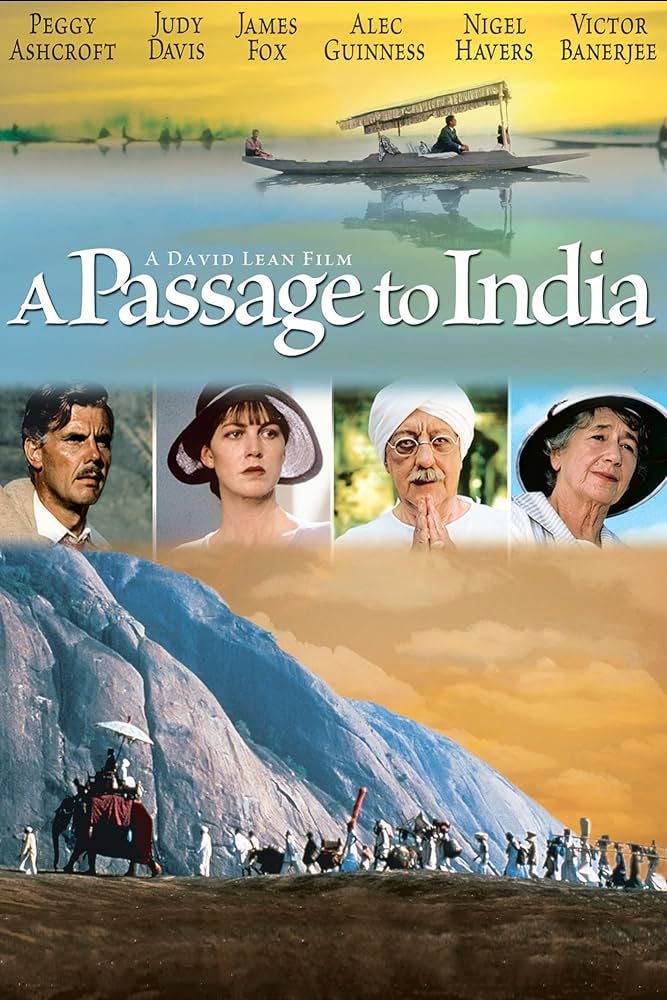
Passage to India-There wasn’t as much to riff off here, except the abstract concept of discovering the real India. It’s a long film with a capital “L” as it was directed by David Lean of epics such as Lawrence of Arabia and Dr. Zhivago. It’s an excellent period piece with an Oscar-winning performance from Peggy Ashcroft. I reviewed it here: Passage to India

Short Circuit-The inspiration to Wake, Rattle, and Roll. Both Passage to India and Short Circuit have some amusing (though others might consider offensive) brownface


Thursday, November 08, 2018

How many David Lean films have you seen?

Originally Published at The Solute

Towards the end of the century, the American Film Institute and the British Film Institute released lists of the top 100 films of the 20th Century. He’s the most honored director on the British Film Institute list with Brief Encounter at #2, Lawrence of Arabia at #3, Great Expectations at #5, Bridge on the River Kwai at #11, Doctor Zhivago at #27, Oliver Twist at #46, and In Which We Serve at #92. Additionally, he has three films on the American Film Institute’s Top 100 epics list with Doctor Zhivago, Lawrence of Arabia and Bridge on the River Kwai

It’s not surprising that astute British cinemaphiles might have missed some of Lean’s earlier films because to many Americans and casual movie goers, Lean is known for the glorious epics that he made over the latter half of his career. None of the six films he made from 1957 to 1984 clocks in at less than two hours and forty minutes. 

In a way, Lean is one of the most avant-garde directors I have watched because of the sheer length of his films. Although Lean appears to be a traditionalist in terms of narrative, there is something uncompromising about going to a studio and declaring “I’m going to make a film about a relatively obscure World War I general, it will have no women, and it will be three and a half hours long!” I watched Lawrence of Arabia as a high school freshman for a history assignment on Lawrence. I remember thinking “hmmm, shouldn’t this movie have ended by now?” but I certainly thought it was interesting. Perhaps, it was the novelty of seeing a different kind of film that was clearly a product of its period. The next year, our European History teacher decided to show the film in class over several periods and our reaction was, “yes it’s a pretty movie, but seriously, it’s this long?!”

A couple weeks ago, I was visiting my father at his swimming pool when he was conversing with some friends. I was reading a book review on the Russian Revolution from the Sunday newspaper and asked him what the Russian revolution was and his friends started telling me I should watch Doctor Zhivago. I mentioned that although I liked some of David Lean’s films, some of them like Lawrence of Arabia are excruciatingly long and one of them said “yes, but there’s not a wasted minute in it.”

This past week, I watched the first half of Doctor Zhivago (I plan on watching the second) and I have to agree with his assessment. The film isn’t bloated but narratively ambitious in a way that few are. Like his other epics, it’s a film that’s uninterested in telling a simple three-act narrative to get one to a happy ending: Lean is somewhat Altmanesque in weaving a tapestry but in a more linear fashion towards an end goal. It’s a film that meanders but it builds up story and character as it veers away from the main arc. The imagery in David Lean’s films are often striking and not simply in terms of cinematography. Watching Doctor Zhivago, I’m struck by the way Pasha (Tom Courtenay) is framed with his scarred face or of the scene in which Yevgraf (Alec Guiness ) trails the titular character through dark alleyways or the military march in which Pasha loses his gun or the image of Yuri being bombarded by peasants who have cordoned off his own home or…well, you get the point.
Additionally, Lean directed a whole slew of praised films before his epic phase that were largely adaptations of beloved literary works. His first three films he directed solo were adaptations of Noel Coward plays. He followed this by two Charles Dickens novels—Great Expectations and Oliver Twist—that are considered two of the best and most faithful cinematic adaptations of Dickens’ work.  Ironically, some critics would take issue with his later deviation from the source material in Lawrence of Arabia and Doctor Zhivago.

Brief Biography:
Lean was born in Croydon, England in 1930. He was raised in a Quaker household where he was not allowed to see movies due to his religious upbringing. At Quaker School, Lean was a mediocre student but he displayed a passion for photography though his parents discouraged him from making a career out of it. After working for his father’s accounting firm, he was convinced by a friend to follow his passion to be a cinematographer and worked from Gaumont British Studios in 1927.  He eventually worked his way up a series of jobs to editor before Noel Coward himself invited him to co-direct and eventually direct solo his productions. He was known for being autocratic (closed off to outside input) on sets but not overly difficult on actors. Another Oscar-winning director. Kevin Costner, was inspired by his films in thinking that an epic was ideal.

In addition to directing, he was also the founder of the production company CineGuild with Roland Neame. In addition to 28 Academy Awards being awarded to his films, he was knighted in 1984 and received an AFI Lifetime Achievement Award a year before his death in 1991 at the age of 83. Another interesting distinction: In 1970, he was Hollywood’s all-time top directorial grosser (adding the money made from all his films; a title Spielberg holds today). He did plan an eventual retirement in Tuscany but he was working until the day he died on the unfinished film Nostromo. He asked for his ashes to be buried in the three places he loved most: Tahiti, Tuscany, and India.

Films I’ve Seen:
I’m making my way through my 5th. I’ve seen Summertime, Lawrence of Arabia, Passage to India, Bridge on the River Kwai, and Doctor Zhivago.

Favorite:
Bridge on the River Kwai – My favorite war film. It’s lush, it’s rich in story, and conveys the senseless tragedy of war with just one scene that has remained etched in my mind. It also has a quartet of indelible characters: William Holden pulls on the charisma as a soldier roped in for one last mission, Geoffrey Horne plays a green-eyed private with a palpable sense of fear and naivetĂ© about killing another person; Alec Guinness is a morally complex man with an ironclad sense of integrity that leads him astray ever so gradually, and Sessue Hayakawa is a worthy sparring partner.

Underrated:
Passage to India – A story about the grandeur of India (circa 1928) and the racial prejudice, conflicts in national loyalty and sexual repression that lurks underneath. For a film that starts out centering around one character—a stuffy British magistrate played by Nigel Havers– almost entirely irrelevant by the end of the story, this is a film that’s extremely fluid and doesn’t feel draining time-wise.

Overrated:
I am ok with leaving this section blank if I don’t think anything’s overrated. I thought Summertime was uneventful and lackluster but I was assuming that film was panned. TCM.com classified  it as a hit, though, so yes, Summertime. It’s basically Katharine Hepburn having a Connecticut socialite’s version of a spring break experience in Venice with a hot local. The film has its moments and there’s something slightly interesting about just how unapologetic the film is at hewing so closely to the Latin lover archetype with the male lead.

Blind spots:
If Brief Encounter is the #2 all-time film according to the BFI, who am I to doubt them? One of David O Russell’s favorite films (or at least in in 2016) is Hobson’s Choice. Ryan’s Daughter is another epic but one that even the critics felt didn’t justify its long running time, so maybe?

Filmography as Director (17 films)
Summertime (1955)
Madeleine (1950)
Oliver Twist (1948)
Blithe Spirit (1945)
Major Barbara (1941)

Monday, May 02, 2011

Passage to India Review


David Lean’s films are epics, which I would define as at least a half hour longer than they need to be. The plot and storyline meanders but if it’s a good plot, you’re in for a grand adventure. It’s like National Geographic meets Shakespeare. The films tell dramatic stories while taking you on a journey to an exotic place, whether it’s the deserts of Arabia, the jungles of Southeast Asia, or the frigid winters of Russia on the eve of revolution.

In this case of “A Passage to India,” it’s a story about the grandeur of India (circa 1928) and the racial prejudice, national loyalty and sexual repression that lurks underneath. At the start of the film, the plot centers on the bonding between the fiancĂ©e and the mother (known only as Mrs. Moore) of a stuffy colonial magistrate as they form similar anti-establishment attitudes. They both want to “see the real India” and they don’t approve of the insular attitudes of the whites towards the natives. A college professor is sympathetic to their cause and arranges a luncheon with an Indian colleague (Alec Guinness in brown face) of his as well as a local doctor. The doctor proposes they go on a trip to the caves where trouble happens. The doctor and the betrothed Mrs. Quested get separated from the group where something happens in the cave (we’re not shown what) and the doctor is accused of rape.

The interesting thing about Lean’s films are that they’re too big for any one character. By the third act, the film isn’t even really about Mrs. Moore, Mrs. Quested, or the stuffy magistrate but rather the bonds of trust between the doctor and the college professor trying to see that justice is served to him.


The “what happened in the cave” mystery is one of those “Was the top spinning or not?” moments that makes the audience engage with the material and ask questions. It points the way to some complex symbolism (I’ve gotten a whole new appreciation for the film after seeing explanations from various message boards) and shows the film really has a lot to say and wonderfully subtle ways of expressing them.

If I can level one criticism, there were characters in the film who were boorish and apathetic to the British-Indian inequality and a very few liberal-minded people and almost nothing in between. If Mrs. Moore had the ability to look at the situation and see this is wrong, why was her own son (you'd think they'd share some of the same values) so distanced from that viewpoint that he couldn't even fathom it? If Fielding had a rational awareness of racism, he seemed to be the only one in the club. When society got progressive enough to realize slavery was wrong, even the ones who owned slaves could fathom the other side's argument. It felt like in this film, Fielding and his two friends were just living amongst zombies.