I have been doing a lot of writing on the topic of wokeness gone awry and cancel culture at Medium.com
Here is one of my latest:
Brandee Blocker Anderson, is an Ivy-League-educated lawyer, teacher, and activist preaching anti-black bias in Disney and posted a video that made me pull my hair out on first viewing.
Her video concluding that “Soul” — a well-meaning effort by a film studio to show inclusion by hiring a black writer, promoting him to co-director and consulting with several black musicians — is racist goes a long way to diluting the concept of racism.
I too was exposed to critical race theory in my film courses in college but it’s not supposed to be a tool to damn anyone that doesn’t make films along a narrow definition of wokeness. Before anyone criticizes a film like “Soul” without recognizing the context in which the film was made, they should try to re-write a basic plot outline of what you would rather see in a film and forecast how others would see it without giving the benefit of the doubt to your intentions.
At the same time, there’s nothing particularly wrong with presenting possible readings to a film and presenting a personal take. I also want to be mindful that the author of the video has dealt with negative experiences of representation as a black person. My problem in this case is preaching that a film is something it isn’t and not being aware of their own biases.
So here’s the film and I will address each contention by point:
For starters:
Each of these points assumes that Disney has an actual malicious agenda. To suggest even a subconscious subtext to the efforts of Pixar’s first black co-director and head writer of a script should be backed with evidence. Furthermore, it’s not hard to find examples of Disney being guilty of perpetuating those stereotypes in the past, but nearly the entire media landscape in 1950 was racist by today’s standards. Sure you can praise today’s film makers like Steve McQueen or Lee Daniels for avoiding those tropes but they’re not burdened by the original sin of being century-old brands.
Now let’s go point-by-point:
Contention: “Disney doesn’t believe that audiences will connect with a black character in non-human form”
Case in point: Tiana spends much of the screen time as a frog and Jamie Foxx spends much of his time as a ghost here.
My response: This is reaching for straws. Pocahontas and Mulan are easy counter-examples.
Tiana was a frog because it was following the template of the original story. Does the author legitimately believe that people are not aware that Tiana is a black character for the portion of the story that she is a frog?
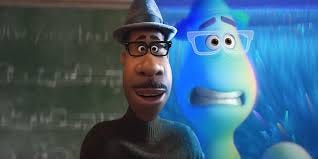
Jamie Foxx was clearly distinguishable as Jamie Foxx. His voice didn’t become less authentically black.
Contention: Joe decides to literally die to to allow Tina Fey’s character to live.
“He decides that that’s not good enough and opts to literally die to allow Tina Fey’s character to live. The idea that a black character should or would die for a white character is racist. According to the plot, Tina Fey’s character didn’t need someone to sacrifice their live for her to live. Yet the film gaslights Joe into thinking that Joe’s a monster for thinking that the only reason she got her spark for thinking that she was in his body.”
My response:
The author completely misses the plot of the movie. Pay attention here! Joe doesn’t “decide to die.” He IS ALREADY DEAD. In fact, he selfishly cheats death and his character arc is about accepting his fate and balancing his own tunnel vision focus with the needs of others. Furthermore, Tina Fey’s character deserves to live because she is a symbolic stand-in for an unborn baby and that’s what people in the before-life are meant for.
Joe Gardener turning into a monster wasn’t meant as a form of damnation but part of a character arc that showed he has to have less tunnel vision and think about his effects on others. He ultimately ends up a better person. Are character acts not permissible and can black characters never do anything wrong by this author’s standards?
Contention: Any film in which a black character dies so that a white character can live is racist
This is a charge known as the white savior complex and it’s been used to erroneously damn half of all stories with white and black characters in them. The gist of this criticism is that white characters helping black characters out makes black characters seem incapable. On the other hand, a black character helping a white character falls under the magic negro trope, so in order to make a movie that please Brandee Blocker Anderson, no character should ever help one another.
(see: The ridiculous backlash to “Green Book” and the ultimate awarding of an Academy Award because actual people and not internet trolls like seeing people come together in times of division)
There’s nothing inherently racist (remember the definition) with a film that has white characters helping black characters out or the other way around. To preach otherwise is to call for a weird economically unprofitable form of film segregation. Emma Stone’s presence in a movie like “The Help” undoubtedly increases the box office and audience potential for a niche story about maids in the South. True, maybe in 2020, white guilt can get people in those seats about exclusively black stories but it’s not inherent that the insertion of a white story taints the development of black characters in that story (except perhaps a sacrifice in screen time)
The coiner of the magic negro term, Spike Lee, spoke about it in 2000 doing press to “Bamboozled” in response to films like “Legend of Bagger Vance” where the Will Smith character had no other purpose than to help Matt Damon. Many films with black and white characters together do not have that template.
A true critical reading would take note that not all tropes are presented the same way.
Contention: Joe doesn’t see the value in teaching and performing
Again, that’s not correctly reading the film’s plot. Joe will likely continue to do one or both of those things. He just will appreciate life more.
Contention: The film reeks of misogyny because the two black women are difficult and rude. Tina Fey is the only nice person.
This is inconsistent with the way the black community tends to praise tough black women role models.
Jamie Foxx himself won an Oscar for Ray and gave a speech in which he praised his grandmother for beating him. Did anyone bat an eye lash. How did the black community react then?
(2) Jamie Foxx Wins Best Actor: 2005 Oscars — YouTube
Additionally, Ray’s mother in the film (Sharon Warren) was a tough-love role model and was praised for the role.
August Wilson’s plays, the adoptive parents in Fresh Prince of Bel-Air, the characters of Precious, the support system of Earn in Atlanta are not friendly characters.
Anyone who would be softer than, say, Audra Day’s version of Billie Holliday, would get lambasted by critics like you for being embodiments of respectability politics.
Contention: The film is racist because the death fairy (Terry) recognizes another guy for Joe
Terry goes after Joe because films need bad guys.
Contention: The film is racist because it only pays lip service to structural inequality and racism rather than making it the central point of the entire film. A black character, Paul, is eating potato chips and the film is portraying it without commenting about the entirety of food deserts in black communities and the structural sources of black problems in inequality.
A film subtly commenting on inequality. Nice! How about this: Any time a massive film studio chasing profits goes out of its way to make social commentary, you at least acknowledge the gesture. I’m not asking
Did you really expect a film to be about food deserts or inequalities in education and still be a film people want to watch?
Contention: When Terry (the death fairy) goes after Joe, he’s doing it with the intensity of a cop which is bad optics.
Actually, this is a reasonable point. Still, bad optics, and intentional (or even unintentional) racism are two entirely different things. The film could have potentially curbed the scene but it might have been written before the eruptions of Black Lives Matter which significantly changed the narrative (contrary to statistics) of how the greatest problem facing the nation was the relationship police have with black people. This change occurred in a matter of weeks.
Conclusion:
The funny thing is I read critical race theory text books like Bell Hooks in film class. I appreciated these takes but if these critics are damning every film that don’t meet a narrow bar of wokeness, than they’re not that different than the culture police of the 1980s dating from Tipper Gore to Pat Robertson to Sarah Palin. Critical race theory isn’t meant to be used as a damning tool and prevent the the free expression of ideas that film represents.
Recently the popcorn comedy “Tag” was crucified on Roger Ebert’s namesake website for being ignorant of white privilege (apparently, showing white adult men having fun is now a sin), the LGBT story about a gay man accepting family “Uncle Frank” was crucified for not being hard on his family in 1969 when they didn’t accept him (he technically never came out to them), and “Isle of Dogs” can’t be accepted because of white washing.
