Showing posts with label Locke and Key. Show all posts

Monday, August 05, 2024

Giving a Second Chance to Shows That Lost My Attention

 Upon learning that my friend’s trepidations about watching films over two hours was that his attention span usually couldn’t handle it, I found myself in similar territory. Blame the advent of cell phones and YouTube but I’m pretty heavily aware that over the past 15 years, I’m significantly dumber than before.

Because it’s not good to have a brain that turns into mush if it has to pay attention to something longer than a half hour, I try to actively train my brain. I try to read books and if I can ever finish one, it feels like compling a marathon. I also think that there are a number of serialized hour-long shows that can be a slog, even if they tell a good story. Sure, we can all jump at the Americans, Homelands, or Breaking Bads, but we’re looking at it the wrong way. The joy of watching TV isn’t to latch onto the most adrenaline-producing high and ride it out; it’s to find a challenging show like Florida Project or The Resort and stick it out through the exposition, to an even greater reward.

I traditionally do a list of top 12 shows with 10 runners-up, and there’s always enough shows (dramas, comedies) to fill up that list. However, looking over my list last year, there’s a ton of shows I gave up on like Mrs. Davis, Big Door Prize, Cleopatra, Transatlantic, and I hobbled to the finish line with The Diplomat.

On the other hand, some of the dramas I did finish like “Locke and Key”, “One Piece,” or “Fubar.” These are pretty flawed works.

I cannot logistically afford to watch all the good art there is produced on a yearly basis. There’s not enough time. As a serious (or whatever word you want to use) consumer of TV, I owe it to myself to watch a substantial amount of challenging output.

For years, I have understood that serialized television can have a slow burn at the beginning as you sift. The big question I ask myself is whether I am challenging myself by what I watch. It’s far easier to watch “Office” or “Futurama” reruns than it is to dive into a new show. In that spirit, I’ve tried to revisit a few shows and see if I can make it through the full season (what I consider to the measure of completism):

In this tradition, I’m giving a second look to a few seasons of shows that didn’t hit me off the bat:
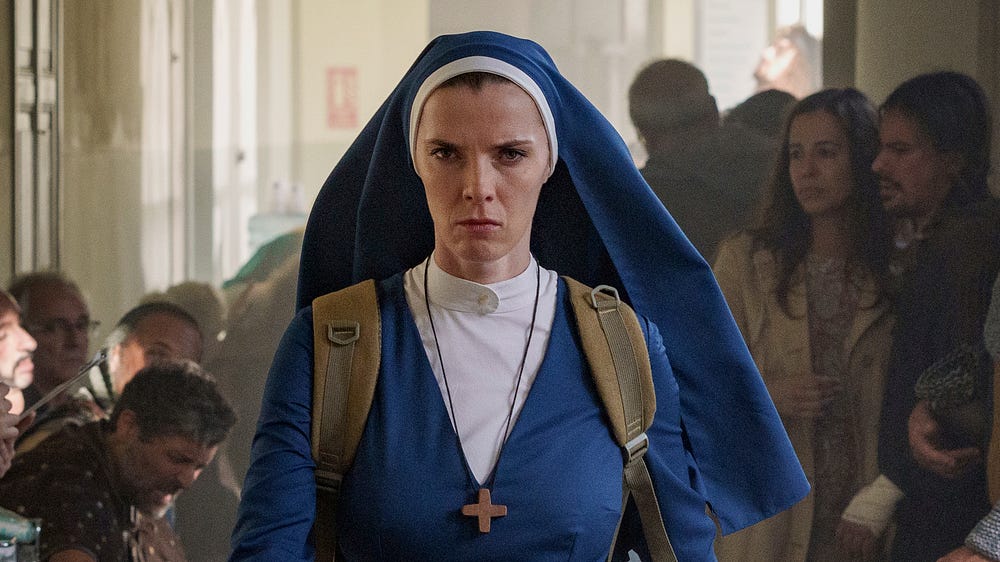
Mrs. Davis (S1, Peacock)-This is a bizarre show about a nun battling against some form of A.I. that has taken over the entire planet. It leans really hard on style and jagged storytelling. For instance, the nun character’s relationship with Jesus, is presented as a story of a couple with a chaste partner who doesn’t want to copulate until marriage. It’s not immediately apparent but reading a recap will tell you that he’s supposed to a version of Jesus that only she can see- a move that deliberately opens more doors than it closes. It’s often a cardinal sin of a reviewer to admit they don’t get something, but let’s face it: These metaphors and other literary tricks push the story too far into confusion, and I had to stop again after four episodes lest I dig myself deeper into plot holes I’m not invested in.
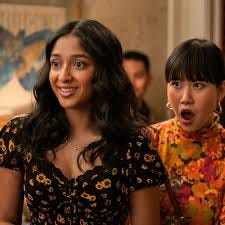
Never Have I Ever (S3, Netflix)­-This show made my top 12 list in previous years, but with the long breaks between seasons, I tend to treat each season like a brand new show. In the third season, I initially shied away because it seemed like a lot of the drama was becoming circular: Paxton, Ben, Dev, and the other characters were rotating romantic partners like musical chairs. I also have to admit, I felt like it was shoehorning in another lesbian plot with Eleanor and Aneesa. Upon second viewing, I’m appreciating genuine care to detail in Paxton’s character: He’s legitimately stepping out of the castes of popularity that define him and finding his own way, which is accurate to the high school experience.

Cruel Summer (S2, Netflix)-The first season of this time-jumping team show made my honorable mention, for it’s interesting take on today’s cyberbullying climate on how lightning quick status can change between two high school doppelgangers. The second one dragged a bit and lowered the stakes from an abduction and abuse of a teenager over several months, to the leak of a sex tape. The characters are decent (in particular, that of an exchange student who integrates well within a family) and the Pacific Northwest has a decent sex of place, but it’s mostly basic teenage drama. Unlike its predecessor, the timescapes hardly mesh with each other to form a rich tapestry: The characters just get more jaded and goth. About six episodes in, I’m considering giving up.
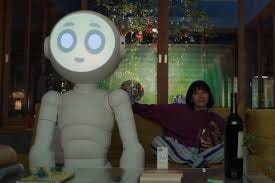
Sunny (S1, Apple)-Set in a near alternate future in Japan, the great Rashida Jones plays an American (Suzy). She’s a bitter and pragmatic ex-pat who plans to go to Japan to live a life of solitude (a cultural practice known as “hikikomori”), until she accidentally falls in love with a programming genius named Masa (Hidetoshi Nishijima). The series revolves around Suzy tracking her husband’s disappearance and uncovering the secrets of his past. There’s a mysterious pollyanish AI robot (the titular Sunny) that also figures into the plot.

Rashida does a great job playing against type as a kill joy, but dour characters don’t always make for engaging television, and she tows the line. This is particularly the case where the expectation of a show set in in Japan — a land of endless fascination and hyperstimulation to our Western eyes –sets up our hopes in a certain direction that doesn’t involve the protagonist moping in a pool of ennui.

There aren’t a lot of positive characters to balance out Sunny and cancel out the net dreariness. The optimistic robot Sunny is meant to be a foil but AI characters don’t float my boat. Half the reason I wouldn’t call Star Trek: The Next Generation great TV is because I never bought Data’s struggle “to be human.” After a lull in episode three, the show started picking up for me once again.
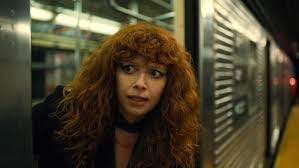
Russian Doll (S2, Netflix)-I didn’t initially begin this season because I figured “why would a show about breaking out of a closed time loop need a second season?” Would Groundhog Day have been improved with a sequel? This season’s existence is a stretch: There’s little reason for Allen to still be in the picture, but the show at least acknowledges it (re: Nadia’s best friend (Greta Lee) getting jealous) and the show mostly exists because TV deserves more Natasha Lyonne in odd situations. The second series is an absurdist, quasi-comic time travel saga in which Lyonne is trying to correct mistakes in her family’s past (she inhabits the bodies of her mother and grandmother) to recover the family treasures: Gold bullion that her Eastern European family invested in when the tragedy of the Holocaust created a distrust in banks. There is some major early-on-set confusion in the pilot if you’re consuming this in a vacuum. Once you catch up on the internet, episode five hits a major speed bump when our heroine jumps from her mother to her grandmother’s body.
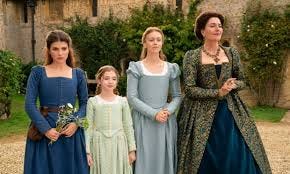
My Lady Jane (S1, Amazon)-A whimsical period piece set in Tudor-era England centering around a spunky heroine who wants more from life than being in the idle rich. She’s the live personification of every Disney Princess, only she’s semi-historically based on a woman who briefly became Queen for nine days. The interesting angle should be Jane’s personality and her interest as an amateur scientist in an era in which science was batshit insane conjecture. Instead, the series takes a turn towards a trite will-they-or-won’t-they art and fantasy (her paramour is an on-again-off-again centaur seeking a cure). Four episodes in, this isn’t on the top of my priority list, but it might be worth another chance if The Decameron (another satiric period piece that recently came out on streaming) doesn’t work out.

Friday, January 06, 2023

Top Ten TV Villains of 2022

 As a staff writer at TV Fanatic, I contributed to the list of 2022’s Villains We Love To Hate — TV Fanatic. Check out that list!

My entries were:

Sunny Balwani (Naveen Andrews), Dropout, Hulu-In this docudrama of the Stanford-educated fraudster Elizabeth Holmes, Sunny is the idle millionaire who initially forms a friendship with Elizabeth as an 18-year-old studying abroad in China. As the relationship veers from age-inappropriate to worthy of many more red lights, Sunny starts to gradually take control of Elizabeth’s better instincts as a CEO. Docudramas are at their best when they frame true stories in novel ways. In this version, Elizabeth Holmes (who, yes, is still responsible for her crimes) as a proverbial Othello to Sunny’s Iago figure. Like all the best villains, there’s a dash of sympathy to the character at the start — he’s lonely; he’s sold his life invention so his best years are behind him — before his crimes start to catch up with him.

Adult Misty (Christina Ricci) Yellowjackets, Showtime-Full disclosure: The show’s inaugural season hasn’t revealed enough to determine whether Misty is the big villain in the present-day. But that’s ok: Misty has done enough bad deeds in the show’s B-plots to qualify her. And holy cow, is she pretty ingenious when it comes to evil doing. In a show as dark as Yellowjackets, Misty is a playful enough personality to balance out the resigned trauma of Shauna or the unsolved anger of Natalie. Without Misty’s presence, it would be a completely different show.

Frederick Gideon (Kevin Durand), Locke and Key, Netflix-I’m having trouble believing, I put this on my Honorable Mentions list last year, because there is a lot of ham and the actors play the level of danger pretty broadly. Kevin Durand, however, must not have gotten the memo when he signed up for the part of back-from-the-dead Revolutionary War general (from the other side) Frederick Gideon. This dude is appropriately dastardly for a man who already hated his American counterparts pre-resurrection; is currently possessed by demons; and has access to modern technology. His presence also comes with small doses of fish-out-of-water humor as he learns about cars and the rules of libraries for the first time.


Lupe (Regina Orozco), Acapulco, Apple Plus: If you’re working at the lavish Las Colinas resort and want a boss who will go easy on you, then you don’t want Lupe. And don’t even think about trying to date her niece! From her tyrannical hold on the lost and found to her low tolerance for fun on the job, Lupe isn’t easy for the laundromat workers under her domain, but she’s a riot for the viewers at home. But she’s full of surprises: She delivers a show-stopping number during the Christmas episode.

Some other entries I would add:
General Eleanor Wright (Linda Hamilton), Resident Alien, Syfy-General Wright is pretty easygoing with torture and various other forms of cruelty in order to meet her goals. On the other hand, she’s pretty consistent the way a diligent civil servant is. So you at least know what you’re getting with her.


Elizabeth Holmes (Amanda Seyfried), Dropout, Hulu-Sure Sunny steals a lot of scenes, but this is Elizabeth’s show. As I said above, a docudrama is about framing a story a certain way. In this eminently watchable version, Holmes is initially portrayed as someone caught in a white lie. “So what if our tech isn’t 100% yet? We’ll figure it out sooner or later,” she assumes. Is it a bad gamble or a malicious act? That’s for the audience to figure out.

Anna Delvy (Julie Garner), Inventing Anna, Netflix-Along with The Dropout, Inventing Anna was another docudrama about a woman with a complex relationship with the truth. But this show wasn’t so much about psychoanalyzing the latest headline-making criminal. Rather, Anna was just a batty meme (exhibit A: Chloe Finneman’s delicious SNL parody) and the story was more about her sly journalist counterpart (Anna Chlumsky) was going to get the story out of her. Though not a dynamic character, Delvy was a pretty entertaining villain. Also, a pretty zeitgeisty one in an era when certain politicians have turned personal narrative into something so plastic.


Quentin (Tom Hollander), White Lotus, HBO-He’s got panache. He’s got refinement. And it’s so nice that he’s just openly gay in contrast to the villains who encoded with effeminate tendencies during the more censored eras of Hollywood. But here’s why I really love him: He’s dumb as a rock as an assassin abettor, and that’s plenty entertaining. Think about it. If not for the fact that Greg entrusted him with such a fool-proof plan and Portia wasn’t so dense, his endless monologuing and extremely direct targeting of Portia would have caught most people off guard pretty instantly.

John Kreese (Martin Kove), Cobra Kai, Netflix-I mean, duh. This guy falls more toward the bottom of the list because he’s quite cartoonish in his motivations. I’m sure there’s a good drinking game to be had for how many times he launches into each of his awful monologues (i.e. “everything I did was to make you stronger blah blah blah”). But on the upside, he actually is pretty scary. Our capacity to care whether the good guys won was significantly lower in Season 6 when Kreese was in prison, so that’s a good indication. It didn’t help that one of the faux sophisticated Terry Silver’s methods of terror was trying to sow seeds of discord by (not making this up) inviting the LaRussos to a fund-raiser and then making Danny look stupid by being nicer to his wife than to him.


Satan (Leslie Bibb), God’s Favorite Idiot, Netflix-In this office comedy set at the potential dawn of the apocalypse, Leslie Bibb plays a Satan with a sexy Halloween costume kind of vibe. Comparable to Elizabeth Hurley in the 2000 Rom-Com flick The Bedazzled, Bibb is practically breaking the fourth wall to telegraph to the audience how much fun she’s having here.

Wednesday, January 26, 2022

Review of TV 2021: My Ten Honorable Mentions

AP Bio (Peacock) Season 4


Premise: Disgruntled Harvard exile gets stuck in his hometown teaching biology and vows never to teach his kids anything. Despite this attitude, life lessons and bonding ensues.

Pros: The show still has great momentum and a deep bench. The fan fiction episode shows just how adept the show is at playing with genre.

What Kept it from Making the Cut: A Lynette-less season can only take the show so far. That was a pairing for the ages. Another of my faves, Stephanie Duncan is a little less sassy during her pregnancy.

The Chair (Netflix) Season 1


Premise: In the world of academia, Sandra Oh can’t win as the English dlit epartment chair at an Ivy Light college. If it isn’t the new wave of political correctness, it’s the conflicting demands of the colleagues underneath her or the demands to keep up enrollment or justify soft skills to her students.

Pros: Sandra Oh kills in this (props to wardrobe too, she always looks like someone who’s too busy to shop f), despite my frustration at the students who rap about Herman Melville’s illegitimacy for being too white, the show does its best to humanize every side in the debate.

What Kept it from Making the Cut: This was my #12 before I watched the Great so it came pretty damn close. There are a lot of six-episode seasons this year, but this one suffered the most from its brevity as a lot of plot movements didn’t have room to breathe.


Cruel Summer (IFC) Season 1


Premise: Two girls at the same high school have divergent paths. One gets kidnapped and held hostage in a predator’s basement for several months while the other is accused as being aware of it and being silenced.

Pros: The editing, for one. Being able to tell a coherent story with this many time jumps, damn!  It also has impressive young actors who mirror each other quite well and handle those time jumps equally adeptly, and then there’s all the fun this show mines from the unreliable narrator trope.

What Kept it from Making the Cut: Ehh, it was a competitive year.


Ghosts (CBS) Season 1


Premise: Utkarsh Ambudkar (no, I couldn’t spell that without IMDBing it) and Rose McIver play a pair of city yuppies who inherit a New England mansion from the gilded age which they plan to turn into a bed and breakfast. However, a gaggle of ghosts (primarily eight who live in the upper floors) stretching back decades and even centuries in some cases (yes, there’s a Viking and a Native American) haunt the mansion.

Pros: It’s a lot of fun and the ghosts are a rich cacophony of characters.

What Kept it from Making the Cut: It’s more fun than a game changer. Considering that it’s such a structurally traditional sitcom (it wouldn’t miss that many beats if a laugh track were inserted), I’m frankly surprised I liked it as much as I did. It’s most definitely worth watching at this point though.


Kevin Can F*ck Himself (AMC) Season 1

Premise: Plot-wise this is a traditional sitcom. What sets it apart is how it’s shot. When Allison (Annie Murphy from “Schitt’s Creek”) is interacting with her husband, it’s a traditionaly laugh track sitcom but in scenes where her husband is not present, the sitcom takes on a much darker form. The sitcom takes on at least three or four different genres per episode.


Pros:  Sheer ambition. You have to watch it to understand it and even then it’s a good book-club-like show to deconstruct as a group.


What Kept it from Making the Cut: While the show is certainly watchable, there isn’t as much of a thru-thread to get me to a state of “I can’t wait to see what happens in the next episode.” As I previously said, it’s a competitive year.


Locke and Key (Netflix) Season 2


Premise: A young widow (Darby Stanchfield), with her kids in tow, moves in to a New England mansion that hold a number of mystical keys with the power to do very good and bad things. Before long, the whole extended family is sucked into a good vs. evil.


Pros: Even as I am more distanced from high school, god help me, I can’t stop getting hooked on the lives of teenagers (or at least, use them as a gateway drug to broader dramatical forms). The mythology behind the story is consistent and not more complex than the story mandates, and the stakes escalate well for a sophomore season. There were also a couple plot twists that blindsided me. 


What Kept it from Making the Cut: For starters, what is up with the catatonic brother who’s all of a sudden engaged to a cultured man Japan? When did he even leave his bed? The teen drama can also get a little Degrassi-ish (or One-Tree-Hill-ish if you’re from the states) before said drama starts integrating itself with the plot in ways that become deliciously Hitchcockonian. But, please, way less Tyler and Jackie drama.  Erase both their memories.


Maid (Netflix) Season 1


Premise: Trailer park mom Amy (Margaret Qualley) makes the sudden decision to leave her borderline abusive husband with her infant in tow. With a dead beat mom (Qualley’s real-life mom Andie MacDowell), uncooperative ex-husband and no previous savings, it’s a constant upbeat battle.

Pros: The constant tension: Amy is like a video game character on her last life. Only the stakes are very real for her and indicative of how real they are for the millions of Americans out there living pay check to pay check. 

What Kept it from Making the Cut: There was a slight dip in intensity towards the end, but it certainly would have made it in a less competitive year.


Saturday Morning All-Star Hits (Netflix) Season 1


Premise: If you’ve seen Kyle Mooney’s offbeat sketches based on 90s sitcoms on SNL, you’ll know what to expect here. Only instead of TGIF offshoots, Mooney focuses here on taking subtle jabs at the Saturday Morning cartoons of the late 80s and early 90s.

Pros: If you like Kyle Mooney doing his thing, this is an uncaged Kyle Mooney completely free to roam in the wild, so you should love this. It’s also a chance to see Mooney do serialized storytelling which works as a satire of the shallow nature of 90s stardom (and sibling envy, a lot to unpack there, I guess). This is a parody that prioritizes attention to detail over a high laugh-per-minute ratio and that works.

What Kept it from Making the Cut: Well, a few more laughs per minute might have been nice.


Schmigadoon (Apple TV) Season 1


Premise:  Ever seen the 1954 musical “Brigadoon”? It’s about 50% of that (present-day couple gets stranded in a magical musical town), with references to “Music Man”, “Oklahoma”, “Sound of Music”, and nearly every other musical from that era.

Pros: The series is a loving parody that is chock-ful of Easter eggs from the golden era of musicals. However, as musical theater in its own right, it works: The cast is filled with darlings of the musical theater community, the musical numbers are fun, and the town looks like a Vincente Minnelli painting. So much to love

What Kept it from Making the Cut: At six episodes, the plot changes are really abrupt. As one example, Cecily Strong’s character gets her love interest’s father killed and the next minute, the two are dancing.

Studio C (BYU TV) Seasons 13 and 14

Premise: Family-friendly sketch comedy

Pros:  Since the show did a nationwide talent search and bought in acclaimed sketch actors and comedians, there has been a very professional feel to this brand of sketch comedy and the cast was really gelling. The show has also shown a penchant for experimentation like an episode exploring (facetiously) how sketches get written, and one examining the impact of messy sketches on the show’s janitor.

What Kept it from Making the Cut: Considering I doubt this show was ever meant to be popular out of the state of Utah, I always view it as the little engine that could. I’m not sure if this could compete in a sketch-by-sketch dead heat with SNL and not even SNL is cracking my top 12 or top 22. However, if I HAD to be nitpicky, the show had a casting overhaul in season 14 and this new configuration will take a while to gel. 

And lest you think I’m being hard on these shows, this is everything else I watched this year that didn’t make my top 12 or Honorable Mention list that these shows rank above:

Abbott Elementary (ABC)^,  Animaniacs (Hulu), AP Bio (Peacock), Attack of the Movie Cliches (Netflix), B Positive (CBS)^, Call Me Kat (ABC), Call Your Mother (ABC), Cobra Kai (Netflix), The Circle (Netflix), Disenchanted (Netflix), Frank of Ireland (Amazon), Explained (Netflix),  Great North (Fox), Inside Job (Netflix), It’s Always Sunny in Philadelphia (FX), Home Economics (ABC), Kevin Hart’s Olympic Show (Peacock), Kim’s Convenience (CBC), La Brea (NBC/Peacock), Lost Symbol (Peacock), Love Death and Robots (Netflix), Mr. Mercedes (Amazon), Mighty Ducks (Disney Plus), Miracle Workers: Oregon Trail (TBS), Mosquito Coast (Apple TV), McGruber (Peacock), Mr. Corman (Apple TV), Mythic Quest (Apple TV), Nora From Queens (Comedy Central), Nine Perfect Strangers (Hulu), Only Murders in the Building (Hulu), The Premise (Hulu), Rebel (Amazon Plus), Reservation Dogs (Peacock), Rutherford Falls (Peacock), SNL (NBC), Solar Opposites (Hulu), Squid Game (Netflix)^, To Tell the Truth (ABC), Young Rock (NBC)^


^ means I watched just one or two episodes. I didn’t necessarily watch every episode of a show if it’s not marked


Sunday, November 21, 2021

What I'm Watching November Edition: Ghosts (CBS), B Positive (CBS), Locke and Key (Netflix), Inside Job (Netflix), La Brea (NBC)


Ghosts (CBS) Season 1-Utkarsh Ambudkar and Rose McIver star as a yuppie couple from the Big Apple who inherit a mansion that’s inhabited by eight ghosts of different eras. There’s a Viking who grunts a lot; a Native American; an effeminate Revolutionary War captain; a 19th Century schoolmarm with aristocratic roots; a sassy flapper from the Prohibition Era; a flower child who is permanently tripping through the afterlife; a square scout leader from the 80s; and a Wall Street playboy from the 90s. The octet makes for a brilliantly strange found family of people whose only commonality is that they died in the the same spot -- seemingly all of them in comic ways.

Before the arrival of Sam, the ghosts simply had little choice but to entertain each other and passively experience the house’s occupants. However, when Sam has a near death experience, the ghosts are suddenly able to communicate with her and suddenly the living and dead residents of the house have to renegotiate a living arrangement between them.

While there might not be a clear stand-out character among the ghost crew,  the contrasts and dynamics between them add up to making them more than the sum of their parts. This a clever premise that’s executed with just the right light-hearted tone. There’s a certain urgency stemming from the couple’s financial uncertainty regarding their plan that adds some stakes but mostly it’s a lot of fun. 


B Positive (CBS) Season 2- Starring the underrated Annaleigh Ashford and token schlub Thomas Middleditch, B Positive is a multi-cam laugh track sitcom that’s a good reminder that sitcoms have evolved for the better nowadays.

The hook is that Thomas's character had an organ donated to him by Ashford's character. At least I think so. There isn't much of the premise's DNA by season 2. It's mostly just a guy fawning over a girl who works in a nursing home.

Annaleigh Ashford’s character is remarkably similar to his other female protagonist creations from “Mom” (Anna Farris) and “Big Bang Theory” (Kaley Cuoco) who wear their hearts on their sleeve and have low filters. I’ve been a fan of Ashford since the days of “Masters of Sex” so here’s hoping her career can take off like theirs.

Similarly, there’s a will-they-won’t-they between the leads that already feels strained by the third episode I saw. I’m taking a pass on the rest. 


Inside Job (Netflix) Season 1: An animated cartoon about a federal government department that does damage control in a world where most conspiracy theories are true. Although it has some of the cynicism of “Rick and Morty”, it’s co-created and executive produced by Alex Hirsch (along with Shion Takeuchi)  who’s most famous for the imaginative yet child-appropriate “Gravity Galls.” It’s a dark turn for sure from the creator and the complexity of the subject matter is heightened by giving the central protagonist (Lizzie Caplan) the Aesperger’s label.

Like “Ghosts”, the show’s premise is a winner and there are memorable moments. The first episode begins with protagonist Raegan Ridley (Caplan) trying to stop her dad from making a fool of himself  in front of the White House as he shouts crazy dribble through a megaphone. It’s immediately established that this is a routine task for Reagan through the fact that this is simply part of her daily commute. It’s smart, economic storytelling and funny in a relatable sense (especially considering I’m a DC native who has seen this kind of activity at the White House often).

The episode involving Valentine’s Day and the nostalgia trip through the 80s are both pretty funny despite following conventional tropes (how many Valentine’s Day episodes have you seen before?). However, the rest of the season was a bit uneven and I’m worried about how high the upper ceiling is on this show. It’s still mildly watchable. 


Locke and Key (Netflix) Season 2-The YA fantasy series is set in an idyllic New England town where a widowed mom of three, Nina Locke (Darby Stanchfield of “Scandal”), moves into her husband’s old home and the family unwittingly enters into a battle of good and evil. As the title indicates the weapons of choice are a set of magical keys that have various functions (one allows you to see into another’s psyche, one allows you to control someone else’s movements, one traps you into a mirror, etc.) and the protagonist family is the Lockes. Get it? Yeah, it’s cute.

In the second season, the show upped the stakes significantly as the big bad, Gabe, used a shape-shifting power to disguise himself as Kinsey’s boyfriend. The show appears to be made for teenage viewers whose hearts are set aflutter with shipping possibilities among various high schoolers. With that caveat, if a show has to cram in superfluous teenage romance storylines, it’s best if the relationship drama ties into the plot. That’s why Kinsey’s love triangle between Gabe and her ex Scott was a nicely performed tightrope act that raised the stakes this season.

Speaking of love interests, apparently Uncle Duncan is gay and engaged? The former’s not a problem (although he’s non-stereotypical which isn’t a good or bad thing but I wonder if his sexuality was changed in adaptation to give the show a token gay character) but isn’t he a reclusive amnesiac? Additionally, Mommy Locke gets a hunky boyfriend this season whose motivations are a welcome enigma.

The show gets a little overly sentimental at points but the essence of the relationships work and the serialization is engaging throughout the entire 10-episode run. Pretty highly recommend. 


La Brea (NBC)-A cross-section of LA denizens fall through a groundswell in Los Angeles that takes them to the stone age and prompts the question “how is this different from a normal day in Los Angeles?” Seriously, I don’t know. It seems like an LA thing though from so many films and TV shows I’ve seen.  

The show cross-cuts between two different scenes.

The dad and husband of two of the victims has paranormal premonitions about what’s happening and gets the attention of a shadow government agency that is determined to suppress the truth and conduct a rescue mission.

Getting the lion’s share of the action is the group of displaced people as they try to figure out what is happening in a loose rip-off of “Lost.” The crew includes a wide variety of professionals such that many are the deus-ex-machinas for each other’s ailments. There’s a kid with life-threatening injuries but fortunately there’s a doctor among the stranded to rescue him. Ditto with a stunted child who’s been trained to pretend she’s mute and a child psychologist who needs to get information from her without traumatizing. Similarly, there’s a paleontologist who can decipher the tea leaves and a cop who can keep order.

The coincidental nature of each person’s abilities isn’t so bad but there’s a clunkiness to the dialogue and the character development that’s par for the course for standard broadcast procedurals rather than the middle brow serial this show aspires to be. This certainly slows down the show but it’s marginally watchable and has enough potential that it’s worth finishing the season.